Why Carbon Nanotubes are important for the energy transition
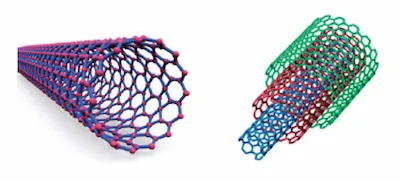
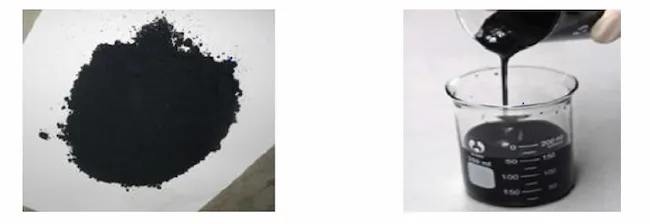
Carbon nanotubes (CNTs) are a graphene sheet rolled up into a cylinder, with walls that are only one atom thick, diameter of the order of 1-3 nanometers and micrometer-sized length, where the length to diameter ratio exceeds 1000, so they can be considered as nearly a one-dimensional object. Carbon nanotubes can consist of single or multiple graphene layers, respectively called single-wall carbon nanotubes (“SWCNT”) and multi-wall carbon nanotubes (“MWCNT”). The carbon atoms are bonded together in a hexagonal (honeycomb) mesh. At the macroscopic level, carbon nanotubes appear as a black powder.
STRUCTURE OF CARBON NANOTUBES
SWCNTs can be formed in three different designs: Zigzag, Chiral, and Armchair. The type of SWCNT formed depends on the orientation of the graphene sheets when they are rolled.
After that, the chiral vector is used to describe the carbon nanotubes, which specifies how the graphene sheet is rolled up. The chiral vector is represented by two integers, n and m, which correspond to the unit vector numbers in the graphene honeycomb crystal lattice’s two directions.
When n – m is divisible by 3, then the nanotube is described as “metallic” (highly conducting), when n – m is not divisible by 3 the nanotube is a semiconductor. The Armchair design is always metallic whereas Zigzag and Chiral CNT can be metallic, semiconducting or insulating depending on tube diameter and chirality.
PROPERTIES OF CARBON NANOTUBES
The key feature of carbon nanotubes is their one-dimensional cylindrical shape with small diameters (nanoscale) and much longer lengths (micron scale). This gives them high aspect ratios with high specific surface area. Carbon nanotubes are known for their exceptional physical and chemical properties, including mechanical strength, electrical conductivity, and thermal stability.
Carbon nanotubes exhibit a high tensile strength of ~ 60 GPa (SWCNT), ~150 GPa (MWCNT) and elastic modulus ~ 1 Tpa (SWCNT), ~ 1-1.2 TPa (MWCNT). The electrical properties of carbon nanotubes are dependent on the chirality of the hexagonal lattice, with different orientations with different chiral index parameters. These lead to CTNs having either metallic or semiconducting properties. Carbon nanotubes have exceptionally high thermal conductivity, enabling efficient heat transfer 1,750-5,800 W/mk (SWCNT), >3,000 W/mk (MWCNT) at room temperature.
Carbon nanotubes are renowned for their chemical stability, particularly in environments where materials are subjected to harsh chemical conditions, such as extreme pH levels or exposure to oxidizing agents. The cylindrical structure of carbon nanotubes provides a robust framework that enhances their resistance to both acidic and alkaline environments. The optical properties of carbon nanotubes are also influenced by chirality. It determines whether the bandgap is present, which strongly influences their optical absorption, emission, and photoluminescence properties.
Carbon nanotubes possess a unique hollow structure that significantly enhances their capabilities as hosts for lithium-ion storage. The hollow cavity within carbon nanotubes, combined with the gap between the inner layer and the tube wall, provides an abundant space for lithium ions to intercalate. This structural advantage allows for efficient transportation channels that facilitate the movement of lithium ions, thereby enhancing the overall performance of lithium-ion batteries.
CARBON NANOTUBE PRODUCTION METHODS
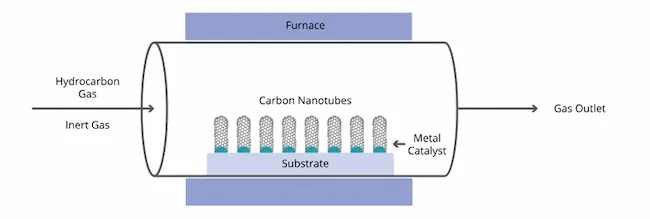
There are various techniques used for growth of carbon nanotubes, however the three main techniques are arc discharge, laser ablation and chemical vapor deposition (CVD). The common characteristic of these techniques is to provide energy to a carbon source for the creation of carbon atoms that generate carbon nanotubes. The energy source is current in an arc discharge, the high-intensity light in the laser ablation & heat from a furnace in CVD. Catalytic chemical vapor deposition (CCVD) is the predominant method for producing carbon nanotubes in the industry.
The second stage of CNT production process, after CNT growth in CVD, involves the process of paste mixing. CNT are nanomaterials with very small scales, large specific surface area, and are in an aggregated state. The key to their application in other material systems is to completely disperse the CNT into a non-aggregated “single root state”. This step primarily focuses on dissolving and dispersing dispersants and solvents to create a homogenous CNT paste product. The quality of this paste is essential for subsequent applications, particularly in fields such as electronics, energy storage, and composite materials.
CHOOSING THE TYPE OF HYDROCARBONS AND CATALYSTS
The choice of the type of hydrocarbons and catalysts used determines the various growth mechanisms, termed as vapor-liquid-solid (VLS) or vapor-solid-solid (VSS) mechanisms. Of the two, the VLS mechanism is widely used. Here, the catalyst particles are in the liquid phase, where hydrocarbons are adsorbed on the metal particles and are catalytically decomposed. Next, the carbon forms a liquid eutectic by dissolving into the particle and later precipitates in to a tubular form upon supersaturation. On the other hand, VSS growth mechanism uses a solid catalyst.
When the catalyst-substrate interaction is weak (metal has an acute contact angle with the substrate), hydrocarbon decomposes on the top surface of the metal, carbon diffuses down through the metal, and carbon nanotubes precipitates out across the metal bottom, pushing the whole metal particle off the substrate. This is known as “tip-growth model”.
When the catalyst-substrate interaction is strong (metal has an obtuse contact angle with the substrate), initial hydrocarbon decomposition and carbon diffusion take place similar to that in the tip-growth case, but the carbon nanotubes precipitation fails to push the metal particle up, so the precipitation is compelled to emerge out from the metal’s apex then extends up in the form of seamless graphitic cylinder. Thus carbon nanotubes grows up with the catalyst particle rooted on its base. This is known as “base-growth model”.
View GDC Carbon Nanotubes Industry Market Research Report click here
Since most of the carbon nanotubes modern application depends on their purity, several procedures have been developed for their purification. The purification techniques are classified to three main methods, namely physical, chemical, and the combination of chemical and physical methods. Purification methods deal with the removal of amorphous carbon and metal (catalyst residue) and graphitic nanoparticles (that can also coat the catalyst particles) or fullerenes that can form during carbon nanotubes synthesis. Each technique presents one or more disadvantages such as non-selectivity, damage of nanotubes, formation of toxic wastes, and time consumption. The choice of purification method depends on the specific application of the carbon nanotubes, the type of impurities present, and the desired purity level.
In chemical purification, there are two routes including dry and wet conditions. The dry refers to oxidation under air, oxygen, and other gases, while the wet conditions refer to using of strong liquid oxidants. The physical methods such as ultrasonication, filtration, and centrifugation are considered as mild and less effective methods, however, they do not destroy the pristine structure.
CARBON NANOTUBES HAVE A HIGHLY HYDROPHOBIC SURFACE
Carbon nanotubes have a highly hydrophobic surface, and are not suitable for aqueous solutions. This is due to their stable structure having pure carbon element. In addition, they have very high long range van der Waals forces of attraction due to which they have a tendency to aggregate together forming ropes or bundles and it becomes very difficult to disperse them.
To overcome these problems and to take full advantage of the properties of carbon nanotubes, functionalization of carbon nanotubes is carried out. Functionalization is the generation of functional groups on the surfaces of carbon nanotubes. Functionalization enhances the reactivity, improves the solubility and provides an avenue for further carbon nanotubes chemical modification. CNT surface modifications can be achieved through covalent or noncovalent functionalization methods.
HOW ABOUT DEFECTS?
Defects in the atomic carbon nanotubes structure may occur during both synthesis, after chemical purification and during modification for covalent functionalization. The carbon nanotubes tensile strength, electrical properties and thermal properties are affected by the presence of defects. A common result is the lowered conductivity through the defective region of the tube. Defects can occur in the form of atomic vacancies or by what is known as the Stone-Wales defect, which creates a pentagon and heptagon pair by rearrangement of the bonds. Defects may be removed by annealing (graphitization) of the CNT.
The production methods for carbon nanotubes, each produce material that is slightly different in diameter, length, chirality, purity, catalysts, impurity species, and defects. Characterisation of carbon nanotubes to determine the quantity, quality, and properties of the carbon nanotubes in the sample is very important, because its applications will require certification of properties and function. Carbon nanotubes can be characterized using microscopic, spectroscopic, thermal and specific surface area analysis.
The quality of conductive pastes (alternatively, can be referred to as conductive slurry) is critical and several tests are performed testing for solid content, fineness, volume resistivity, viscosity, moisture content, morphology, metal content and zeta potential.
CHINA NATIONAL PRODUCT STANDARD
Jiangsu Cnano Technology C., Ltd led the formulation of China national standard GB/T 33818-2017 Carbon nanotube conductive paste implemented on 1 December 2017 and participated in the drafting of three national standards related to carbon nanotubes GB/T 24490-2009 Test method for purity of multi-walled carbon nanotubes, GB/T 26826-2011 Measurement for diameter of carbon nanotubes and GB/T 40568-2021 Nanotechnologies – Characterization of multiwall carbon nanotubes – Mesoscopic shape factors.
The company was the Chinese representative in formulating the international standard for carbon nanotube conductive paste ISO/TS 19808 Nanotechnologies – Carbon nanotube suspensions – Specification of characteristics and measurement methods released on 2 March 2020. ISO, the International Organization for Standardization, has also issued a number of standards related to carbon nanotubes.
COMMERCIALISATION
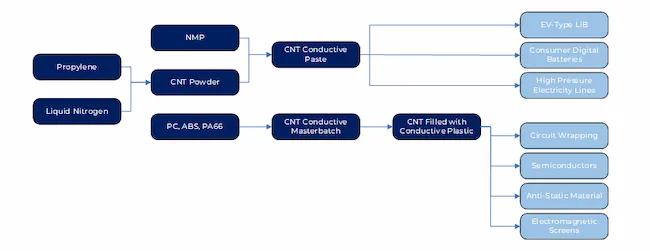
The upstream industrial chain consists of propylene and liquid nitrogen. The midstream industrial chain includes NMP (N-methyl-2-pyrrolidone) along with CNT powder products. The downstream industrial chain features carbon nanotubes as conductive pastes and conductive masterbatch which is used as an additive in conductive plastics. The large-scale commercial applications of carbon nanotubes are primarily concentrated in two key industries, conductive pastes in lithium-ion batteries and conductive plastics.
CARBON NANOTUBES – ROLE AS A CONDUCTIVE AGENT
Conductive agents play a crucial role in lithium-ion batteries by enhancing conductivity and rate performance.
Traditional conductive agents include carbon black and conductive graphite, while newer materials such as carbon nanotubes, carbon fibers, and graphene offer significant advantages. These advanced materials create more effective conductive networks between active substances, greatly improving overall conductivity.
The amount of conductive agent added varies by battery manufacturer’s electrochemical system but typically ranges from 1% to 3% for traditional agents. In contrast, the quantity of carbon nanotubes used is only one-sixth to one-half that of traditional materials.
Carbon black typically constitute about 3% of the weight of the cathode material, carbon nanotubes can achieve the same conductive effect with only 0.5% to 1.0% usage due to a larger specific surface area than carbon black.
In cathodes, they fill gaps between active materials to facilitate electron flow, thereby improving performance. For anodes, graphite is commonly used due to its good electrical conductivity.
However, repeated charging and discharging cycles can cause expansion and contraction of graphite particles, leading to reduced conductivity over time. Adding a suitable amount of conductive agent helps maintain this conductivity and ensures optimal electrochemical reactions. Overall, the strategic use of conductive agents is vital for maximising the efficiency and longevity of lithium-ion batteries.
Guangdong Dowstone Technology Co., Ltd a market leader
The main carbon material products of Guangdong Dowstone Technology Co., Ltd are carbon nanotube conductive agents and graphene conductive agents, which are used in nickel-cobalt-manganese ternary power battery positive electrodes, silicon-based negative electrodes, iron-lithium power and energy storage batteries.
| Generation | Product Name | Launch Time | Features | Applications |
| Gen-1 | Graphene conductive paste G8 series | 2015 | The number of graphene layers is 8, the diameter is 10um, and it has excellent conductivity and processing performance | LFP cathode material |
| Gen-2 | Graphene conductive paste G6 series | 2016 | The number of graphene layers is 6-8, the diameter is 5-10um, and it is compounded with carbon nanotubes to form a multi-dimensional conductive network, which reduces the internal resistance and improves the rate performance of lithium-ion batteries | LFP cathode material |
| Gen-3 | High-purity and high-conductivity thin-tube conductive paste NS-7 series | 2017 | The diameter of the carbon tube is 5-15nm, with excellent conductivity. When used in ternary and lithium cobalt oxide positive electrodes, it can significantly reduce the internal resistance of the battery | Ternary + LFP cathode material |
| Gen-4 | Thin-tube thin-walled carbon tube NS-6 series | 2020 | The diameter of the carbon tube is 3-6nm, the length is 10 50um, and the number of tube walls is 3-5. It has a conductivity close to that of single-walled carbon nanotubes. It can reduce the amount of conductive agent added by 30%-50% when used alone or in combination | Ternary + LFP cathode material |
| Gen-5 | Single-walled carbon nanotube | Already certified with customers | The diameter is 1-3nm, the length is ≥50μm, the specific surface area is ≥800m2/g, and the purity is ≥98.5% | Cathode material + Si/C anode material |
Conductive plastics are essential in conductive polymer materials due to their unique combination of metal-like conductivity and plastic properties. The conductivity of conductive plastics arises from conductive fillers, such as carbon materials and metal powders, which provide carriers and enhance conductivity. The plastic matrix itself is non-conductive and serves as a structural component.
Conductive plastics offer advantages such as low density, mechanical flexibility, high strength, cost-effectiveness, corrosion resistance, and adjustable resistance. Carbon nanotubes in conductive plastics provide antistatic properties and electromagnetic shielding.
Key downstream applications include automobiles, aerospace semiconductors, antistatic materials, integrated circuit packaging, and electromagnetic wave shielding. The main application field of carbon nanotube conductive plastics is automobiles, such as fuel tanks, electronics and interior parts, to improve the safety, comfort and energy saving of automobiles.
COMPETITIVE LANDSCAPE
In 2020 the market size of carbon nanotube paste in China was 48,000 tonnes and it increased to 117,000 tonnes by 2022 and 2023, with a three-year compound growth rate of 34%. In 2021 the production of carbon nanotube powder in China was 1,412.6 tonnes. China’s carbon nanotube powder production reached 1,798.1 tonnes and 2,285.7 tonnes in 2022 and 2023.
The main manufacturers of carbon nanotube conductive paste in China include Jiangsu Cnano Technology C., Ltd, ranked first in China with a capacity of 50,000 tonnes and market share of 46.7%, Shenzhen Sanshun Nano New Materials Co., Ltd (wholly owned subsidiary of Cabot Corporation), Qingdao Haoxin New Energy Technology Co., Ltd (wholly owned subsidiary of Guangdong Dowstone Technology Co., Ltd), Huizhou Jiyue Nano Material Technology Co., Ltd and Wuxi Dongheng New Energy Technology Co., Ltd.
TOP5 COMPANIES
The top five manufacturers account for about 83% of the global market share. China is the largest market, accounting for about 99% of the market share. In terms of product types, NMP paste is the largest segment, accounting for about 87% of the market share. In terms of downstream, lithium-ion power batteries are the largest downstream field, accounting for 75% of the market share.
At present, the scale of companies producing CNT is not large in the world. Few commercial CNT powder production lines exceed 1,000 tonnes per annum. For such a new material industry, the most important thing is that the product performance indicators and technology level improve performance and reduce costs through technological progression and innovation.
OVERSEAS COMPANIES
Overseas companies that produce carbon nanotubes include LG Chem, JEIO Co., Ltd and Kumbo Petrochemical Co., Ltd (South Korea), Showa Denko Co., Ltd (Japan), NoPo Nanotechnologies (India), Nanocyl SA (Belgium), Arkema SA (France), OCSiAl (Luxembourg), Cabot Corporation, Nano-C, Carbon Solutions, Inc, Hyperion Catalysis International and Cheap Tubes Inc (US), Klean Commodities and Raymor Industries Inc. (Canada) and Thomas Swan & Co. Ltd (UK). Most companies produce MWCNTs. OCSiAl is the major producer of SWCNTs.
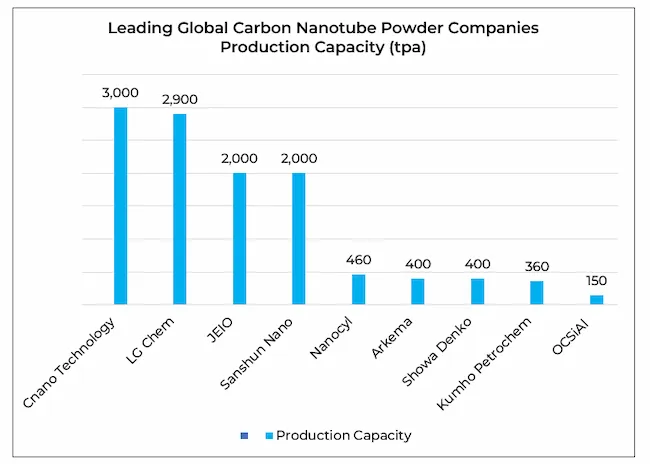
While traditional conductive agents like carbon black continue to dominate the market due to their low cost and established technology, advanced materials such as carbon nanotubes and graphene are gaining traction for their superior conductivity and lower dosage requirements. The primary downstream markets for carbon nanotubes include new energy vehicles (NEVs), consumer batteries, and conductive plastics. Technological progress and scale effects are expected to promote the large-scale application of CNT. In the past, CNT were not widely popularized mainly due to immature technology and high product prices.
The market demand for high-performance lithium-ion batteries is on the rise, driven by advancements in technologies such as high-nickel cathode materials and silicon-based anode materials. As these technologies become more cost-effective, the market penetration of carbon nanotubes is expected to experience significant growth. Carbon nanotubes enhance battery performance by improving energy density, cycle life, and rate capacity, aligning well with the evolving demands of downstream applications.
For more blog articles click here
To view GDC market research reports click here
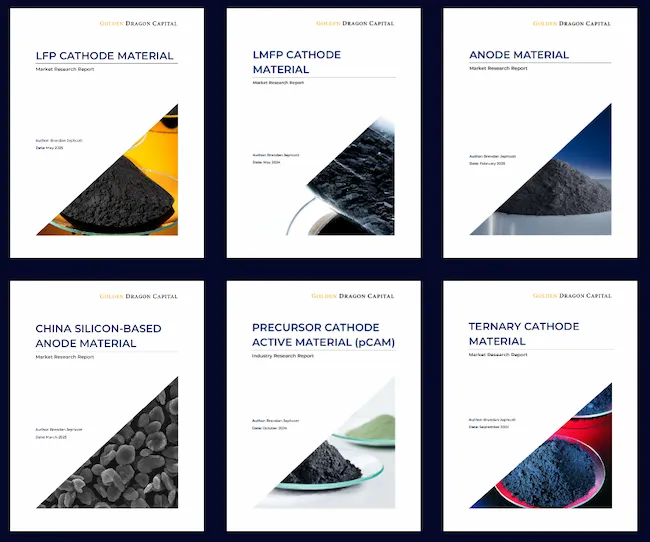
Golden Dragon Capital Limited | Comprehensive Market Research Reports
About us
GDNM provides commentary on how energy transition minerals contribute towards the decarbonisation and electrification of the global economy, with a particular focus on the lithium-ion battery and rare earths supply chains.
GDNM founder, Mr Brendan Jephcott is an Australian who has worked in the global mining sector for more than 13 years, of which his experience covers precious metals, nonferrous metals, ferrous metals, base metals, bulk commodities, rare earths, and the lithium-ion battery industry.
For the last 9 years Mr Jephcott has focused on the burgeoning new energy industry, participating in cross-border transactions in buy-side and sell side roles, cultivating a global business network ranging from upstream resource companies, midstream intermediate product producers, and downstream consumers such as gigafactories and auto companies.