What is pCAM and its use in Lithium-ion Battery Production

Precursor Cathode Active Material (pCAM) is a powder-like substance essential in the production of high-performance lithium-ion batteries, specifically for ternary cathode materials like NCM (nickel-cobalt-manganese).
It is created by chemically combining nickel, cobalt, and manganese compounds in specific ratios tailored to customer needs.
As a midstream component in the lithium-ion battery industry chain, pCAM serves as the foundational material that, when mixed with lithium carbonate or hydroxide and calcined, forms the final cathode active material (CAM).
How is pCAM produced?
The primary method for producing pCAM is the hydroxide co-precipitation process, which takes place in a continuous stirred tank reactor.
This method involves dissolving hydrated sulfates of nickel, cobalt, and manganese to form an ionic metal solution, then adding a chelating agent like ammonium hydroxide and a precipitating agent such as sodium hydroxide to control particle size and morphology. The process allows for precise tuning of physical properties like tap density and particle shape by adjusting parameters such as pH, temperature, and stirring rate.
| Influencing Factor | Influencing Effect |
| Ammonia Concentration | When there is no complexing agent, the pCAM has a loose morphology and a low tap density; when there is a complexing agent, the pCAM is dense and the tap density is increased. When the complexing agent is too high, there are too many complexed nickel and cobalt ions in the solution, which will cause incomplete reaction and make the ratio of nickel, cobalt and manganese in the pCAM deviate from the designed value. |
| PH Value | When the pH value is too high, the hydroxide cannot agglomerate into spheres and is a loose aggregate of primary grains; when the pH value is too low, the precipitates are severely aggregated, with different morphologies and large differences in the size of secondary particles. |
| Reaction Temperature | Temperature mainly affects the reaction rate. In the actual production process, we hope that the chemical reaction rate is as fast as possible while ensuring the quality of the pCAM. However, the temperature cannot be too high, as it will cause oxidation of the pCAM. |
| Reaction Time | Within a certain period of time, the particle size, tap density and reaction time of the pCAM are directly proportional, but the reaction time should not be too long, otherwise the pCAM particles will be too large. |
| Reaction Atmosphere | Without nitrogen protection, the pCAM morphology is blocks and agglomerates of varying sizes. |
| Solid Content | The solid content affects the morphology of the pCAM. The solid content of the pCAM in the reactor of most manufacturers is around 5-10%. |
| Flow Rate | The flow rate mainly refers to the flow rate of the metal salt solution, which is directly related to the output. Therefore, under the premise of ensuring the quality of the pCAM, the larger the flow rate, the better. |
| Impurities | A small amount of organic solvent (extractant in the preparation process of nickel sulfate and cobalt sulfate) will cause the pCAM particles to fail to grow and have a non-spherical morphology. Another type of impurity in the raw materials, such as Ca2+ and Mg2+, will cause adverse effects such as non-spherical shape and low tap density. |
The production challenges of pCAM are significant, especially when it comes to high-nickel variants which are prone to structural instability and safety issues due to Ni2+ and Li+ mixing in the lattice.
To address these, companies employ advanced modification techniques like element doping, surface coating, core-shell structures, and single crystallisation. These methods aim to stabilise the material, reduce side reactions with electrolytes, and enhance cycle life, though they add complexity and cost to the manufacturing process.
Important pCAM product indicators
pCAM’s quality directly impacts the performance of the final cathode material, influencing factors like energy density, cycle life, and battery safety.
Key characteristics such as morphology, particle size distribution, specific surface area, impurity content, and tap density are critical, as they are inherited by the cathode material during production. For instance, a densely packed spherical shape in pCAM enhances energy density, with typical particle sizes ranging from 10 to 15 micrometers.
The production of pCAM requires stringent control over reaction conditions to ensure consistency and meet the high standards of lithium-ion battery applications.
Parameters like ammonia concentration, pH value, reaction temperature, and atmosphere significantly affect the final product’s properties. Even minor deviations can lead to issues such as irregular particle shapes or reduced tap density, which compromise battery performance.
Commercially, pCAM is a non-standardised product with strong customization characteristics, necessitating high technical expertise and process control capabilities from manufacturers.
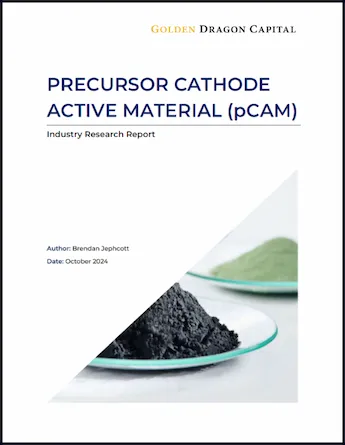
View the GDC pCAM Market Research Report click here
Competitive Landscape (2025)
The industry is highly concentrated, particularly in China, which accounted for 86.05% of global ternary precursor output in 2023, with major players like CNGR Advanced Material Co., Ltd and Zhejiang Huayou Cobalt Co., Ltd dominating the market. This concentration reflects the technological and scale advantages of leading companies.
The demand for pCAM is driven by the growing need for high-performance batteries in new energy vehicles and other applications, with global shipments forecasted to exceed 1.38 million tonnes by 2026, reflecting a compound annual growth rate of 13% from 2024 to 2026.
As nickel and cobalt prices decline, ternary batteries using pCAM are becoming more competitive against alternatives like LFP batteries, due to their superior energy density and charging speed.
Concluding Thoughts
pCAM plays a pivotal role in the evolving landscape of battery technology, particularly as the demand for sustainable energy solutions intensifies. With the global push towards decarbonisation and electrification, pCAM is at the heart of enhancing lithium-ion battery performance for applications in new energy vehicles, energy storage systems, and consumer electronics. Its ability to be tailored through specific nickel, cobalt, and manganese ratios allows manufacturers to meet diverse performance requirements, such as higher energy density and improved safety features.
Looking ahead, the pCAM industry faces both opportunities and hurdles as it scales to meet projected demand. Innovations in production methods, such as optimizing the co-precipitation process for better yield and consistency, are crucial for maintaining quality while reducing costs. Additionally, the reliance on raw materials like nickel and cobalt, subject to price volatility and geopolitical supply risks, underscores the need for recycling and alternative sourcing strategies to ensure a stable supply chain.
As the market evolves, collaboration between pCAM producers, battery manufacturers, and end-users will be essential to align product specifications with application needs. The forecasted growth in global pCAM shipments, expected to surpass 1.38 million tonnes by 2026, highlights the urgency of addressing these challenges. With China leading production, the industry must also navigate regional disparities in technology adoption and regulatory frameworks to sustain its growth trajectory.
For more blog articles click here
To view GDC market research reports click here
Golden Dragon Capital Limited | Comprehensive Market Research Reports
About us
GDNM provides commentary on how energy transition minerals contribute towards the decarbonisation and electrification of the global economy, with a particular focus on the lithium-ion battery and rare earths supply chains.
GDNM founder, Mr Brendan Jephcott is an Australian who has worked in the global mining sector for more than 13 years, of which his experience covers precious metals, nonferrous metals, ferrous metals, base metals, bulk commodities, rare earths, and the lithium-ion battery industry.
For the last 9 years Mr Jephcott has focused on the burgeoning new energy industry, participating in cross-border transactions in buy-side and sell side roles, cultivating a global business network ranging from upstream resource companies, midstream intermediate product producers, and downstream consumers such as gigafactories and auto companies.