LMR Cathode Material Faces Three Challenges
Lithium-rich manganese-based cathode material (LMR cathode material), formulated as xLi₂MnO₃·(1-x)LiMO₂ (where M = Mn, Ni, Co), represents a promising next-generation cathode material for use in high-energy lithium-ion batteries.
LMR cathode materials feature a unique composite structure consisting of layered LiTMO₂ and Li₂MnO₃ components, where the Li₂MnO₃ component can be activated at high voltages (above 4.5V) to provide exceptional specific capacities of 250-280 mAh/g and energy densities exceeding 900 Wh/kg.
The high manganese content makes LMR cathodes significantly more cost-effective and less toxic compared to cobalt-rich alternatives, while offering superior thermal stability and safety characteristics due to their low nickel content.
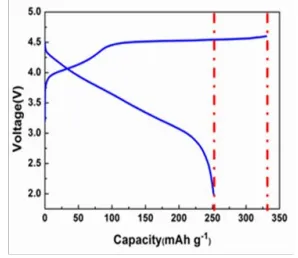
Despite their exceptional energy storage potential, LMR cathodes face several critical challenges that currently impair their commercial viability. The primary issues include severe voltage decay during cycling (typically 0.02-0.1 mV per cycle), large first-cycle irreversible capacity loss (leading to initial Coulombic efficiencies as low as 72%), and poor rate performance due to structural degradation.
These problems stem from irreversible phase transitions from layered to spinel structures, oxygen loss at high voltages, and transition metal migration that occurs during the activation of the Li₂MnO₃ component.
Recent research efforts have focused on surface modification strategies, structural engineering through morphology control, and the development of cobalt-free compositions to address these limitations while maintaining the high energy density advantages.
Three Problems with LMR Cathode Material
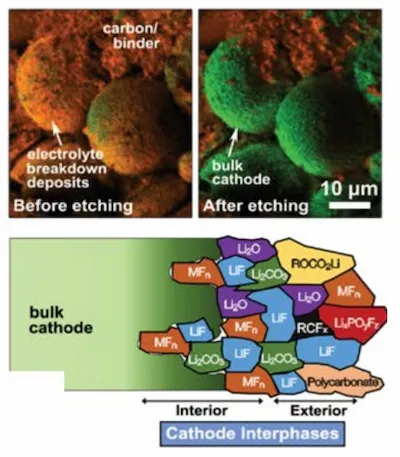
1. Poor Interface Stability
Mechanism: The cathode-electrolyte interface undergoes parasitic reactions (e.g., electrolyte oxidation at high voltages >4.5 V), forming a resistive surface reconstruction layer (SRL) rich in transition metals (TMs) like Ni and Mn, resulting in:
- Low ion diffusion kinetics: TM migration into Li layers blocks Li+ pathways, increasing charge-transfer resistance.
- Relatively low initial Coulombic efficiency (ICE): Irreversible Li+ loss occurs as Li₂O or trapped Li in the SRL, reducing available Li for cycling.
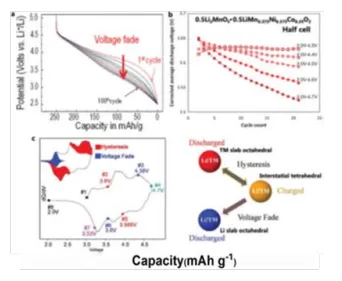
- Voltage decay: SRL-induced strain promotes phase transitions (layered → spinel) with lower redox potentials.
2. Lattice Oxygen Redox Reversibility
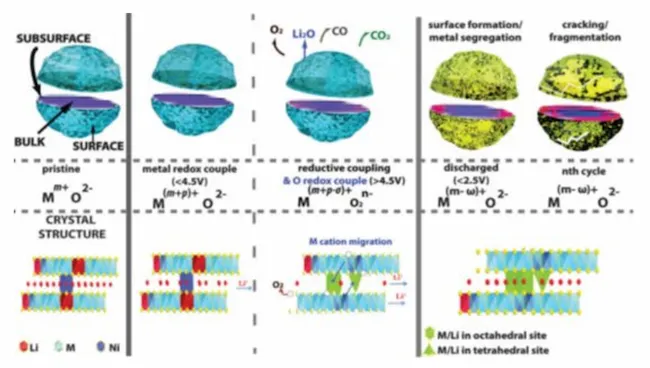
Mechanism: Anionic oxygen redox (O²⁻ → O⁻/O₂ⁿ⁻) provides extra capacity but often irreversibly releases oxygen gas (O₂), creating oxygen vacancies and TM migration.
Consequences:
- Low ICE: ~50–100 mAh g⁻¹ capacity loss occurs during initial cycles due to O₂ evolution and Li₂O formation.
- Voltage decay: Oxygen loss destabilizes the TM-O framework, enabling Mn³+ disproportionation and spinel phase nucleation.
- Kinetic limitations: Structural disorder from oxygen vacancies hinders Li+ transport.
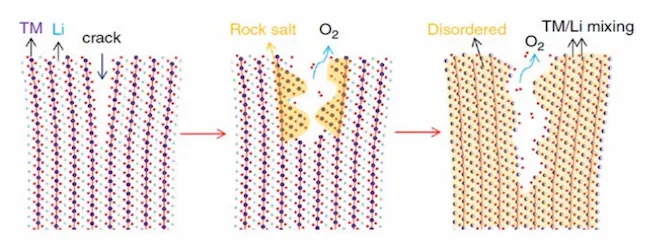
3. Phase Transition and Particle Bloom
Mechanism: Repeated Li+ extraction/insertion triggers irreversible layered-to-spinel/rocksalt phase transitions, exacerbated by TM migration and oxygen loss.
Consequences:
- Voltage decay: Spinel phases (e.g., LiMn₂O₄) operate at ~3 V vs. Li/Li⁺, reducing average voltage by ~1 mV/cycle.
- Low ion diffusion kinetics: Disordered spinel domains disrupt Li+ pathways, increasing diffusion barriers.
- Mechanical failure: Strain from phase mismatch causes particle cracking, exposing fresh surfaces to electrolyte degradation.
LMR Cathode Material – Resulting Performance Limitations
These issues form a degradation cascade where oxygen redox irreversibility initiates structural collapse, while interfacial reactions and phase transitions amplify kinetic and thermodynamic instability.
- Low ion diffusion kinetics: Oxygen loss during cycling creates structural disorder and transition metal migration, blocking Li⁺ pathways and increasing diffusion energy barriers. This is exacerbated by irreversible phase transitions that disrupt layered structures.
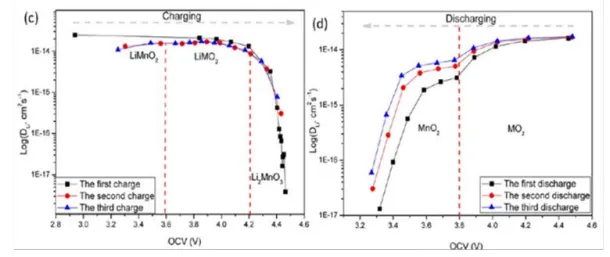
- Low initial Coulombic efficiency: ~15-25% of Li⁺ becomes irreversibly trapped in surface reconstruction layers (e.g., Li₂O) or compensates for oxygen vacancies formed during initial high-voltage charging.
- Voltage decay: Layered-to-spinel phase transitions reduce redox potentials, while oxygen release destabilizes the transition metal-oxygen framework, progressively lowering operating voltages by ~1 mV/cycle.
LMR Cathode Material – Product Modification Strategies
1. Element Doping
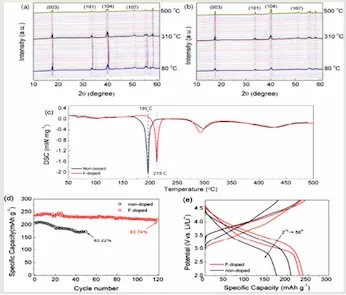
Ion doping can stabilise the crystal structure, inhibit the release of oxygen in the lattice, and expand the (003) interplanar spacing in the transition metal layer.
Doping at different positions of lithium-rich layered cathode materials has different effects on the electrochemical properties of the materials.
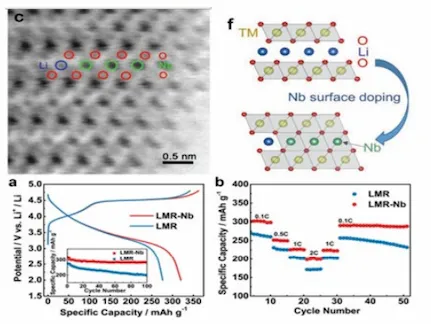
- Lithium (Li) doping: Nb is doped into the lithium layer on the surface, and the stronger Nb-O bond binds the nearby O-TM (Li)-O layer into a whole, improving the material rate performance and cycle stability
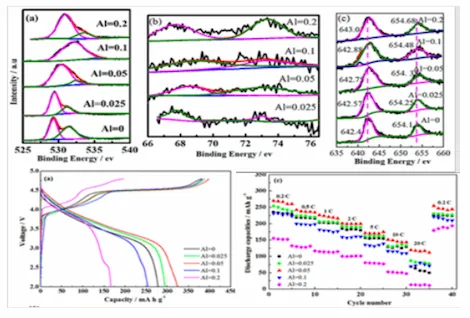
- Select appropriate doping ions to replace transition metal ions to increase the migration barrier. The spinel layered heterostructure formed on the surface of the material after Al+ doping stabilises the system structure and improves the electronic conductivity
- Lithium-rich manganese-based positive electrode material voltage>4.45V, part of the oxygen in the lattice is irreversibly removed, and F doping can inhibit the reduction of Mn2+ during the charge and discharge process
2. Surface Treatment
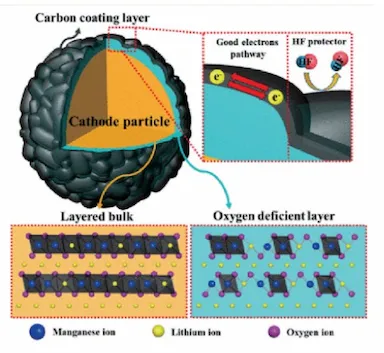
Lithium-rich manganese-based cathode materials require a high operating voltage (>4.6V) to activate the Li2MnO3 component, accelerate the side reaction of electrolyte decomposition on the interface, and surface modification inhibits the side reaction.
- The synergistic effect of the formed oxygen vacancy layer and the carbon coating layer can inhibit the oxygen evolution reaction.
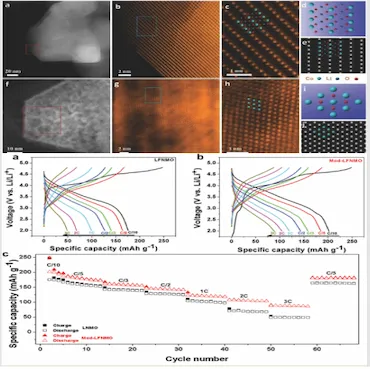
- The AlF3 coating can inhibit the interface side reaction and reduce the impedance.
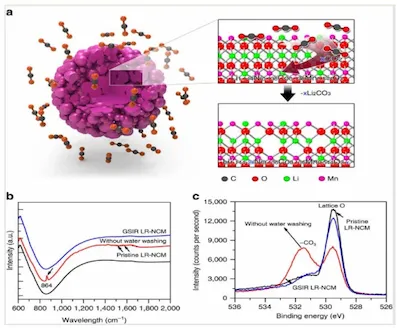
- The carbonate ions on the surface are treated with GSIR to produce a uniform layer of oxygen vacancies on the surface.
For more blog articles click here
To view GDC market research reports click here
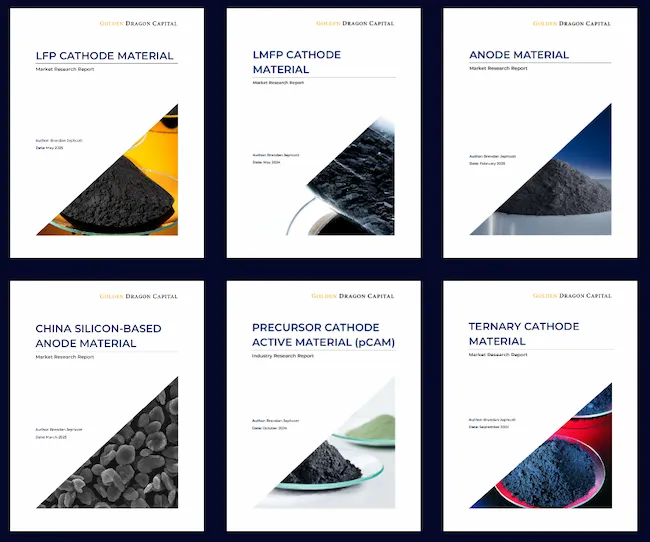
Golden Dragon Capital Limited | Comprehensive Market Research Reports
About us
GDNM provides commentary on how energy transition minerals contribute towards the decarbonisation and electrification of the global economy, with a particular focus on the lithium-ion battery and rare earths supply chains.
GDNM founder, Mr Brendan Jephcott is an Australian who has worked in the global mining sector for more than 13 years, of which his experience covers precious metals, nonferrous metals, ferrous metals, base metals, bulk commodities, rare earths, and the lithium-ion battery industry.
For the last 9 years Mr Jephcott has focused on the burgeoning new energy industry, participating in cross-border transactions in buy-side and sell side roles, cultivating a global business network ranging from upstream resource companies, midstream intermediate product producers, and downstream consumers such as gigafactories and auto companies.