Ternary Cathode Surface Coating Modification
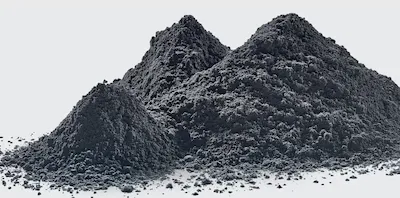
Ternary cathode surface coating is an effective strategy to protect the NCM surface from direct contact with the electrolyte, inhibiting the dissolution of transition metal ions and harmful phase changes.
Through ternary cathode surface coating, the battery safety problem caused by the thermodynamic instability of the H3 phase of the high nickel ternary material can be alleviated to a certain extent.
The highly oxidative Ni3+/Ni4+ ions on the surface of Ni-based cathode materials, especially at a high delithiated state, can easily react with the liquid electrolyte and induce gas generation, which is one of the main reasons for the safety issues of batteries.
Purpose of ternary cathode surface coating
The surface coating is like putting a protective layer on the particle surface to reduce the direct contact between the cathode material and the electrolyte, and thus suppress the side reactions and transition metals dissolution.
Protective coating of NCM-based cathode materials protects the material surface from parasitic reactions with the electrolyte. The major parasitic reaction involves a spontaneous reaction between the surface-residual LiOH/LiCO3 and the electrolyte (LiPF6) to form an insulating layer of LiF on the cathode surface.
LiPF6 also has a tendency to dissociate in the presence of moisture and generate HF. The in situ generated HF also corrodes the material surface and affects the structural integrity of the cathode.
Surface coating is a physical or chemical treatment of the surface of the positive electrode material to isolate the cathode material from the electrolyte.
Types of ternary cathode surface coating layers
Ternary cathode surface coating layers can be classified into metal oxides, phosphides and fluorides, Li-containing compounds and conducting polymers and carbon. The inactive compounds, such as oxides, fluorides, and phosphates, act as a physical protective layer and do not involve chemical reactions.
While conductive materials with lithium or electron conductivity cannot only stabilize the cathode interface but also facilitate lithium ions diffusion and electron transfer, improving the electrochemical properties.
Various inactive coatings (e.g. Al2O3, ZrO2, Zr(OH)4, TiO2, Co3O4 and AlF3) have been used to modify Ni-rich layered oxides. Al2O3 is one of the most successful coating materials and has been used in industrialization.
Coating methods include deposition techniques, wet chemistry and dry chemistry. Atomic layer deposition (ALD) and chemical vapor deposition (CVD) are deposition techniques, and they have gained attention in the battery application to modify electrode surfaces.
Both are thin film deposition techniques which utilizes gaseous or liquid reactants in specific atmosphere to enable surface chemical reactions between the volatile precursors and the material to be coated.
These ternary cathode surface coating techniques can be widely used to form suitable conformal coatings on electrode materials to reduce the electrolyte-electrode side reactions, reduce self-discharge reactions, improve thermal and structural stability, increase the conductivity of electrodes, and thus further enhance the battery performance.
Wet coating chemical routes
Co-precipitation, sol gelm and hydrothermal are wet chemical routes which have been widely used for cathode material coatings. Wet coating is a thin film deposition technique in which the material is dispersed in a liquid precursor solution, followed by heat treatment, which results in a crystalline and non-uniform coating on the surface of positive electrode materials. The wet coating process is simple and scalable. Therefore, it is the most commercially employed coating technique offering high purity and high adhesion coatings.
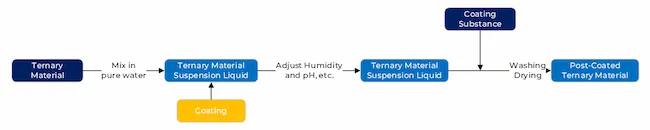
An alternate route is to coat the modified material on the surface of the ternary cathode in an inorganic system. Through an inorganic coating tank, the ternary cathode and pure water are placed in a coating tank in a certain proportion. After the ternary cathode particles are evenly dispersed in the water by stirring, the coating material is slowly added at a suitable temperature and pH to make it evenly coated on the surface of the ternary cathode.
Dry coating chemical routes
Dry coating is a technique where a coating additive is mechanically mixed with cathode active material particles to form a thin surface layer. It is simple and low-cost compared to other coating techniques while unable to produce very conformal layer with controlled thickness.
The thickness may vary in nano to submicron range. This technique requires a high-temperature post-treatment to finalize the coating and grow crystalline compounds at the surface of the particles, which can hinder Li+ ion diffusion at the cathode electrolyte interface.
Improvement in electrochemical performance is mainly dependent upon the correct thickness and the selection of a proper coating material as the inert coating layer will hinder the rapid removal of lithium ions to a certain extent, decreasing the capacity and energy density of Ni-rich layered oxides.
As such the improvement in electrochemical performance is dependent on the type, amount, and thickness of the coating obtained to further improve the thermal stability of layered cathode materials.
For more blog articles click here
To view GDC market research reports click here
Golden Dragon Capital Limited | Comprehensive Market Research Reports
About us
GDNM provides commentary on how energy transition minerals contribute towards the decarbonisation and electrification of the global economy, with a particular focus on the lithium-ion battery and rare earths supply chains.
GDNM founder, Mr Brendan Jephcott is an Australian who has worked in the global mining sector for more than 13 years, of which his experience covers precious metals, nonferrous metals, ferrous metals, base metals, bulk commodities, rare earths, and the lithium-ion battery industry.
For the last 9 years Mr Jephcott has focused on the burgeoning new energy industry, participating in cross-border transactions in buy-side and sell side roles, cultivating a global business network ranging from upstream resource companies, midstream intermediate product producers, and downstream consumers such as gigafactories and auto companies.