Synthetic Graphite Anode Material Raw Materials
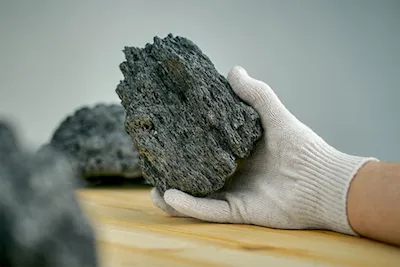
The raw materials of synthetic graphite anode material are divided into three categories: coal series, petroleum series, and coal and petroleum mixed series of which coal-based needle coke, petroleum-based needle coke and petroleum coke are the most widely used.
The different cokes, such as petroleum-based needle coke and coal-based needle coke, China’s domestic coke, and imported coke, all have large price differences, which is a key point in cost control.
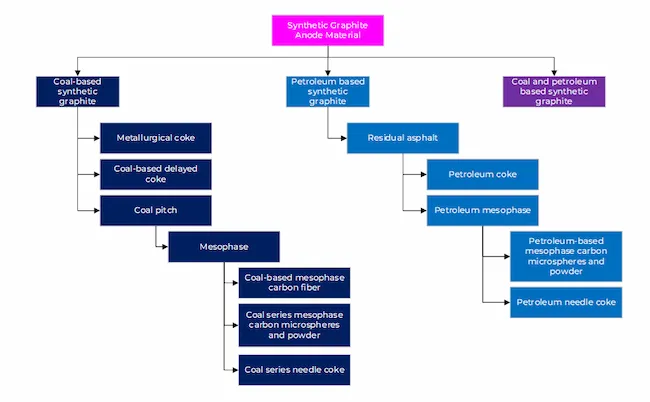
The main raw materials to produce synthetic graphite anode material is needle coke and petroluem coke
Raw materials required for the production of synthetic graphite anode material is coke products such as needle coke and petroleum coke.
The main raw material used to produce high-end synthetic graphite anode material is needle coke, the raw material used to produce mid-end synthetic graphite anode material is a mixture of needle coke and petroleum coke, and the raw material used to produce low-end synthetic graphite anode material is pure petroleum coke.
Different raw materials are important factors in determining the performance of synthetic graphite anode material such as specific capacity, cycle life, and compaction density. The prices of needle coke and petroleum coke are also an important factor affecting the synthetic graphite anode material production cash cost. Synthetic graphite anode material companies will choose different coke raw materials and proportions according to product performance and usage, resulting in differences in cost and product price.
- High-end synthetic graphite anode material uses needle coke as the raw material because it has the advantages of low sulfur content, low ash content, low metal content, and easy graphitisation.
- Low-end anode material uses cheap ordinary petroleum coke as the raw material. Its advantages include low production cost and low price, but it has the problem of high sulfur content.
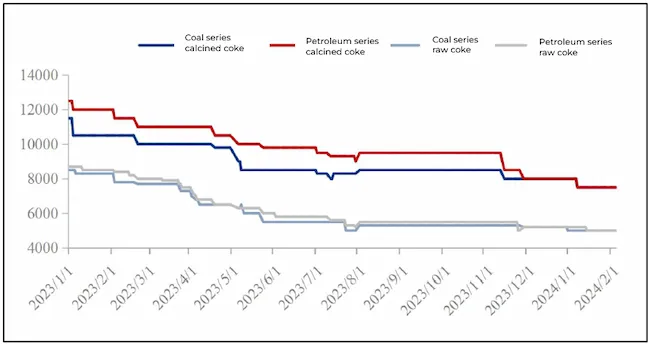
According to the heat treatment method, petroleum coke is divided into raw coke and calcined coke. Raw coke has not been heat treated and contains a large amount of volatile matter, calcined coke is called cooked coke, it has low volatile content after calcination.
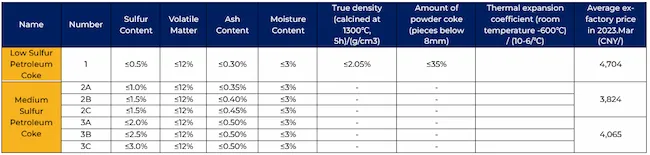
Petroleum coke is divided into different brands according to indicators such as sulfur content, volatile matter, and ash content.
To view GDC anode material industry market research report click here
High-end anodes are made from needle coke
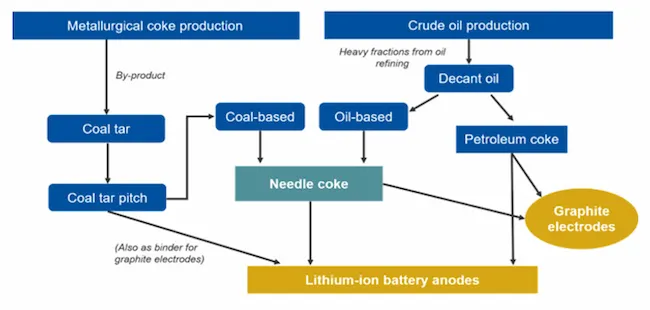
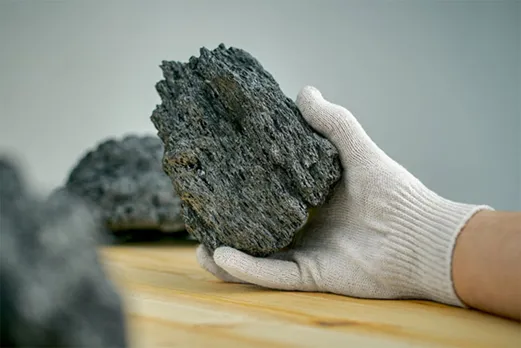
Needle coke is a specialised form of petroleum coke that is derived during coke production from coal tar or as a by-product of the oil refining process. Needle coke has low electrical resistance, strong shock resistance and good anti-oxidation ability.
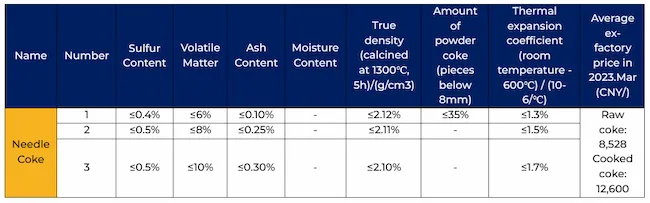
In the past, almost all the needle coke demand emanated from graphite electrode industry. However, owing to the cyclical nature of the industry and a low demand situation, the leading needle coke manufacturers started working with other industries to explore alternative applications for needle coke. During the period 2012 to 2017, needle coke prices collapsed as the graphite electrode industry was experiencing a demand slowdown from EAF steel industry.
Needle coke pricing
Needle coke prices declined to below $1,000 CNY/t (US$143/t) to just under $500 CNY/t (US$71/t) in early 2016 making needle coke more competitive for use in synthetic graphite anodes for batteries as an alternative to the preferred natural graphite. This created a reliable incremental demand for needle coke from the growing lithium-ion battery industry.
However, the graphite electrode industry witnessed a sudden surge in demand in the second half of 2017, resulting in a high requirement of needle coke, the supply of which was limited. Graphite electrode manufacturers (traditional consumers of needle coke) competed with lithium-ion battery manufacturers for needle coke and hence the price increased from $500 CNY/t (US$71/t) in early 2017 to $4,300 CNY/t (US$614/t) in May 2019.
China’s needle coke market situation
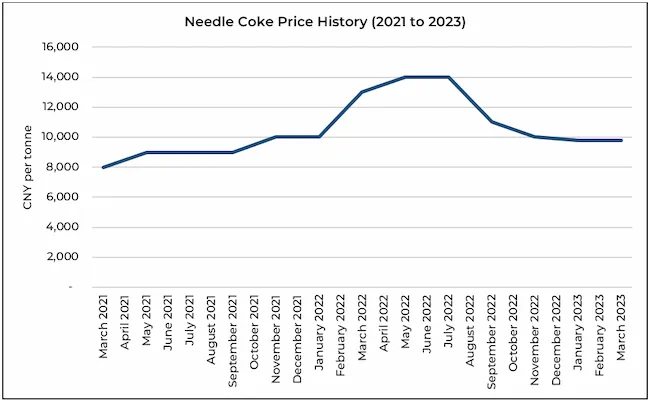
Overall demand for needle coke is limited and new production capacity has been released since the end of 2019. In 2020, due to the combination of the Covid-19 pandemic and declining market demand, the price dropped to a low level of 6,000-7,000 CNY/t (US$1,000/t). In 2021 lithium-ion battery companies developed rapidly and continued strong demand for materials saw the price of needle coke rise. Since Q1-2021, the price of needle coke increased from 8,000 CNY/t (US$1,142/t) up to 14,000 CNY/t (US$2,000/t) in July 2022, an increase of 75%.
As synthetic graphite anode material producers undergo supply-side reforms, their demand for electric arc furnaces has increased significantly, resulting in a tight supply of needle coke and a sharp price increase. In 2022, needle coke prices in China continued to rise, significantly pushing up the raw material cash costs of anode material producers. However, due to changes in downstream demand, the price of needle coke gradually stabilised and dropped to a certain extent in the second half of 2022. As of March 2023, the price of needle coke was 11,900 CNY/t (US$1,700/t), which is 15% lower than the highest point in July 2022. The fall in the price of needle coke significantly reduced the production costs of anode material companies.
Importance of vertical integration
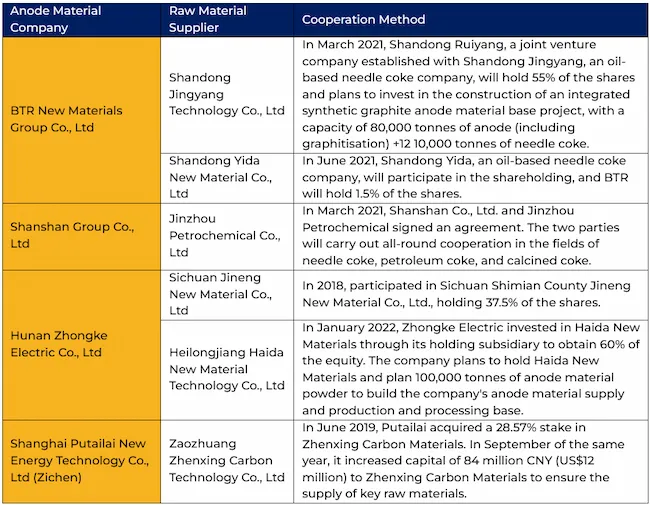
The rise in price and tight supply for needle coke has put pressure on synthetic graphite anode material companies. Becoming vertically integrated along the industrial chain extending into the upstream has become an important part of reducing cash costs and ensuring stable supply for synthetic graphite anode material companies. At present, several mainstream synthetic graphite anode material manufacturers have plans for upstream raw materials.
Low to mid-end anodes are made from petroleum coke
Petroleum coke is produced in the process of petroleum processing. The crude oil is distilled to separate light and heavy oil, and the heavy oil is converted into petroleum coke by hot cracking. It passes through a furnace tube of 500°C at a high flow rate, so that the cracking and condensation reactions are carried out in the coke tower, and then the coke is cooled and removed after a certain period of time.
Petroleum coke can be divided into two types according to the heat treatment temperature, raw coke and calcined coke. The former is petroleum coke obtained by delayed coking, which contains a large amount of volatile matter and has low mechanical strength. The latter is obtained by calcining petroleum coke.
According to the sulfur content, it can be divided into low-sulfur petroleum coke, medium-sulfur petroleum coke, and high-sulfur petroleum coke. Low-sulfur coke is used in the production of graphite electrodes, battery anode material, and high-end prebaked anodes, medium-sulfur coke is mainly used in the production of ordinary prebaked anodes, and high-sulfur coke is mainly used as fuel and reducing agent.
Contained sulfur content of petroleum coke is important
The sulfur content of petroleum coke largely depends on the feedstock, which is crude oil. There are differences in the quality of crude oil in various regions. China’s crude oil is low-sulfur, while the sulfur content in major overseas oil-producing countries is higher.
Supply of low-sulfur coke is dependent on domestic crude oil smelting. As domestic crude oil production is stable, the space for increasing low-sulfur coke production is limited. At the same time, affected by the carbon neutrality policies, strict requirements for energy conservation and consumption, reductions have driven several suppliers such as PetroChina and CNOOC to install hydrogenation units, resulting in part of the coke output being converted into oil and gas again, so the coking rate decreases and the low-sulfur coke production is affected.
The supply situation of medium-high sulfur coke is better than that of low-sulfur coke, China’s petroleum coke imports are mainly medium-high sulfur coke, and overseas supply mainly comes from the United States, Saudi Arabia, and Canada, and their crude oil has a higher sulfur content., which means that the coke produced from this imported crude oil also has a higher sulfur content.
China’s petroleum coke market
China’s petroleum coke market is dominated by low-end combustion applications. Its application consumption in lithium-ion batteries accounts for a small proportion, and its growth rate is relatively slow. Refineries give priority to chemicals and refined oil products, and do not pay enough attention to the pricing of petroleum coke. There is no clear pricing formula on the production side. Production companies mostly refer to their own sales, peer pricing levels, and the quality of petroleum coke. The company’s supply situation and the previous day’s sales are key factors in pricing. Many companies will also refer to crude oil prices, but mostly as a secondary reference and will not incorporate them into the core pricing basis.
Since there is no clear benchmark company in the industry and no clear production-end pricing model, this has made it more difficult to grasp the price volatility of petroleum coke to a certain extent. This allows for traders to enter the market with most petroleum coke products, including refinery export products and imported petroleum coke products involved in a large number of trading activities. If petroleum coke is only used as fuel, the price will not be excessively raised, and the reasonable price range is 2,000 CNY/t (US$286/t) when the supply and demand of petroleum coke in China are balanced.
For more blog articles click here
To view GDC market research reports click here
Golden Dragon Capital Limited | Comprehensive Market Research Reports
About us
GDNM provides commentary on how energy transition minerals contribute towards the decarbonisation and electrification of the global economy, with a particular focus on the lithium-ion battery and rare earths supply chains.
GDNM founder, Mr Brendan Jephcott is an Australian who has worked in the global mining sector for more than 13 years, of which his experience covers precious metals, nonferrous metals, ferrous metals, base metals, bulk commodities, rare earths, and the lithium-ion battery industry.
For the last 9 years Mr Jephcott has focused on the burgeoning new energy industry, participating in cross-border transactions in buy-side and sell side roles, cultivating a global business network ranging from upstream resource companies, midstream intermediate product producers, and downstream consumers such as gigafactories and auto companies.