Sulfide Solid Electrolytes will power next-generation lithium-ion batteries
Sulfide solid electrolytes are a group of compounds all containing lithium and sulfur as the main components, which can be complemented by phosphorous, silicon, germanium or halides.
Sulfide solid electrolytes have received a lot of attention as a key product for research by several solid-state battery development companies.
- They have higher ionic conductivity compared to oxide electrolytes because S2− has a larger ionic radius and less electronegativity than O2−, which has less binding force on lithium ions, increasing the concentration of free-moving lithium ions, achieving conductivity comparable to that of liquid electrolyte.
- In addition, sulfide solid electrolytes have the advantages of good flexibility, excellent mechanical properties, a simple production process, and good contact with the interface of electrode materials.
- Furthermore, their plasticity enables better volume change compensation of the active materials during cycling compared to brittle oxide materials.
| Name | Conductivity at room temperature (S/cm) |
| Li3.25Ge0.25P0.75S4 | 2.2×10⁻³ |
| Li10GeP2S12 | 1.2×10⁻² |
| Li10SiP2S12 | 2.3×10⁻³ |
| 70Li2S30P2S5 | 3.2×10⁻³ |
| Li9.54Si1.74P1.44S11.7Cl0.3 | 2.5×10⁻² |
| Li7SnP2S12 | 4×10⁻³ |
| Li3.833Sn0.833As0.166S4 | 1.39×10⁻³ |
| Li6PS5Cl | 1.33×10⁻³ |
Disadvantages of sulfide solid electrolytes
However, disadvantages of sulfide solid electrolytes is their instability in air and the limited interface stabilities at the anode and cathode.
- Sulfides are highly hygroscopic and form the toxic gas hydrogen sulfide (H2S) when in contact with oxygen and moisture. The production process must be carried out in an inert atmosphere. No gas is formed in the sealed battery cell, so there are no problems with battery operation. However, in the event of an accident including battery damage, H2S formation, as well as SO2 formation from oxidised electrolytes may be potential safety risks.
- Sulfide solid electrolytes have a narrow electrochemical stability window and react at low potentials with lithium metal and at higher potentials with the cathode active material. The cathode electrolyte interphase, formed by the reaction of the solid electrolyte and the cathode active material, mainly consists of sulfates and phosphates, both are lithium-ion and electronically isolating, which results in high interface resistances.
- At the anode, the solid electrolyte interphase is formed of decomposition products, such as Li2S, Li3P or LiCl. They all have significantly lower ionic conductivities than the solid electrolyte, which results in interface resistances and causes battery performance to deteriorate. The formation of lithium dendrites is also another problem at the interface of lithium metal and sulfide solid electrolytes.
Electrode Coatings provide enhancements
Electrode coatings (e.g., Li7La3Zr2O12 at the anode or LiNbO3 at the cathode), which function as an artificial solid electrolyte interphase/ cathode electrolyte interphase to avoid direct contact between the solid electrolyte and the active materials are the most common approach taken to minimise interfacial resistances.
- Other approaches include doping the solid electrolyte surface with for example oxygen (exchange of S with O-atoms) to enhance the surface stability, and tailoring the particle sizes of the active material and solid electrolyte.
| Challenges | Possible Solutions |
| Moisture and air stability | 1. Dry rooms 2. Material coatings 3. Doping of SE surface (e.g., with oxygen) |
| Lithium metal interface | 1. Artificial SEI / coating 2. Doping of SE surface (e.g., with oxygen) 3. Tailoring particle size of the solid electrolyte 4. 3D composite Li metal anodes 5. Defect-free SE production 6. Minimize electronic conductivity of SE |
| Cathode interface | 1. Cathode coatings 2. Doping of SE surface (e.g., with oxygen) 3. Tailored cathode for SSB (e.g., zero-strain cathodes) 4. Tailoring particle size of the solid electrolyte and active material |
Advantages of sulfide solid electrolytes
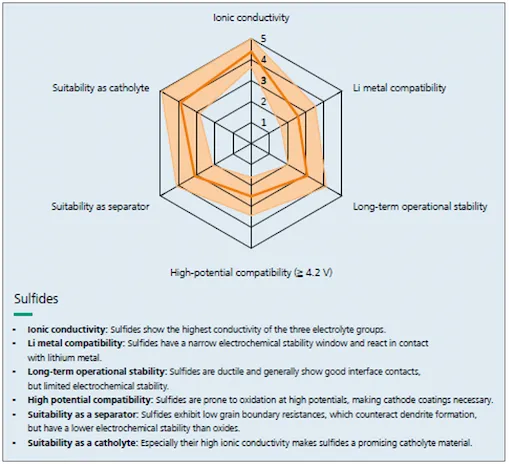
Sulfide solid electrolytes have the highest conductivity and a wide electrochemical stability window, which can be above 5V. They also have strength and processing performance and good interface compatibility. They are the best solid electrolyte materials in theory.
- Many power battery giants (Toyota, Honda, LGES, Panasonic, CATL, etc.) have chosen it as the main technical path, among which Toyota is the most radical and has the most solid-state battery patents in the world.
- However, sulfides have poor thermal stability, the starting temperature of thermal reactions is as high as 400-500ºC, poor compatibility with cathode material, and complex preparation processes, so it is currently difficult to mass produce.
- Sulfide electrolytes are considered to be solid electrolytes with great development potential due to their excellent properties such as high ionic conductivity, wide electrochemical window, good mechanical properties, and low grain boundary resistance.
- Compared with oxide solid electrolytes, sulfide solid electrolytes have better ionic conductivity, which enables them to show better rate performance in the application of solid-state batteries. In addition, the electrochemical window of some sulfide electrolytes with lithium is above 10V, and they are highly compatible with high-voltage cathode materials.
- However, due to the poor air stability of sulfides, they react with water in the air to generate toxic gas H2S, which causes the electrolyte structure to be destroyed and the electrochemical performance to decay, which makes its preparation conditions more demanding and the manufacturing cost high. The second dilemma of sulfide electrolytes is that they have poor thermal stability and are prone to phase change at high temperatures, affecting their stability and ionic conductivity.
| Name | Conductivity at room temperature (S/cm) |
| Li-P-S System Li11-xM2-XP1+XS12 (M = Ge, Sn, Si) | Take Li7P3S11 as an example, it has a high room temperature ionic conductivity of 1.5 ∗ 10−3S/cm. Li10GeP2S12 has a conductivity of up to 1.5 ∗ 10−2S/cm. It was produced by Tokyo Institute of Technology in Japan in 2011. It is the first solid electrolyte with ionic conductivity comparable to that of liquid electrolytes. It also exhibits high ionic conductivity at lower temperatures, 4 ∗ 10−4S/cm at -45°C. Some cost-effective elements are used to replace Ge elements. |
| Li6PS5X (X = Cl, Br, I) | Compared with Li10GeP2S12, the argyrodite phase has better chemical and electrochemical stability, and the halogen elements have a great influence on its crystal structure and room temperature ionic conductivity. |
The main types of sulfide solid electrolytes
There are main types of sulfide electrolytes currently being studied: glass-ceramic electrolytes, thiolithium fast ion conductors (Thio LISICON), and argyrodite-type Li6PS5X (X = Cl, Br I), and their product performances vary.
| Material | Advantages | Disadvantages | Ionic Conductivity (S·cm⁻¹) |
| Glass-ceramic solid electrolyte | High ionic conductivity | Complex synthesis process | >10⁻³ |
| Thio-LISICON type electrolyte | Simple synthesis, good thermal stability, low electronic conductivity | Relatively low ionic conductivity | >10⁻³ |
| Silver sulfide mineral type | Good electrochemical stability | Poor air stability | >10⁻³ |
To view GDC Solid-State Lithium-ion Battery Market Research Report click here
Crystalline form of sulfide solid electrolytes
The crystalline form of sulfide solid electrolytes can be divided into glasses, glass-ceramics, and crystalline electrolytes.
- Glass sulfide electrolytes mainly include Li2S–P2S5 and Li2S–SiS2 two systems. For the glass state, there is no grain boundary impedance, crystal structure is isotropic, lithium-ion transport is easier, and ion conductivity is higher.
- Glass-ceramic state sulfide electrolytes are mainly obtained by high-temperature precrystallisation of glass sulfide electrolytes, which is essentially an organic combination of crystalline and amorphous phases.
Crystalline sulfide electrolyte has good lithium-ion transport channels, its room temperature ionic conductivity is higher, and its comprehensive performance is superior. The more common types of crystalline sulfide electrolytes are Thio-LISION, sulfur-silver-germanium ore type, and Li10GeP2S12 type.
Lithium Sulfide Glass
The commonly used sulfide glass electrolytes include Li2S-P2S5, Li2S-GeS2, Li2S-B2S3, and Li2S-SiS2. Lithium sulfide glassy electrolytes have notable advantages, such as high conductivities (10-4 to 10-2 S/cm) at room temperature, wide electrochemical stability window (up to 5V or more ), isotropic ionic conduction, relatively small grain boundary resistances, high thermal stability and a simple film manufacturing process, all of which make these electrolytes good for all-solid-state batteries. The high conductivity of the glassy sulfide electrolyte is due to the open structure and the high polarisability of sulfur ions, which weakens the interaction between the anions and Li ions.
Since the crystallisation process of glassy electrolytes is easy, glassy electrolytes are typically prepared by melting, followed by rapid quenching or a simple mechanical milling route. More importantly, lithium sulfide glasses are soft, which allows the solid-state batteries to be assembled by cold pressing lithium sulfide glasses with the anode and cathode materials.
In recent years, it has been found that the preparation of glass electrolytes by heat treatment or ball milling can form a partially crystalline semi-glass-semi-ceramic structure, and its ionic conductivity can be significantly improved. In addition, ionic conductivity and chemical stability can be improved by doping and modification.
However, lithium sulphide glasses cannot be stored in air owing to the reaction between sulfides and moisture, yielding H2S, which would lead to a high manufacturing cost. In addition, lithium sulfide glasses show instability when they are coupled with oxide cathodes, such as LiFePO4 and LiCoO2.
Sulfide Glass-Ceramics
Glass-ceramic sulfide electrolytes are a type of solid electrolyte with unique structure and performance. Through heat treatment of amorphous glass precursors, part of the material is crystallized, thereby forming a dispersed nanoscale crystalline phase in the amorphous glass matrix. The formed crystalline phase can provide more ion transmission channels, which makes the ionic conductivity of glass-ceramic sulfide higher, but because an additional heat treatment step is required to form a crystalline phase during the preparation process, its preparation process is more complicated.
Lithium sulfide glass-ceramics can be synthesised by annealing glassy lithium sulfide materials beyond their crystallisation temperature, which are metastable phases but exhibit an extremely high room temperature conductivity of >10-3 S/cm). Li7P3S11, one of the most studied lithium sulfide glass-ceramic electrolytes has a conductivity of 3.2 x 10⁻³ S/cm at room temperature.
Similar to the sulfide glasses, the high ionic conductivity of lithium sulfide glass-ceramics is attributed to the large ionic radius and the high polarisability of the sulfur ions in the system. Moreover, the crystalline domains are surrounded by amorphous phases in the glass-ceramics system, which can decrease the grain boundaries resistance and thus promote lithium- ion conduction.
However, the main disadvantages of Li7P3S11 glass-ceramic is the instability in air and moisture, narrow electrochemical stability window, as well as the incompatibility with lithium metal anode materials.
Thio-LiSICON Type Electrolytes (LGPS)
Crystalline lithium sulfide conductors can be classified into thio-LISICON (thio-lithium superionic conductor)-type sulfides and argyrodite structured sulfides.
Crystalline sulfide materials demonstrate ionic conductivity on par with those of liquid electrolytes through the utilisation of near ideal conduction pathways.
The Thio-LISICON structure, derived from the LISICON-type γ-Li3PO4 oxide electrolyte by replacing oxygen with sulfur, is found in systems such as Li2S-GeS2, Li2S-GeS2-Ga2S3, and Li2S-GeS2-ZnS. Sulfur’s lower electronegativity and larger radius compared to oxygen reduce lithium binding energy and widen lithium migration channels, resulting in higher ionic conductivity for sulfide Thio-LISICON electrolytes compared to their oxide counterparts.
Thio-LISICON-type sulphides have the composition of Li4−xM1−yMy’S4 (M = Si, Ge and M’ = P, Al, Zn, Ga). Among these sulphides, Li4− xGe1−xPxS4 with an ionic conduction of 2.2 x 10⁻³ S/cm at 25 °C shows superior performances than any other members.
Li10GeP2S12 (LGPS) shows potential but at a high cost – could silicon be the answer?
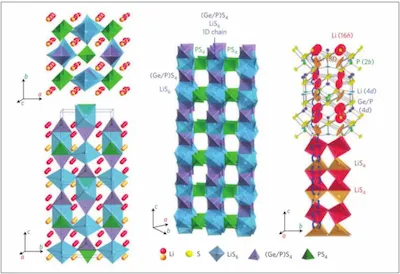
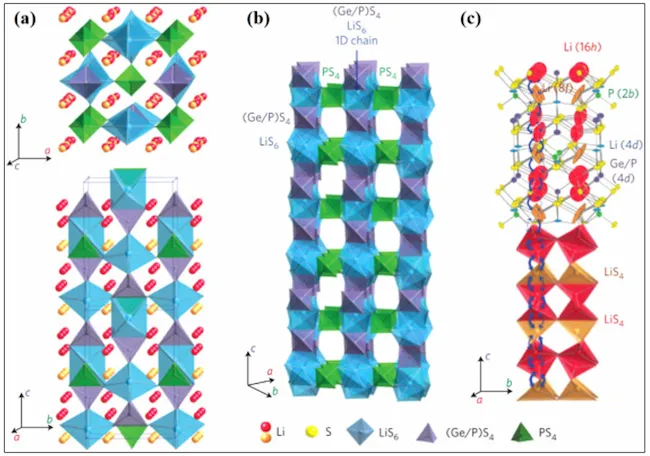
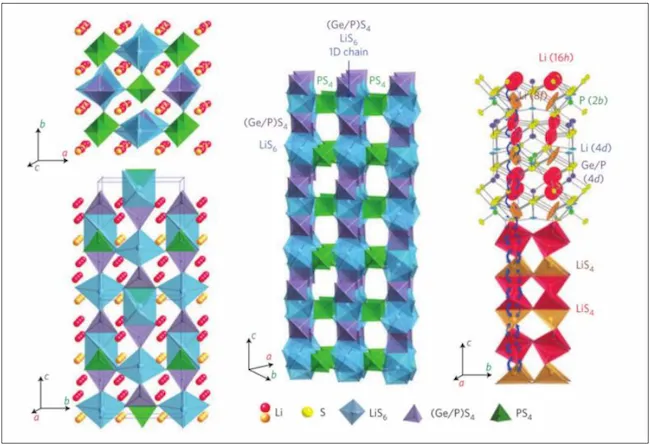
In 2011, Kanno discovered Li10GeP2S12 (LGPS) with a conductivity of 1.2×10⁻² S/cm at room temperature. This new electrolyte is composed of (Ge0.5P0.5)S4/PS4 tetrahedron, LiS4 tetrahedron and LiS6 eight surface composition. Although Li10GeP2S12 has high lithium-ion conductivity at room temperature, the expensive raw material (Ge) and the instability of lithium metal still limit its large-scale mass adoption.
Li10GeP2S12 (LGPS) achieves an ionic conductivity of up to 1.2×10⁻² S/cm, surpassing traditional electrolytes at 1.0 × 10^{-2} S·cm^{-1}, due to its three-dimensional framework composed of (Ge0.5P0.5)S4, PS4, LiS4 tetrahedrons, and LiS6 octahedrons.
However, the high cost of germanium has led researchers to explore alternatives like silicon and tin, resulting in lower-cost materials such as Li4SiS4 and Li4SnS4, though their ionic conductivities are significantly lower, with Li4SiS4 at ≈10^{-8} S/cm at room temperature and Li4SnS4 at 3 × 10^{-4} S/cm at 100°C, dropping to 7 × 10^{-5} S/cm at 20°C, alongside poor electrochemical stability.
To improve such problems, cost-effective Si can be used to replace expensive Ge to further reduce the cost and improve the electrochemical stability. Li10SiP2S12 is considered a candidate for the development of a new generation of solid-state electrolytes due to its high conductivity at room temperature, good stability, and compatibility with high-voltage cathode materials. In addition to Si, the rare Ge4+ can also be replaced by the equivalent cation Sn4+.
Among the sintered blocks, the highest ionic conductivity is the LGPS solid-state electrolyte lithium silicon phosphorus sulfur chloride, and its bulk ionic conductivity reaches 2.5×10⁻²S/cm, which is the highest value among all lithium ion fast ion conductors.
Argyrodite Structured Sulfides
Argyrodite structured sulfides, with the general compositions Li₇PS₆ and Li₆PS₅X (X = Cl, Br, I), exhibit ionic conductivities ranging from 10⁻³ to 10⁻² S/cm at room temperature . Although their conductivity is slightly lower than that of Li₁₀GeP₂S₁₂, argyrodites are significantly more cost-effective, making them an attractive compromise between performance and cost-effectiveness for use in all-solid-state batteries.
Recent developments in argyrodite synthesis have explored fluorine doping, with Li₆PS₅F₀.₅Cl₀.₅ achieving ionic conductivity of 3.5 × 10⁻⁴ S cm⁻¹ at room temperature and demonstrating enhanced stability toward lithium metal. Advanced argyrodite compositions such as Li₅.₃PS₄.₃ClBr₀.₇ have achieved ionic conductivities as high as 2.4 × 10⁻² S cm⁻¹, while Li₆.₆Si₀.₆Sb₀.₄S₅I has reached 24 mS cm⁻¹ at 25°C.
Argentite-type sulfides constitute another promising category of sulfide solid electrolytes, distinguished by their low cost and high room temperature lithium conductivity.
Li₇PS₆ serves as the parent phase for various substitution strategies aimed at increasing Li-ion conductivity. Computational studies have identified promising dopant combinations, with Si-F co-doping predicted to be thermodynamically favorable, potentially leading to the synthesis of the first F-doped Li-containing argyrodite. The optimisation of Li₇PS₆ through strategic doping offers pathways to further enhance ionic conductivity while maintaining cost advantages.
For more blog articles click here
To view GDC market research reports click here
Golden Dragon Capital Limited | Comprehensive Market Research Reports
About us
GDNM provides commentary on how energy transition minerals contribute towards the decarbonisation and electrification of the global economy, with a particular focus on the lithium-ion battery and rare earths supply chains.
GDNM founder, Mr Brendan Jephcott is an Australian who has worked in the global mining sector for more than 13 years, of which his experience covers precious metals, nonferrous metals, ferrous metals, base metals, bulk commodities, rare earths, and the lithium-ion battery industry.
For the last 9 years Mr Jephcott has focused on the burgeoning new energy industry, participating in cross-border transactions in buy-side and sell side roles, cultivating a global business network ranging from upstream resource companies, midstream intermediate product producers, and downstream consumers such as gigafactories and auto companies.