SmCo Magnets Role in the Modern Economy
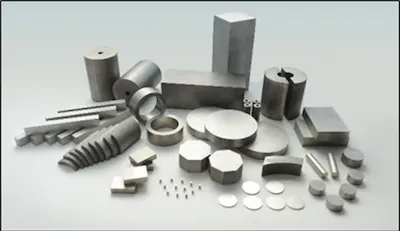
Samarium cobalt (SmCo) magnets belong to the first and second generation rare earth permanent magnet materials. They have characteristics of high magnetic energy and an extremely low temperature coefficient, of which its maximum operating temperature can reach as high as 350°C. Compared with NdFeB magnets, SmCo magnets are most suitable for working in high temperature environments as they can maintain good temperature stability and chemical stability above 180°C.
As SmCo magnets have a high working temperature environment, strong corrosion resistance and oxidation resistance, they are widely used in many high-technology fields including aerospace, national defense, microwave devices, 5G communications, medical equipment, magnetic transmission devices, sensors, magnetic processors, motors, and magnetic cranes.
However, SmCo magnets also face some problems, the most important of which is the scarcity and price volatility of raw materials. The main raw materials of SmCo magnet materials are rare earth elements such as samarium and cobalt, which are very difficult to mine and process, and the main production areas are concentrated in China. This has led to the monopoly of the rare earth market and price fluctuations, bringing instability and uncertainty to the production of SmCo permanent magnet materials. In addition, there are also some environmental pollution and energy consumption problems in the production process of SmCo magnet materials, such as the treatment of wastewater and waste gas, and high energy consumption preparation processes.
In order to solve these problems, the global rare earth permanent magnet material industry has begun to carry out technological innovation and green production. On the one hand, researchers have conducted in-depth research on material formulation, magnetic property regulation, magnetic failure mechanism, etc., and developed new rare earth permanent magnet materials, such as NdFeB. On the other hand, process innovation has gradually become a trend in industrial development, such as introducing advanced separation and purification technology, recycling wastewater and waste gas and other green production technologies to reduce resource consumption and environmental pollution.
In general, although SmCo magnets face problems such as scarcity of raw materials and price fluctuations, with the continuous innovation of technology and the continuous popularisation of green production concepts, the future production and application of SmCo permanent magnet materials will be more sustainable and environmentally friendly, creating more scientific and technological value for the world.
SmCo Magnets Principal Processing Method
SmCo magnets are a hexagonal crystal structure with high uniaxial anisotropy, and are mainly composed of samarium metal (Sm), cobalt metal (Co), copper (Cu), iron (Fe) and zirconium (Zr). They can be divided into two intermetallic compound structure types with the first-generation as the samarium cobalt 1:5 type (SmCo5) and second-generation samarium cobalt 2:17 type (Sm2Co17).
First-generation SmCo magnets (SmCo5)
First-generation SmCo5 rare earth permanent magnets were invented in the United States in 1967. They have the characteristics of a very high magnetocrystalline anisotropy constant, and its theoretical magnetic energy product can reach 244.9 kJ/m3.
The main components are samarium, cobalt, praseodymium, or just pure samarium cobalt. The maximum operating temperature is 350 degrees. The magnetic energy product of SmCo5 magnets is lower than that of Sm2Co17, but the machinability is better, and it is suitable for machining parts with special shapes. In the 1970s, SmCo5 magnets were commercialised, however, because samarium and cobalt mineral reserves and extraction are scarce and expensive as raw materials, their mass development prospect was limiting.
Second-generation SmCo magnets (SmCo17)
Second-generation of Sm2Co17 rare earth permanent magnets were invented by Japan in 1977. Sm2Co17 is a stable Th2Ni17 type hexagonal (rhombohedral) structure made from samarium, cobalt, copper, iron and zirconium. Sm2Co17 magnets have the characteristics of excellent magnetic stability, high temperature magnetic properties, excellent oxidation resistance and corrosion resistance. The magnetic energy product of Sm2Co17 can reach 28MGOE, with excellent magnetic properties. The price is cheaper than SmCo5, and the current consumption is relatively large. It Sm2Co17 are still widely used in aerospace, national defense, military industry, high-end motors and other fields.
| Product Types | Maximum Magnetic Energy (BH)max | Curie Temperature Tc (℃) | Maximum Operating Temperature (℃) | Oxidation Resistance and Corrosion Resistance | Price Range |
| AlNiCo | 1.2~1.3 | 890 | 600 | Good | Middle |
| Ferrite | 0.8~5.2 | 450 | 300 | Good | Cheap |
| SmCo5 | 15~24 | 740 | 250 | Good | Expensive |
| SmCo17 | 22~32 | 926 | 550 | Good | Expensive |
| Sintered NdFeB | 30~52 | 310 | 230 | Poor | Middle |
| Bonded NdFeB | 3~13 | 350 | 160 | Good | Middle |
The manufacturing process of SmCo magnets undergo crushing, milling, orientation molding, sintering and heat treatment. SmCo magnets are processed by machinery, so the shape should not be too complicated during design, and the shape and position tolerances should not be too tight, otherwise it will greatly increase the cost of the product; in addition, SmCo magnets are extremely brittle, and factors such as processing and assembly should be fully considered during design to prevent the magnets from breaking and the processing cost from increasing significantly.

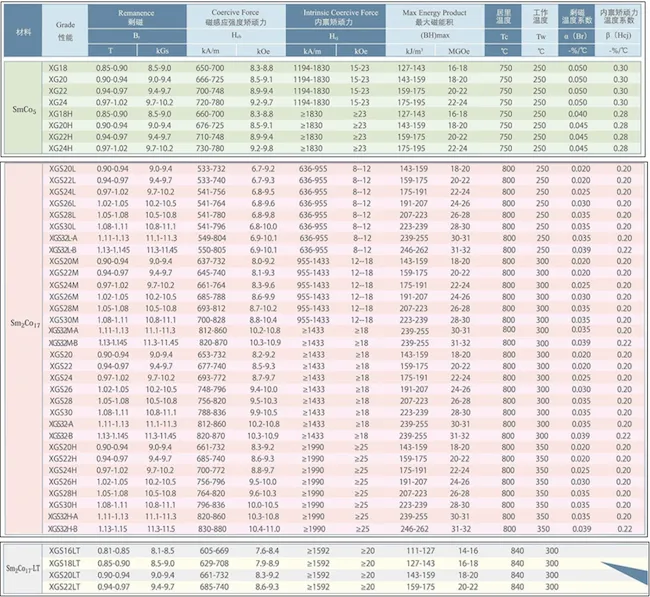
SmCo magnets are grouped under two product series (SmCo₅ and Sm₂Co₁₇), delivering remanence (Bᵣ) of 0.85–1.15 T, intrinsic coercivity (Hᵢ) from about 1.2 to 2.0 MA/m, and maximum energy products (BHₘₐₓ) ranging 127–262 kJ/m³. SmCo₅ grades have a Curie temperature of ~750°C and can operate up to 250°C with temperature coefficients of –0.05%/°C for Bᵣ and –0.30%/°C for Hᵢ, while Sm₂Co₁₇ alloys feature a higher Curie point (800–850°C), usable temperatures up to 350°C, and improved thermal stability (α ≈ –0.02%/°C, β ≈ –0.20%/°C). Their combination of high coercivity, low thermal demagnetisation, and excellent corrosion resistance makes these magnets ideal for high-temperature applications.
SmCo Magnet Commercialisation
China’s SmCo magnets industry emerged in the 1970s, evolving through three key phases. Beginning with the Ninth Research Institute’s breakthrough in 1972, the industry progressed from basic technology and limited applications to rapid expansion during 1997-2005 when global production shifted to China due to its rare earth resources and cost advantages. Since 2006, China’s SmCo magnet industry has achieved high growth driven by increasing demand across multiple sectors, with companies like Hangzhou Permanent Magnet Group Co., Ltd expanding production capacity through product innovation, thereby solidifying China’s global dominance in SmCo magnet production.
SmCo permanent characteristics include high coercivity, high magnetic energy product, low temperature coefficient and excellent corrosion resistance. These characteristics make SmCo magnets have important applications in many fields, such as motors, electronics, magnetic sensors, medical equipment, etc. One of the most important fields is motors.
In the field of motors, SmCo magnets are widely used in various types of motors, such as permanent magnet synchronous motors, DC motors, stepper motors, etc. Compared with traditional motors, permanent magnet motors using samarium cobalt permanent magnet materials can greatly improve the efficiency and power density of motors, thus having greater advantages in achieving high efficiency and miniaturization. Therefore, samarium cobalt permanent magnet materials are widely used in modern electric vehicles, high-speed trains and new generation wind turbines.
In addition, due to the excellent characteristics of SmCo magnets such as high coercivity and high magnetic energy product, they are also widely used in various magnetic sensors. For example, in the automotive ABS system, magnetic sensors made of samarium cobalt permanent magnet materials can detect the speed and position of the wheels in real time, thereby helping the car to achieve more precise braking and control.
High-Tech Commercial Applications
In short, the excellent properties and wide application of SmCo magnets make it an important material in rare earth materials. Although there are problems with the supply of rare earth resources in the world, with the continuous development of science and technology, I believe that more technologies and means will be developed to better utilize and develop rare earth resources.
Currently, China is the world’s largest producer and consumer of SmCo magnets, producing approximately 3,000 tonnes in 2022. The domestic industry exhibits three important characteristics: business operations extend downstream, high market concentration, and focus on increasing high-end product development. However, despite significant growth, Chinese manufacturers still lag in high-end applications, with many companies limited to producing low-to-medium-end products, used in the fields of mechanical equipment and instrumentation.
SmCo magnets offer exceptional advantages that make them essential in high-tech applications. With magnetic energy products reaching as high as 35MGOe (second only to NdFeB magnets), they feature outstanding temperature resistance (up to 550°C), excellent corrosion resistance requiring no additional surface treatment, and minimal temperature coefficient (-0.030%/K) ensuring consistent performance across wide temperature ranges. These properties make them ideal for aerospace, defense, microwave devices, 5G communications, medical imaging, and precision sensors.
| Consumption Field | Applicational Use | Characteristics |
| Energy | Oil exploration permanent magnet motors | Good temperature stability, can be used for a long time in high temperature environment; low energy consumption, high energy efficiency |
| Wireless Communication | 4G/5G base stations, sensors | Low temperature rise, good temperature stability; good corrosion resistance, long service life; small size, light weight, flexible application |
| New Energy Vehicles and Traditional Automotive Parts | Sensors, ignition coils, turbochargers, fuel cell vehicles | Good temperature stability, small performance change when temperature rises |
| Rail Transit | Permanent magnet synchronous traction motors | Small size, light weight, high power density; simple maintenance, low energy consumption, low long-term use cost |
| Aerospace | Permanent magnet motors | Small size, high power density; suitable for high-speed operation, good reliability, long service life; good temperature stability, small performance change when the temperature rises |
The industry’s growth potential remains substantial due to vigorous development in downstream sectors. While benefiting from abundant domestic raw material supply, Chinese manufacturers face challenges in high-end production, particularly for aerospace applications. As downstream applications continue to expand and diversify, the SmCo magnet industry is positioned for continued growth, though advancing capabilities in high-end production remains a critical challenge.
Energy
SmCo magnets are widely used in oil exploration permanent magnet motors, where their exceptional temperature stability enables operation in extreme downhole environments up to 350°C. These magnets typically comprise 1-5% of exploration equipment costs but deliver value through extended service life and reduced maintenance. Their low energy consumption and high efficiency characteristics make them ideal for continuous operation in remote drilling sites and subsea applications where accessibility is limited. The energy sector values their ability to maintain consistent magnetic performance in high-temperature environments without demagnetisation, a critical factor in drilling equipment and production monitoring.
Wireless Communication
Wireless communication infrastructure uses SmCo magnets in 5G base stations and sensor technologies, where their low temperature rise and excellent temperature stability ensure consistent signal quality. These magnets are used in microwave isolators and circulators that prevent signal interference, with each base station typically incorporating 5-15 SmCo components. Their good corrosion resistance and long service life make them valuable for remote installations where maintenance access is limited. The small size and light weight characteristics enable more compact equipment design while maintaining excellent thermal characteristics, crucial for the increasing densification of communication networks.
New Energy Vehicles and Traditional Automotive
The automotive industry uses SmCo magnets in sensors, ignition coils, turbochargers, and fuel cell systems where reliable performance under fluctuating temperatures is essential. Electric vehicles may use up to 1-2 kg of SmCo magnets in high-temperature motor applications, while traditional vehicles incorporate smaller amounts in various sensing and control systems. The minimal performance change when temperatures rise makes these magnets ideal for engine compartments, which can experience temperature variations from -40°C to 200°C. Despite their higher cost compared to other magnetic materials, automotive manufacturers value these magnets for their reliability where performance impacts on vehicle safety and efficiency.
Rail Transit
SmCo magnets are components in PMSM that power modern train systems. These high-performance motors leverage SmCo’s small size, light weight, and exceptional power density to achieve superior energy efficiency. A typical high-speed train may incorporate 50-200 kg of SmCo magnets across its traction system, depending on design specifications and power requirements. Their simple maintenance requirements and low long-term operational costs make them attractive for rail applications, where equipment must remain in service for decades with minimal performance degradation.
Aerospace
The aerospace sector employs SmCo magnets in PMSM and control systems where reliability under extreme conditions is paramount. These applications leverage SmCo’s suitability for high-speed operation (often exceeding 100,000 RPM), exceptional reliability, and minimal performance change across extreme temperature ranges (-65°C to 350°C). Aircraft and spacecraft typically use smaller quantities but in highly critical applications, with 0.5-5 kg in engine systems, 50-300 grams in avionics, and varying amounts in satellite positioning mechanisms. The aerospace industry specifically values these magnets for their high power density and long service life, which enable reduced weight without compromising performance-critical in environments where every gram impacts fuel efficiency and payload capacity.
National Defense
SmCo magnets are pivotal for modern fighter jets, providing unparalleled stealth, thermal stability, and performance in critical aerospace systems. Their incorporation into radar-absorbing coatings reduces an aircraft’s radar signature, while their ability to maintain full magnetic strength from cryogenic temperatures up to 350°C ensures reliable operation of electronic warfare suites, turbine engines, and flight controls-without the need for protective coatings required by other rare-earth magnets.

Despite their operational advantages, SmCo magnets carry substantial economic and strategic drawbacks. The complex extraction and processing of samarium and cobalt drive up costs, and China’s dominance in rare-earth production creates supply-chain vulnerabilities. In 2022, the discovery of a Chinese-sourced SmCo alloy in a Honeywell turbomachine for the F-35 program halted deliveries to comply with U.S. defense procurement laws, illustrating the geopolitical risks associated with reliance on a single supplier.
How China is breaking through technology thresholds in high-end SmCo magnet applications dominated by Japan and USA
High-iron SmCo magnets are critical for China’s high-speed rail, 5G infrastructure, and synchrotron radiation equipment, but traditional methods struggle to balance iron content with structural integrity. While iron boosts saturation magnetisation, excessive amounts (>20 wt.%) cause inhomogeneous cellular structures and grain boundary defects that degrade coercivity.
Recent breakthroughs combine composition optimisation and microstructure engineering:
- Defect mitigation: Adjusting Sm/Fe/Zr ratios reduced impurity precipitation during solid solution treatment, while nano CuO doping created copper-rich grain boundaries that narrowed defect zones from ~800 nm to ~300 nm.
- Hydrogen-assisted sintering: Increased hydrogen content in magnetic powder enabled 24% larger grain growth, minimizing grain boundary volume and enhancing structural uniformity.
These innovations yielded magnets with Br=12 kGs, Hcj>24.95 kOe, and (BH)max=33.10 MGOe – surpassing Arnold’s RECOMA 35E (≤30 MGOe) and Toshiba’s heavy-rare-earth-free designs. Third-party tests confirm performance exceeds international benchmarks, enabling applications in Beijing’s advanced light sources, CRRC traction motors, and 5G base stations.
| Company | Maximum Magnetic Energy Product (MGOe) | Coercivity (kOe) | Remanence (kGs) |
| Arnold Magnetics Corporation (United States) | 33.3 | 23 | 11.9 |
| Electron Energy Corporation (United States) | 32~34 | ≥18 | 11.7~11.9 |
| Ningbo Institute of Materials Technology and Engineering (NIMTE) of the Chinese Academy of Sciences (CAS) | 31.1 | >24.95 | 12.00 |
These technology address a key bottleneck in China’s rare earth industry by providing domestically produced high-energy SmCo magnets previously monopolised by overseas firms.
Competitive Landscape
China’s rare earth permanent magnet materials industry is strategically shifting toward downstream integration, with companies expanding into high-value-added application products to increase profit margins. While China possesses abundant rare earth resources and mature smelting and separation technologies, its competitiveness in end-product development needs improvement. This vertical integration strategy follows the value chain logic – from upstream mining to downstream applications, product value increases substantially. Leading enterprises like Chengdu Galaxy Magnets Co., Ltd exemplify this approach, building on their core SmCo magnet production while expanding into various downstream applications.
The industry is simultaneously becoming more concentrated and technically sophisticated. Market resources are increasingly gravitating toward industry leaders such as Chengdu Galaxy Magnets Co., Ltd and Hangzhou Permanent Magnet Group Co., Ltd, who leverage their advantages in capital, scale, and customer relationships to expand production capacity and market share. This concentration is partly driven by growing demand from high-end sectors like aerospace and defense, which require advanced manufacturing capabilities and substantial investment in production facilities.
China’s dominance in global SmCo magnet production
According to recent data, China has established itself as the world’s largest producer and supplier of SmCo magnets, leveraging its rich rare earth resources, mature manufacturing technology, and strong industrial chain integration capabilities. The country’s production of this high-performance permanent magnet material continues to grow steadily.
China’s SmCo magnet production has been steadily increasing in recent years. According to the China Rare Earth Industry Association, China’s SmCo magnet production volume reached 1,490 tonnes in the first half of 2022 alone, representing a year-on-year increase of 14.6%. This growth trajectory suggests that China’s annual SmCo production capacity likely exceeds 3,000 tonnes currently.
The growth in SmCo production aligns with China’s broader dominance in rare earth magnetic materials. In 2024, China exported a record 58,152 tonnes of rare earth permanent magnets and permanent magnet alloys, though this figure includes both NdFeB and SmCo magnets, with SmCo representing a smaller portion.
Leading companies include Hangzhou Permanent Magnet Industry Co., Ltd., Ningbo Ninggang Permanent Magnet Material Co., Ltd., Chengdu Galaxy Magnets Co., Ltd, Ningbo Kexing Magnetic Material Co., Ltd., Southwest Institute of Applied Magnetism, etc.
For more blog articles click here
To view GDC market research reports click here
About us
GDNM provides commentary on how energy transition minerals contribute towards the decarbonisation and electrification of the global economy, with a particular focus on the lithium-ion battery and rare earths supply chains.
GDNM founder, Mr Brendan Jephcott is an Australian who has worked in the global mining sector for more than 13 years, of which his experience covers precious metals, nonferrous metals, ferrous metals, base metals, bulk commodities, rare earths, and the lithium-ion battery industry.
For the last 9 years Mr Jephcott has focused on the burgeoning new energy industry, participating in cross-border transactions in buy-side and sell side roles, cultivating a global business network ranging from upstream resource companies, midstream intermediate product producers, and downstream consumers such as gigafactories and auto companies.