Sintered NdFeB Magnets – Principal Production Process
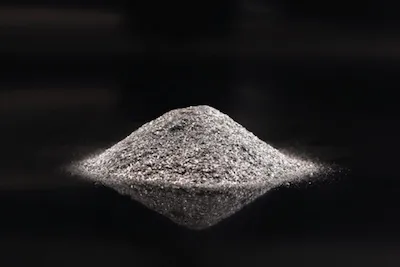
Sintered NdFeB magnets are made by powder metallurgy. NdFeB smelted alloy is made into powder and compact pressed into a magnetic field and is sintered in an inert gas or vacuum to achieve densification. The process of smelting NdFeB alloy powder is a complex but essential process which involves several stages, starting with the heating and mixing of elements neodymium, iron, and boron to form a homogeneous alloy. By controlling each step from heating and mixing to cooling and post-processing, manufacturers can produce magnets with magnetic properties and physical characteristics tailored to customer demands.
The main raw materials include rare earth metals, iron alloys, and boron (under composition Nd₂Fe₁₄B). First, the raw materials need to be pulverized and mixed to ensure uniformity. During raw material preparation, the materials must be mixed in specific proportions. Once the raw materials are ready, they undergo a series of processes to form the NdFeB alloy. Initially, the raw materials are melted in a ball mill to create finer and more uniform powders. These powders are then melted in a vacuum or inert gas-protected furnace to form an alloy. During smelting, it is crucial to control the melting point and composition to ensure alloy quality.
| Steps | Process | Description |
| Raw material preparation | Gathering of raw materials | Neodymium (Nd): A rare earth element that provides strong magnetic properties |
| Iron (Fe): A transition metal that contributes to the magnetic strength and structural integrity of the alloy | ||
| Boron (B): An element that enhances the magnetic performance when combined with neodymium and iron | ||
| Heating and mixing | Heating the raw materials in a controlled environment | Temperature control: The mixture is heated to high temperatures, often exceeding 1400°C to ensure that all components melt and combine thoroughly. The temperature can vary based on the desired properties of the final alloy |
| Homogenisation: During this heating phase, elements interact at the molecular level allowing for the formation of a homogeneous alloy. This ensures consistent magnetic properties throughout the material and achieving a uniform mixture | ||
| Formation of the alloy | As materials melt, they undergo chemical reactions | Phase formation: The primary phase formed during this process is Nd₂Fe₁₄B, which is responsible for the strong magnetic characteristics of NdFeB magnets. The melting and subsequent cooling allow this phase to crystallize effectively |
| Oxidation considerations: To prevent unwanted oxidation which can degrade the quality of the alloy, the smelting environment may be controlled by using inert gases or vacuum conditions | ||
| Cooling and solidification | Cooling after homogeneous alloy is achieved | Controlled cooling: The cooling rate can influence the microstructure of the alloy, which in turn affects its magnetic properties. Slow cooling can lead to larger crystal sizes, while rapid cooling may result in finer microstructures |
| Casting: The molten alloy is often cast into molds to create ingots or other shapes suitable for further processing |
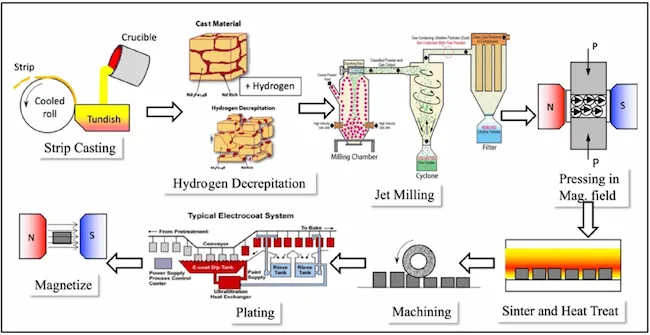
NdFeB Magnets Principal Processing Flowsheet
The production of sintered NdFeB magnets is a complex, multi-stage process designed to optimise the material’s magnetic and mechanical properties.
It begins with the precise formulation of raw materials-primarily neodymium, iron, and boron, plus minor additions of other metals-to tailor the magnet’s key characteristics such as polarization, Curie point, and coercivity. These ingredients are melted in a vacuum induction furnace, then rapidly cooled using strip casting, which produces fine metal grains essential for high-quality magnets.
The brittle cast sheets are then subjected to hydrogen decrepitation, a process that introduces hydrogen to break the material into extremely small grains, making it easier to grind. The resulting powder is further refined using jet milling, where high-speed cyclonic inert gas grinds the material and classifies particles by size, ensuring a narrow and optimal distribution.
This fine powder is pressed into a block under a strong external magnetic field, aligning the magnetic domains in the desired direction. To eliminate air gaps, the block undergoes cold isostatic pressing under great pressure, resulting in a denser, more uniform material.
Sintering follows, where the block is heated above 1000°C, allowing the grains to bond and the magnetic properties to fully develop while maintaining the aligned orientation. Annealing is then performed to relieve internal stresses by gradually heating and cooling the blocks, ensuring structural stability.
Final steps include cutting, machining, and grinding the blocks to precise specifications, with waste material carefully managed and recycled.
Due to the material’s vulnerability to corrosion, surface treatments such as nickel-copper-nickel plating or epoxy coatings are applied depending on the intended application.
Rigorous testing at each stage ensures only magnets meeting strict quality standards are shipped to customers.
The finished magnets are magnetized by exposing them to a strong electric coil field, locking in their powerful magnetic properties for use in demanding applications.
| Step | Content |
| Raw Materials | The main materials of a NdFeB magnet are neodymium, iron and boron and small additions of other metals. The chemical composition of the magnet is adjusted to determine magnetic polarisation, Curie point, flux density, and coercivity. |
| Melting and Strip Casting | The metal alloy is melted in a vacuum induction furnace and a stream of molten metal is forced under pressure onto a cooled drum where it is rapidly cooled, resulting in thin flakes of the material. The high cooling rate produces small grains of metal that help simplify and enhance the effect of the downstream processing. Small grains are an important part of producing high-quality magnets. |
| Hydrogen Decrepitation | While the grains are very small from strip casting, the material from strip casting comes out of the caster in sheets that must be reduced to powder in order to make magnets. The metal is now brittle enough that it can easily be broken into smaller pieces. Hydrogen Decrepitation is a process that introduces hydrogen to purposely disintegrate the magnet material to create extremely small grains. Then it is easy to grind it even smaller in a subsequent operation. |
| Jet Milling | The Jet Mill uses a high-speed stream of cyclonic inert gas to grind pieces of NdFeB metal into powder. The metal impinges on other pieces of metal powder inside the cyclone. The cyclone automatically classifies the particles by size as they go through the system, so a narrow and very favourable particle size distribution is maintained. The cyclonic air flow naturally separates the particles and prevents the material from having contact with the sides of the pressure vessel due to the gas flow pressure and velocity because different particle sizes have different aerodynamics. |
| Pressing Under External Magnetic Field | The powder is kept in an inert gas atmosphere and handled in glove boxes before going to the automated press. The powder enters a mold and is pressed between plates while under a strong magnetic field forming a block of material. The magnetic field orients the grains so that the magnetic domains remain aligned in the designed direction for all subsequent processing steps. The magnetic field can be oriented two ways: 1) in alignment with the block or 2) perpendicular to the block. Sintered neodymium magnets are typically pressed perpendicular to the block in order to achieve the highest anisotropy (strongest north-south magnetisation). |
| Cold Isostatic Pressing | The block of material is bagged and submerged into a cold isostatic press (CIP) under great pressure. This removes any remaining air gaps in the block, which comes out of this press quite a bit smaller than it was when it went in. |
| Sintering | The pressed block is removed from the bag and sintered. Sintering is a process where the blocks are placed in a furnace at a very high temperature just below the melting point of the metal. At this temperature of >1000oC, the individual atoms have a lot of motion, which allows the blocks to develop their full magnetic and mechanical properties. The magnetic domains maintain the same orientation they had before sintering. At this temperature, full density is achieved and the blocks have shrunk to their final size. |
| Annealing | After sintering, there are pent-up stresses in the metal from all the movement during sintering, so the blocks are heat-treated again in a step fashion at lower temperatures to reduce the stresses. The blocks are ramped up to a high holding temperature for a set time and then they are ramped down to a lower holding temperature. Once the holding time is achieved, the now stress-free blocks are slowly cooled to room temperature. |
| Cutting, Machining and Grinding | Cutting, machining and grinding are performed according to a strict control plan, and waste is minimised by design. Wire cutting uses very fine wire to cut magnets precisely and economically and minimise kerf losses. Machining and grinding are minimised by close controls throughout the previous processes. The NdFeB swarf powder produced during machining needs to be cooled by liquid, otherwise it may spontaneously combust. Waste material is reused and recycled. |
| Surface Treatment | Once the final dimensions for the magnet have been met by machining, due to its poor corrosion resistance, the magnet is given a protective coating. The treatment is nickel-copper-nickel electroplate, which protects the magnet from corrosion in most use environments. The plating is very thin, e.g. 15-35 microns for Ni-Cu-Ni. Some end users specify no coating at all for various reasons. Others specify coatings with greater protection such as aluminium-zinc which offers much greater protection. IVD aluminium is another choice specified by end users. Epoxy is a good coating for environments with applications where magnets could be exposed to salt fog. |
| Testing | Testing and evaluation are performed on magnet material at almost every process step, and records of every data point are kept. Rigorous testing insures only top-quality products are shipped to the customer. Such intensive testing maintains product quality, production efficiency and cost. |
| Magnetizing | The material is placed inside an electric coil which is energized to produce a very strong magnetic field for a short time. After the coil is de-energized, the magnetic field in the magnet remains. |
Oxide Impurity Consideration
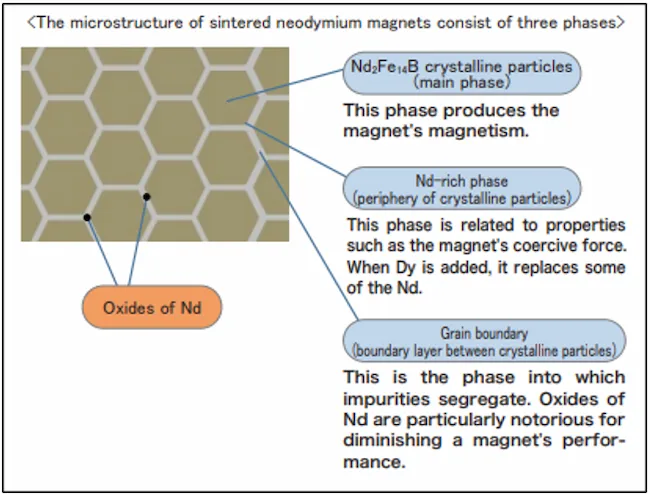
As it is the Nd2Fe14B phase which produces the magnet’s magnetism, the relative proportion of Nd2Fe14B must be increased by eliminating impurities as much as possible. Additionally, impurities that segregate into the grain boundaries must be eliminated. The primary impurity is an oxide of Nd (Nd2O3) that is created when Nd oxidises in the manufacturing process. This Nd oxide does not contribute to the magnetic properties of the magnet and diminishes magnet performance. Such impurities cannot be removed once the magnet has been formed, which is why the magnets are made in a low-oxygen environment where oxygen levels are maintained at the ppm level.
Doping of Dysprosium Enhances NdFeB Magnets High-Temperature Performance
Dysprosium, a rare and costly heavy rare earth element (HREE) is added to NdFeB magnets to significantly enhance coercivity (resistance to demagnetisation). By partially replacing neodymium at the edges of crystalline particles, dysprosium improves the NdFeB magnet’s ability to maintain its magnetic properties, especially at elevated temperatures. The amount of dysprosium added directly affects both the quality of the magnet and the environmental conditions it can withstand. Theoretically, for every 1% increase in dysprosium content, the coercive force of an NdFeB magnet rises by approximately 11.4 kA/m.
However, dysprosium is much less abundant than neodymium or praseodymium, with reserves estimated at only about 11% of those elements. Its price is also nearly ten times higher. Even though dysprosium typically makes up less than 10% of the total composition in NdFeB magnets, fluctuations in its price can have a substantial impact on production costs. Efficient use of dysprosium and other associated resources remains a key challenge in rare earth mining and utilisation.
As a result, sintered NdFeB magnets product series with high-coercivity functionality as expensive, as the dysprosium cost contributes significantly to raw material costs, sometimes even exceeding the cost of neodymium itself. In contrast, hot-pressed NdFeB magnets do not require the addition of expensive heavy rare earths such as dysprosium, resulting in much lower material costs. Therefore, reducing the use of heavy rare earths in sintered magnets not only lowers production expenses for high-coercivity magnets but also conserves valuable and limited rare earth resources.
| Series | Hcj | Dysprosium metal | Neodymium metal | ||||
| Content (middle value) | Content (middle value) | Content (middle value) | Content (middle value) | ||||
| Mass/g | Cost/CNY | Mass/g | Cost/CNY | ||||
| N | ≥ 11K Oe | 0.25% | 2.5 | 14.75 | 28% | 280 | 200.2 |
| M | ≥ 14 Koe | 0.50% | 5 | 29.5 | 28% | 280 | 200.2 |
| H | ≥ 16 Koe | 1.00% | 10 | 59 | 28% | 280 | 200.2 |
| SH | ≥ 20 Koe | 2.75% | 27.5 | 162.25 | 28% | 280 | 200.2 |
| UH | ≥ 25 Koe | 4.50% | 45 | 265.5 | 28% | 280 | 200.2 |
| EH | ≥ 30 KOe | 7.00% | 70 | 413 | 28% | 280 | 200.2 |
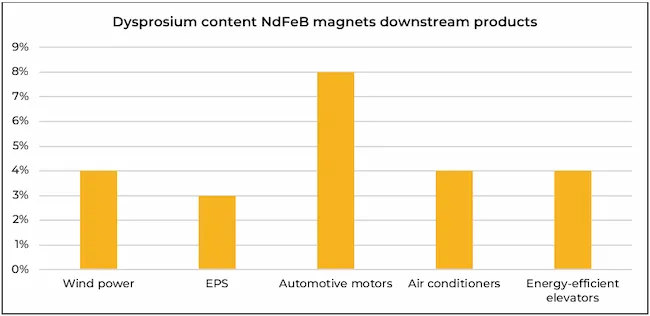
As mentioned earlier, dysprosium is mainly used in NdFeB magnets for air conditioners, refrigerators, washing machines, hybrid electric vehicle drive motors, other automobiles, HDD voice coil motors, industrial automation equipment, etc. The dysprosium content in NdFeB magnets varies depending on the ambient temperature in which the product is used. Products such as walkie-talkies and medical MRIs do not require heat resistance in their use environments, so the NdFeB magnets they use do not contain dysprosium. On the other hand, because motors used in air conditioners and new electric vehicle have heat resistance requirements, the NdFeB magnets in the products must contain dysprosium.
| Application | NdFeB Magnet Content | Dy Metal Content |
| Air Conditioners | Household: 60–100 g/unit | 3–7 % (avg. 5 %) |
| Commercial: 300–400 g/unit | ||
| Refrigerators | 40–60 g/unit | 2–5 % (avg. 3.5 %) |
| Washing Machines | 80–180 g/unit | 1–5 % (avg. 3 %) |
| NEV Drive Motors | 1–2 kg/unit | 6–10 % (avg. 7–8 %) |
| Traditional Automobiles | EPS: 10–50 g/unit | |
| 4–5 % (avg. 5 %) | ||
| Voice Coil Motors | 3.5″ HDD: 0.0069 g/unit | Unknown status |
| 2.5″ HDD: 0.1161 g/unit | ||
| Cameras: 0.0722 g/unit | ||
| Industrial Automation Equipment | Wind turbines: 2,652 g/kW | 3–10 % (avg. 6.5 %) |
Based on the above applications, Japan predicts that by 2020, the domestic consumption of dysprosium alone will exceed 800 tonnes per annum. It is expected that the consumption of dysprosium in household appliances will decrease, but the demand for automobiles, VCM, industrial automation equipment, etc. will increase, especially the consumption of dysprosium in automobiles and industrial automation equipment will account for a large proportion. Looking at the world from the perspective of Japanese demand, the demand for NdFeB magnets containing dysprosium is increasing.
With the evolution of rare earth metal supply restrictions, dysprosium prices remain high. Various industries have begun to develop magnetic materials that do not contain dysprosium, hoping to disperse the risk of unstable material supply. Magnetic materials that do not contain dysprosium or rare earths have become a hot topic, and R&D results are the key to attracting much attention in the future.
Doping of Terbium Enhances NdFeB Magnets High-Temperature Performance
Terbium increases the anisotropy field of NdFeB magnets by partially replacing neodymium in the crystal lattice. This substitution strengthens the magnet’s resistance to demagnetization, boosting coercivity (HcJ) by up to 125% compared to untreated magnets. The terbium-rich shell around Nd₂Fe₁₄B grains creates a “core-shell” microstructure, which acts as a barrier against reverse magnetic domain nucleation.
Terbium’s strategic integration via advanced diffusion techniques ensures NdFeB magnets meet the rigorous demands of modern applications, combining efficiency, thermal resilience, and cost-effectiveness.
Terbium raises the operating temperature limit of NdFeB magnets from <80°C to 200°C. This is achieved by stabilizing the magnet’s microstructure at elevated temperatures, reducing flux loss (e.g., magnets with optimized terbium diffusion show only 1.5% flux loss at 180°C, compared to 10% in base magnets). The improved thermal stability is critical for motors in electric vehicles and generators in wind turbines, where heat generation is significant.
Modern manufacturing uses terbium vapor diffusion instead of bulk alloying to minimize terbium usage. In GBDP: Terbium is applied to the magnet surface and diffused along grain boundaries during heat treatment (~800–940°C). This method concentrates terbium at grain boundaries, forming a (Nd,Tb)₂Fe₁₄B shell around Nd-rich cores, enhancing coercivity while preserving remanence. GBDP reduces terbium consumption by 30–50% compared to traditional alloying, lowering costs given terbium’s scarcity (36x rarer than neodymium).
Lower diffusion temperatures (~620°C) promote better core-shell structures, improving thermal stability, while higher temperatures (~940°C) maximize room-temperature coercivity but compromise high-temperature performance. This balance is crucial for industrial applications requiring both strength and durability.
With terbium prices volatile and ~10 metric tonnes produced annually (mostly in China), GBDP offers a cost-effective solution. It aligns with industry goals to reduce heavy rare-earth reliance while meeting growing demand for high-performance magnets in green technologies.
HREE Reduction Technologies used in NdFeB Magnets
NdFeB magnet manufacturers extensively use HREE reduction technologies such as grain refinement, grain boundary diffusion technology and grain boundary control technology in mass production to reduce the amount of dysprosium, thereby reducing the raw material cash cost of NdFeB magnet products.
At present, the coercive force of materials is continuously increased by using grain refinement technology which can significantly reduce the amount of HREE by up to 50%. The traditional process adds HREE during the smelting process, so that the HREE are evenly distributed inside the magnet, and the utilisation rate is low. The use of grain boundary diffusion technology can cause HREE to be segregated at the grain boundaries and the surface of Nd2Fe14B hard magnetic grains, rather than evenly distributed in the magnet, thus greatly saving the amount of HREE consumption. The use of grain boundary diffusion technology also further improves the performance of the magnet. Due to the high price of HREE, various producers have reduced production costs by increasing the use of grain boundary diffusion technology in their production process, thereby improving competitiveness.
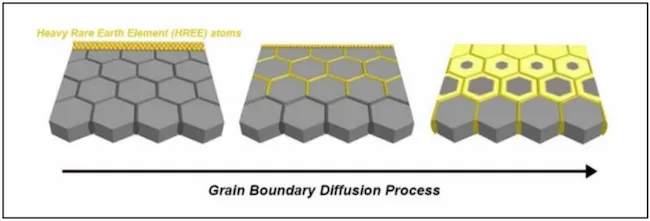
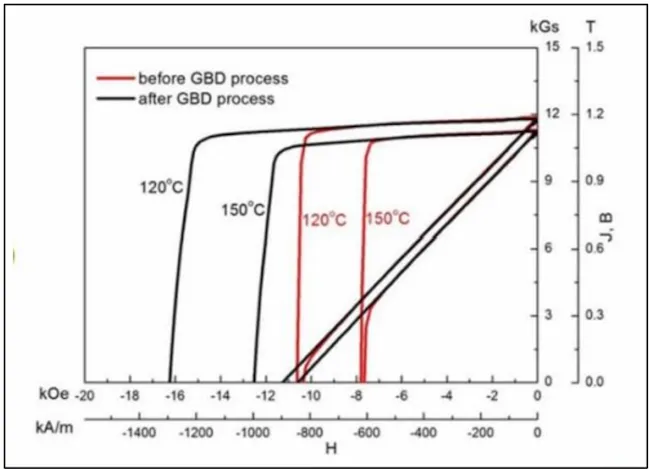
With the ability to develop N–AH grade products, companies can meet the needs of various customers for NdFeB high-performance magnets. Heavy rare earth metals such as Dy, Tb or alloys and their compounds are attached to the surface of the magnet, and after high-temperature heat treatment, they penetrate into the interior of the magnet, significantly improving the intrinsic coercive field.
By regulating the rare earth grain boundary phases, the magnetic isolation effect of the magnet grain boundary is strengthened. The brand range of products without heavy rare earths is expanded, and the Hcj of magnet with high-abundance rare earths is significantly improved.
Through the advanced powder-making process, together with the whole process of strict oxygen control process effectively solves the manufacturing difficulties caused by the grain refinement, and realizes the large-scale mass production of fine crystal magnets.
- Improvement of dendrite width of cast film
- Improvement of airflow crushing efficiency
- Reduce the total amount of CON
- Lower Cost of Materials ≥ 7%
- Integrated Cost Reduction 3%
- Reduced Use of Heavy Rare Earths ≥ 10%

| Technology Name | Content | Applications |
| Fine grain technology | It can produce finer particles while ensuring good particle size distribution, thereby ensuring the consistency of product performance, and has the characteristics of low heavy rare earth and high temperature resistance. | Products in all fields |
| Grain boundary penetration technology | The rare earth amorphous alloy containing heavy rare earth powder can be coated on the surface of the product, and the heavy rare earth atoms can be diffused from the surface of the product to the center of the product under high temperature vacuum conditions. The adding method changes from adding the entire magnet to adding at the grain boundary of the magnet. The grain boundary accounts for a relatively small volume in the magnet, so this technology can significantly reduce the amount of heavy rare earth added by 60%. | Energy-saving variable frequency air conditioners and new energy vehicles and auto parts fields |
| One-time molding technology | In the oriented pressing process, automatic powder weighing and automatic feeding can be realized, and tile-shaped or other heterogeneous specifications of blank products can be directly pressed, thereby reducing the subsequent machining cost and grinding amount of the product. | Products in the fields of wind power generation and energy-saving elevators |
| New coating technology with high corrosion resistance | The nanocomposite material is coated on the surface of the product through automatic spraying. This coating has higher salt spray and high temperature resistance than ordinary coatings. | Products in the field of new energy vehicles and auto parts |
| Formula system | Able to design alloy compositions of different brands of magnetic materials to reduce the amount of medium and heavy rare earth added while ensuring magnet performance. | Products in all fields |
For more blog articles click here
To view GDC market research reports click here
About us
GDNM provides commentary on how energy transition minerals contribute towards the decarbonisation and electrification of the global economy, with a particular focus on the lithium-ion battery and rare earths supply chains.
GDNM founder, Mr Brendan Jephcott is an Australian who has worked in the global mining sector for more than 13 years, of which his experience covers precious metals, nonferrous metals, ferrous metals, base metals, bulk commodities, rare earths, and the lithium-ion battery industry.
For the last 9 years Mr Jephcott has focused on the burgeoning new energy industry, participating in cross-border transactions in buy-side and sell side roles, cultivating a global business network ranging from upstream resource companies, midstream intermediate product producers, and downstream consumers such as gigafactories and auto companies.