Silicon-Based Anode Material Key Features
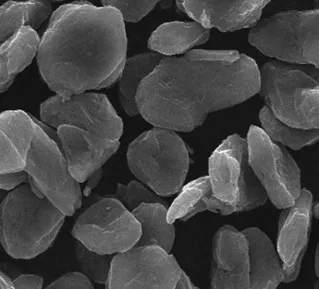
Silicon-based anode material (Si/C) is on track to become the next-generation anode material for application in electric vehicles and consumer electronics.
Silicon based materials such as pure silicon (Si), silicon monoxide (SiO), and silicon dioxide or silica (SiO2) are considered promising candidates for anodes of lithium-ion batteries. The theoretical capacities of silicon dioxide, silicon monoxide, and silicon are ∼1963, 2675, and 4200 mAh/g, respectively. In addition, silicon is environment-friendly and abundant in the earth’s crust.
The large difference in capacity between silicon and graphite arises because in the lithiation/de-lithiation process a silicon atom can bond with up to about four lithium ions (stoichiometry of Li4.4Si/Li22Si5) while it takes six carbon atoms to bond with only one lithium ion. The lithium storage mechanism of Si is different from the intercalation lithium storage mechanism of graphite. Si achieves lithium storage by alloying and dealloying with Li+. During the lithiation process of silicon materials, crystalline Si and amorphous lithium-silicon alloys coexist.
There are two main challenges faced when using silicon as the anode material, the first being high-volume expansion (~ 300%) during the insertion and extraction reactions of lithium ions and second being poor electric conductivity (in the range of 10−5 – 10−3 S/cm) and poor Li-ion diffusivity (ranging from 10−14 to 10−13 cm²/s). Solutions include preparation of nanosilicon particles to alleviate the expansion of silicon and compounding with carbon giving silicon/carbon (Si/C) hybrid anodes where silicon acts as the active material that provides high capacity and carbon improves the conductivity.
In order to solve the problems of fast cycle attenuation, low first efficiency, pole piece expansion, low conductivity and problems caused by the volume expansion of silicon-based anode material materials during the lithium insertion process, researchers in China have been improving the battery cells and materials for many years, forming generations of silicon-based anode material mainly based on silicon oxygen and silicon carbon.
Grinding Silicon Carbon
BTR was the first to use grinding method to prepare silicon carbon anode material. The silicon carbon anode material prepared by grinding or sand milling can effectively reduce the particle size of the powder, and adjust the size distribution at the same time, helping to alleviate the stress and deformation of silicon during the process of lithium-ion insertion and extraction.
However, it is difficult to grind the particles to less than 100nm in this way, the particle size of the material is still large, the particle size distribution cannot be effectively controlled, and the particle agglomeration phenomenon is obvious. In addition, impurities are easily introduced during the grinding process, and the purity is low. Larger nano-silicon particles will have a faster capacity decay as the battery cycles, resulting in a cycle of less than 500 cycles. Therefore, ground silicon carbon can only be used in some rate-type batteries with low cycle requirements.
Silicon Oxygen Materials
Silicon oxide has a smaller volume expansion (220%) during lithium insertion, so the cycle stability is significantly improved compared to pure silicon anodes. However, silicon oxide anodes have a low first coulombic efficiency, which is due to the reaction of lithium ions with silicon oxide materials to generate lithium oxide and lithium silicate, which irreversibly consumes lithium ions. Therefore, silicon oxide materials generally require pre-lithium or pre-magnesium.
Lithium/Pre-magnesium Silicon Oxygen
Silicon oxide consumes a large amount of lithium ions in the process of lithium extraction to form lithium oxide and lithium silicate, which not only soars in cost, but also leads to a low first efficiency of the material, which is far from meeting the requirements of the full battery for the anode material. In order to improve the first efficiency, pre-lithium and pre-magnesium doping technologies are mainly used.
However, pre-lithium and pre-magnesium silicon-oxygen materials still face many problems. At present, the industry has modified the materials by uniform deposition of silicon-magnesium and low-temperature coating, but the performance of pre-physical and pre-magnesium silicon-oxygen materials themselves is still limited. At the same time, the cost of pre-lithium is too high, which makes pre-lithium silicon-oxygen have no competitive advantage over new silicon-carbon.
In addition, the relevant patents of pre-magnesium and pre-lithium are mainly in the hands of overseas manufacturers such as Shin-Etsu of Japan and Samsung of South Korea. In view of the various limitations of the application of silicon-oxygen anode material, a new type of silicon-based anode material material-new vapor-deposited silicon-carbon has gradually attracted the attention of the industry.
CVD Silicon-Carbon
The battery technology innovation brought about by the advent of the new vapor-deposited silicon-carbon material has been widely recognized in the industry, laying the foundation for the main development route of silicon-based anode material, and truly realizing the path of driving capital investment and strengthening industrial development from the innovation of materials science.
Compared with SiOx, Si/C materials use silicon particles as active materials, so their first-cycle coulomb efficiency is higher and the gram capacity can reach more than 1750mAh/g. Secondly, Si/C materials use the CVD method to load nano-silicon into porous carbon. The cavity of the porous carbon retains enough space to facilitate the expansion of the silicon anode material. The interface between the electrode material and the electrolyte remains stable, without violent expansion, and has excellent cycle performance.
| Category | Traditional Silicon-Carbon Anode | Pre-lithiated SiOx Anode Material | New CVD Si/C Anode Material |
| Preparation Process | Ball milling | Heat treatment | CVD (Chemical Vapor Deposition) |
| Structural Features | Si ≥ 50nm; granular with loose pores | Si ≤ 5nm; silicon oxide with loose pores | Si ≤ 10nm; porous with loose pores |
| Specific Capacity | Low capacity, ≤ 650mAh/g | High capacity, ≤ 1450mAh/g | High capacity, ≥ 1750mAh/g |
| Initial Efficiency | Relatively high | Low, requires pre-lithiation | High |
| Cycle Performance | Poor cycle performance, ≤ 500 cycles | Good cycle performance, ≥ 1000 cycles | Excellent cycle performance, ≥ 1200 cycles |
| Disadvantages | Large particle size, prone to impurities, low purity; difficult to control particle size distribution effectively | Li₂O and other inactive substances reduce conductivity; SiOx material has low initial efficiency (~70%) | Difficulties in achieving uniformity in large-scale production |
| Advantages | Simple process | Improved stability and significant capacity enhancement during cycling | Low swelling rate, excellent cycling performance; cost-effective due to simplified production processes |
Commercialisation of silicon-based anode material
Silicon-based anode material have been commercialized in 3C electronic products and have been tried in small batches in power batteries and new energy vehicles due to their high energy density and fast charging performance advantages.
China’s new energy vehicle market is developing rapidly and constantly iterating, which has also promoted the rapid development of the silicon-carbon anode material industry. It is estimated that by 2030, the global new silicon-carbon anode industry, including the 3C and power markets, will have a market size of 30 billion CNY, corresponding to a new silicon-carbon anode shipments of about 130,000-150,000 tonnes.
Silicon-based Anode Material Enterprises
In China, companies in the silicon-based anode material industry can be divided into four categories as follows:
- Existing graphite anode enterprises such as BTR New Material Group Co., Ltd, Shanshan Group Co., Ltd, Shanghai Putailai New Energy Technology Co., Ltd, Jiangxi Zhengtuo New Energy Technology Co., Ltd, Hunan Zhongke Electric Co., Ltd, and Shenzhen XFH Technology Co., Ltd,
- Founders coming from scientific research institutions such as Liyang Tianmu Pilot Battery Material Technology Co., Ltd, and Beijing Yijin New Energy Technology Co., Ltd,
- Lithium-ion battery manufacturing companies such as Contemporary Amperex Technology Co., Ltd, Guoxuan High-tech Co., Ltd, Tianjin Lishen Battery Joint-Stock Co., Ltd, and Xingheng Power Supplies Co., Ltd, and
- Chemical companies or silicon material companies such as Shinghwa Advanced Material Group Co., Ltd, Xinan Co., Ltd, and Silicon Treasure Technology Co., Ltd.
According to incomplete statistics, the total production capacity of silicon-carbon and silicon-oxygen has reached about 53,000 tonnes, and the under-construction and planned capacity exceeds 500,000 tonnes.
For more blog articles click here
To view GDC market research reports click here
About us
GDNM provides commentary on how energy transition minerals contribute towards the decarbonisation and electrification of the global economy, with a particular focus on the lithium-ion battery and rare earths supply chains.
GDNM founder, Mr Brendan Jephcott is an Australian who has worked in the global mining sector for more than 13 years, of which his experience covers precious metals, nonferrous metals, ferrous metals, base metals, bulk commodities, rare earths, and the lithium-ion battery industry.
For the last 9 years Mr Jephcott has focused on the burgeoning new energy industry, participating in cross-border transactions in buy-side and sell side roles, cultivating a global business network ranging from upstream resource companies, midstream intermediate product producers, and downstream consumers such as gigafactories and auto companies.