Rise of Continuous Graphitisation
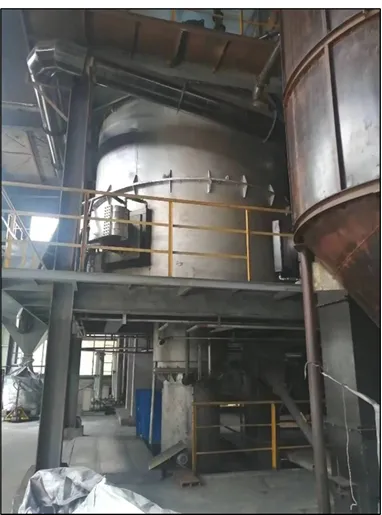
The continuous graphitisation furnace is expected to become the future development direction. The continuous graphitisation furnace method involves the raw materials continuously enter the heating furnace. Moreover, the so-called ‘continuous’ means that there is no power-off process during the production process, and the graphitised products passed through a series of temperature zones in the furnace, and are moved and heated in the furnace, so as to realise the continuous production of the graphitisation process. After graphitisation, it enters the cooling zone for cooling.
Raw Materials Handling
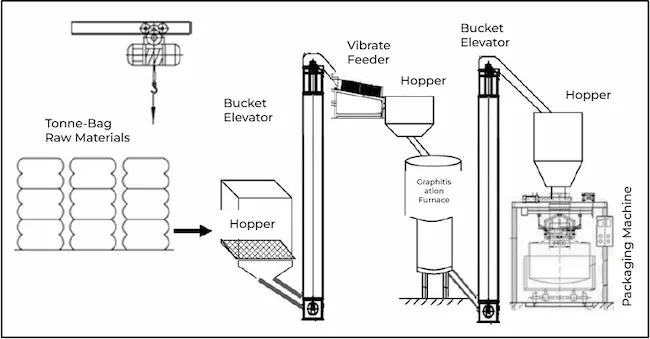
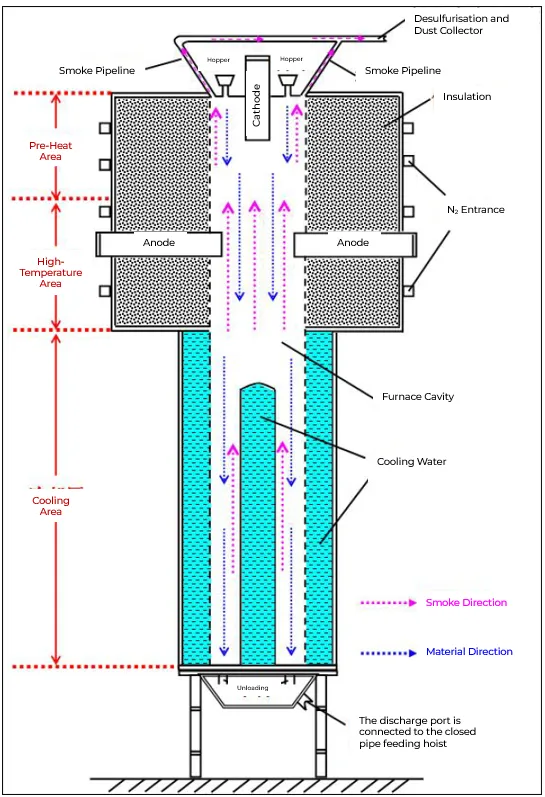
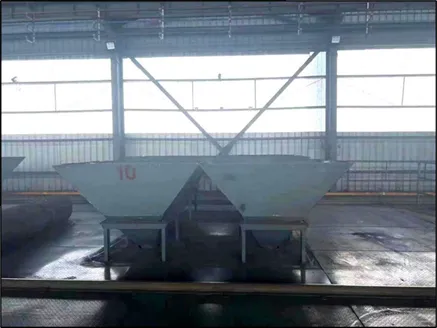
The raw materials, prepared bulk petroleum coke, in the graphitisation furnace hopper enter the furnace cavity of the graphitisation furnace through a closed pipe by their own weight. The nitrogen generator is turned on while feeding. The nitrogen generated by the nitrogen generator is passed into the graphitisation furnace through a pipe to protect the product from oxidation and ensure that the entire production process is isolated from the air. The graphitisation furnace is equipped with cathode and anode material. Power is transmitted through a rectifier transformer, and the material generates resistance heat.
Heating Process
The continuous graphitisation furnace is divided into three zones from top to bottom:
- Preheating zone (2m, temperature about 1400-1500°C)
- High temperature zone (2m, temperature about 2800-3000°C)
- Cooling zone (8m, temperature about 200-150°C)
The material moves from top to bottom in the furnace, and the flue gas flows from bottom to top. The material absorbs the heat of the flue gas from the high temperature zone in the preheating zone for preheating. The preheated material enters the high temperature zone for graphitisation.
The resistance heat is used to heat the carbonaceous material. Therefore, when the temperature reaches 2300°C, the carbonaceous material begins to graphitize. When the temperature reaches 3000°C, the entire graphitisation process is completed. The entire graphitisation production process is continuously powered on and nitrogen is continuously passed. Therefore, as the lower part discharged, the material layer in the furnace moves downward, and the raw materials complete graphitisation.
Cooling Process
The products that have completed graphitisation enter the cooling zone at the bottom of the graphitisation furnace for cooling. Indirect water cooling is used to reduce the product temperature to below 150 degrees. Then the products are discharged through the closed feed plate at the bottom of the furnace. The products enter the discharge elevator through a closed pipe and are lifted to the hopper of the packaging machine.
Mmorevoer, the products in the hopper are naturally cooled to room temperature and then packaged and stored. During packaging, the packaging machine is sealed and connected to the packaging bag. In order to ensure the cooling effect of the product and prevent the formation of scale in the cooler, pure water is used for cooling water in the cooling zone of the graphitisation furnace, which is recycled and replenished regularly.
Furnace
The graphitisation furnace is a closed furnace body, and the sealing of the furnace body feed port is sealed by the raw material itself in the silo. Therefore, the material feeding will bring in a small amount of air, but the entire furnace cavity is filled with nitrogen to discharge the air in the furnace cavity to avoid product oxidation. Moreover, a closed flue gas collection pipe is installed on the top of the furnace, and the waste gas (particulate matter, SO2, a small amount of nitrogen oxides and nitrogen) is collected and then enters the environmental protection facility for treatment.
The continuous graphitisation furnace integrates multiple processes such as furnace cleaning, furnace loading, power on, cooling, and unloading in batch production, thereby improving production efficiency, reducing power consumption, and is easy to automate. However, the equipment maintenance and depreciation costs of the continuous graphitisation furnace are very high, and the process problems such as furnace insulation and discharge intervals still need to be solved.
| Crucible Method | Box Method | Continuous Method | |
| Loading capacity of a single furnace (t) | 20-30 | 50-60 | / |
| Heating method | Mainly for resistance material heating | Body graphite plate heats up | Electrode heats up |
| Temperature (ºC) | 3,100 | 3,050 | 2,800-3,000 |
| Unit power consumption (kWh/t) | 10,000-15,000 | 7,500-12,500 | 6,000-7,000 |
| Production cycle (days) | 20-25 | 40 | / |
| Daily output (t) | 1 | 1.2 | / |
| Product capacity (mAh/g) | 353.8 | 353.1 | 346.8 |
| Product first effect (%) | 93.9% | 93.4% | 93.1% |
| Product specific surface area (m2/g) | 1.92 | 2.29 | 1.4 |
| Graphitisation degree (%) | 96.38 | 95.82 | 93.73 |
| Auxiliary materials | Need to fill with insulation and resistance material | No resistance material is needed, only insulation between the box body and the furnace wall is required | / |
| Product stability | Very high | Very low | Very low |
| Product uniformity | Very high | Very low | Very low |
| Production difficulty | Simple | Complex | Complex |
| Crucible Type | Crucible Furnace (Acheson furnace) | Inner Skewer Furnace | Box Furnace | Continuous Furnace |
| Advantages | Mature technology, large output, safe and reliable, good product homogeneity, simple operation and wide application | Mature technology, short cycle, safe and reliable, good product quality, suitable for the production of high-quality anode materials | High output and relatively low energy consumption | High output, simple process, low energy consumption and short cycle |
| Disadvantages | High energy consumption and complex loading and unloading process | Low output (17-22t/furnace) and high crucible cost (9,000 CNY/piece) | Long production cycle (generally 40-55 days), poor homogeneity, and poor safety | Furnace type, immature technology, and poor product quality |
For more blog articles click here
To view GDC market research reports click here
About us
GDNM provides commentary on how energy transition minerals contribute towards the decarbonisation and electrification of the global economy, with a particular focus on the lithium-ion battery and rare earths supply chains.
GDNM founder, Mr Brendan Jephcott is an Australian who has worked in the global mining sector for more than 13 years, of which his experience covers precious metals, nonferrous metals, ferrous metals, base metals, bulk commodities, rare earths, and the lithium-ion battery industry.
For the last 9 years Mr Jephcott has focused on the burgeoning new energy industry, participating in cross-border transactions in buy-side and sell side roles, cultivating a global business network ranging from upstream resource companies, midstream intermediate product producers, and downstream consumers such as gigafactories and auto companies.