Main reasons why anode material is important
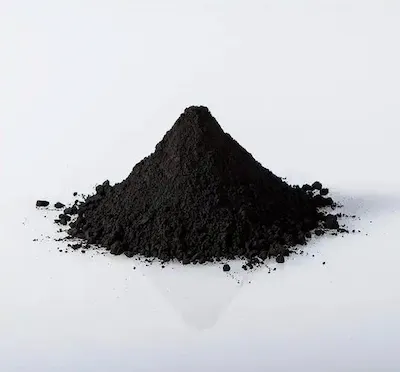
Anode material is the negative electrode in high-performance rechargeable lithium-ion batteries and is paired with cathode in a lithium-ion cell. The anode acts as the host where it allows lithium-ion intercalation and deintercalation during the charge and discharge cycles.
Moreover, the anode should have the lowest possible electrode potential, high Li+ migration rate, high Li+ intercalation/deintercalation reversibility, good electrical conductivity and thermodynamic stability.
Anode Material Product Characteristics
Anode material generally needs to meet the following characteristics:
- Low first cycle irreversible loss
- High coulombic efficiency
- Fast lithium-ion diffusion into and out of the anode
- High ionic and electronic conductivity
- Minimum structural changes upon charge and discharge
- High specific capacity (mAh/g)
- Ability to form and maintain a stable solid electrolyte interface (SEI) layer upon cycling.
Product Categories
Products are mainly divided into two categories as either carbon-based or non-carbon based.
Carbon-based material is mainly subdivided into synthetic graphite anode material or natural graphite anode material. Other types include composite material, mesophase carbon microspheres, graphene-based material, and disordered carbon (hard carbon and soft carbon) material.
Non-carbon anode material is subdivided lithium titanate material, tin-based alloy material, silicon-based anode material, and other non-carbon anode material. At present, natural graphite and synthetic graphite anode material are most commonly used today.
Principal Production Methods
Natural graphite anode material: uses natural flake graphite as the main raw material. Of which, this material has its own crystal structure and does not require graphitisation. Simply put, natural graphite anode material is made through crushing, spheroidisation, purification, surface treatment, and other processes.
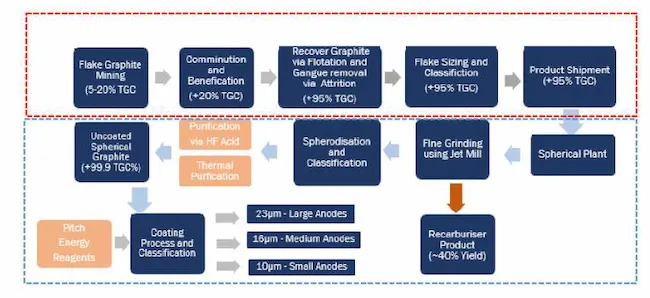
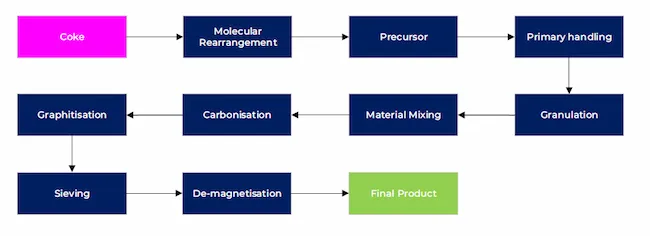
Synthetic graphite anode material: is made through a process called “graphitisation”. Of which, graphitisation is the structural change from disordered carbon atom structures towards a perfect three-dimensional crystal of pure graphite. Moreover, this process mainly involves heating non-graphitic carbon materials to a temperature above 2,800°C in a high-temperature electric furnace. Resulting in transforming the non-graphitic carbon material into an ordered graphite structure.
Mainstream incumbent graphitisation processing manufacturers use the crucible graphitisation processing method. Going forward, improving furnace loading efficiency is key to achieving cost reduction and differentiation for the incumbent graphitisation processing manufacturers.
Commercialisation
Global anode shipments reached 1.55 million tonnes in 2022, a year-on-year increase of 71.9%. China’s shipments of anode materials reached 1.43 million tonnes in 2022, up 84.0% yoy.
Today, more than 90% of the world’s anodes are produced in China. Of which, in 2022, China’s synthetic graphite shipments will be 1.15 million tonnes, accounting for 84%. Moreover, the natural graphite shipments will be 205,500 tonnes, accounting for 15%. Lastly shipments of other anode materials will be 14,000 tonnes, accounting for 1%.
The rapid development of the global new energy vehicle market led to a serious shortage of China’s mid-to-high-end anode materials in 2021-2022. In order to meet the downstream market demand for mid-to-high-end power batteries and keep pace with the capacity expansion of upstream and downstream leading power battery manufacturers, incumbent manufacturers expanded their production capacity one after another.
Moreover, with the gradual release of the expanded production capacity of various companies in 2021-2022, the market may shift from a shortage of supply to a balanced market, or even overcapacity in 2023.
Global production capacity reached 1.1 million tonnes in 2022, of which production capacity from Chinese manufacturers reached 940,000 tonnes, accounting for 85% of global production. Lastly production capacity of South Korea and Japan 160,000 tonnes is only expected to account for 15%.
Importance of ESG
Firstly, it should be noted, ESG considerations are becoming increasingly important in the synthetic graphite industry. Secondly, this is driven by a combination of investor and consumer demand, regulatory pressures, and environmental impact of synthetic graphite production. Lastly, companies in the sector are responding by adopting ESG policies and seeking to reduce their carbon footprint.
Competitive Landscape
Firstly, the Chinese material market is led by four major producers consisting of BTR New Material Group Co., Ltd, Shanghai Putailai New Energy Technology Co., Ltd subsidiary Sichuan Zichen Technology Co., Ltd, Ningbo Shanshan Co., Ltd, and Guangdong Kaijin New Energy Technology Co., Ltd. Moreover, these four producers had a combined market share exceeded 61.5% in 2022.
In addition, other major producers, include Shijiazhuang Shangtai Technology Co., Ltd (“Shangtai”), Hunan Zhongke Electric Co., Ltd (“Zhongke”), and Shenzhen XFH Technology Co., Ltd (“Xiangfenghua”). Moreover, these four producers had a combined market share exceeded 24.8% in 2022.
Lastly, outside of China, anode material production comes from South Korea and Japan, of which production is stagnated at around 53,000 tonnes. However, with a renewed interest in anode material, planned production capacity expansion coming.
For more blog articles click here
To view GDC market research reports click here
About us
GDNM provides commentary on how energy transition minerals contribute towards the decarbonisation and electrification of the global economy, with a particular focus on the lithium-ion battery and rare earths supply chains.
GDNM founder, Mr Brendan Jephcott is an Australian who has worked in the global mining sector for more than 13 years, of which his experience covers precious metals, nonferrous metals, ferrous metals, base metals, bulk commodities, rare earths, and the lithium-ion battery industry.
For the last 9 years Mr Jephcott has focused on the burgeoning new energy industry, participating in cross-border transactions in buy-side and sell side roles, cultivating a global business network ranging from upstream resource companies, midstream intermediate product producers, and downstream consumers such as gigafactories and auto companies.