LMFP Cathode Material Processing Methods
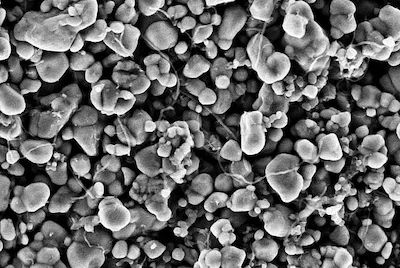
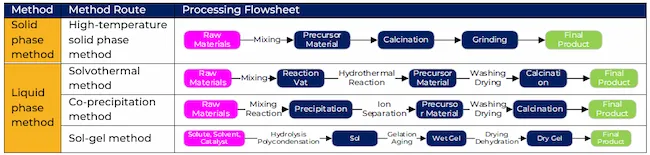
Firstly, the preparation method of LMFP cathode material is similar to that of LFP with two categories, being the solid phase methods and the liquid phase methods. Solid-phase methods include the high-temperature solid-phase method and the carbothermic reduction method.
Moreover, the liquid-phase methods include the hydrothermal method, sol-gel method and co-precipitation method. Each method has its own advantages and disadvantages. Iron and manganese need to form a uniform solid solution to produce high-quality LMFP.
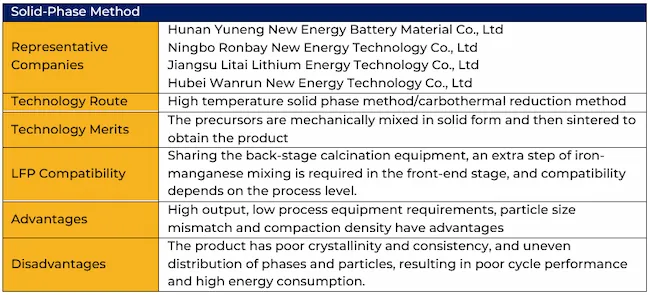
LMFP Cathode Material Solid-Phase Processing Method
Notably, the solid phase method uses mechanical grinding to mix raw materials to ensure compaction density, and then coats the surface with carbon source through sintering to improve conductivity. The advantage is that the process is simple, the equipment requirements are low, and it is easy to produce on a large scale. However, the disadvantage is that the product consistency is poor and it is difficult to control the particle size distribution and morphology.
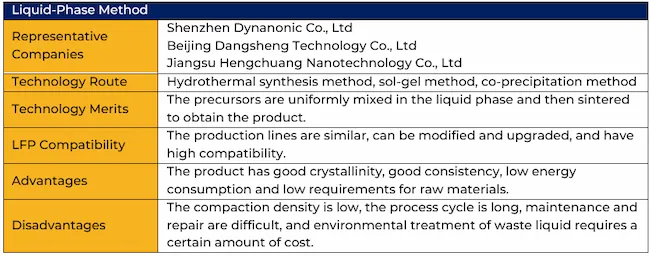
LMFP Cathode Material Liquid-Phase Processing Method
Furthermore, in terms of the liquid phase method, precursors are uniformly mixed in the liquid phase and then sintered to obtain the product. Liquid phase methods have the advantage of the raw materials can be mixed more uniformly at the molecular level and the size and morphology of the product are controllable, realising a high-quality product with small particle size, good ferromanganese dispersion, and high product consistency. The disadvantages are complex processes, high equipment requirements, and difficult process control.
Examples (refer to: Golden Dragon Capital LMFP Cathode Material Industry Research Report)
- Tianjin Skoland and Wanrun New Energy: adopt the solid-phase method. Dynanonic Co., Ltd, and CATL adopt the hydrothermal method and sol-gel method, whereas Litai Lithium and Dangsheng Technology adopt the co-precipitation method. Skoland Technology next-generation will use an integrated liquid and solid-phase method. For ternary cathode companies LMFP production lines are either self-developed or can be acquired, and the latter stage (except the precursor) may be made with ternary equipment, which has a certain degree of synergy, and it is complementary with the research of compounding ternary material with LMFP cathode material.
- Skoland Technology: mainly adopts high-temperature solid-phase method for synthesis. After uniformly mixing the required raw materials, it is then sintered at high temperature to obtain lithium iron manganese phosphate, which is then compounded with ternary materials for supply.
- CATL: mainly uses the solvothermal method to prepare lithium iron manganese phosphate. Dissolve the required raw materials in the solvent and configure it into a uniform solution. Transfer it to the reactor to react to obtain the precursor, which is then dried and sintered to obtain lithium iron manganese phosphate.
- Shenzhen Dynanonic: mainly uses the sol-gel method to prepare lithium iron manganese phosphate. The lithium source, manganese source, phosphorus source and iron source are mixed and dissolved in proportion to obtain a liquid slurry. The water is removed and crushed to obtain a powder. The precursor is then sintered and pulverized to obtain lithium iron manganese phosphate.
- Litai Lithium Energy: mainly uses the co-precipitation method. First, the iron-manganese-containing precursor is obtained through the co-precipitation method, and then the precursor is evenly mixed with the lithium source and carbon source and then sintered to obtain lithium iron manganese phosphate.
LMFP Cathode Material Specific Capacity
The specific capacity of LMFP cathode material is close to the level of LFP cathode material, and it has more energy density advantages. The nanoscale carbon-coated LMFP cathode material prepared by Shenzhen Dynanonic Co., Ltd 1C discharge specific capacity can reach 153.4 mAh/g. The 1C discharge specific capacity of the LMFP cathode material prepared by the ion exchange membrane process can reach 151.5 mAh/g. The 1C discharge specific capacity of LMFP composite material reaches 155.7 mAh/g. It is coated with lithium nickel cobalt manganate
Furthermore, Jiangsu Litai Lithium Energy Technology Co., Ltd lithium-doped magnesium ion composite material has a 1C discharge specific capacity of 143 mAh/g, and the LMFP material prepared using precursor homogenization technology has a 1C discharge specific capacity of 140 mAh/g.
Moreover, Gotion Hi-Tech Group Co., Ltd’s LFP/carbon-coated core-shell LMFP composite has a 1C discharge specific capacity of 152 mAh/g. Compared with the specific capacity level of 145-160mAh/g of LFP materials, the specific capacity limit of LMFP has been greatly reduced. Coupled with the high voltage characteristics, LMFP will have more energy density advantages.
For more blog articles click here
To view GDC market research reports click here
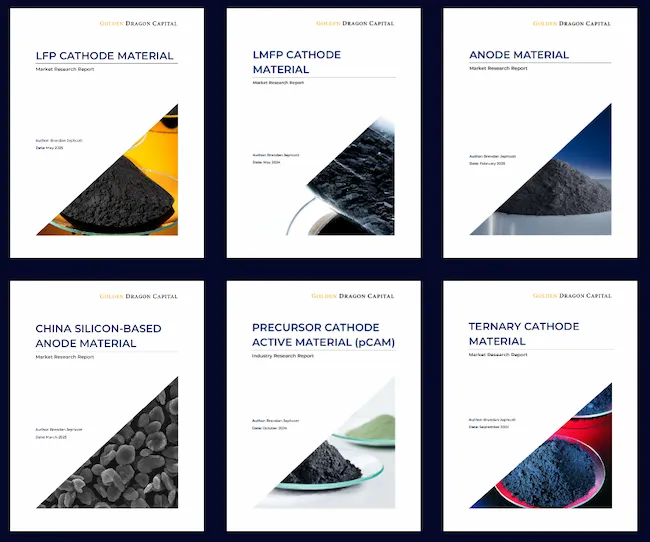
Golden Dragon Capital Limited | Comprehensive Market Research Reports
About us
GDNM provides commentary on how energy transition minerals contribute towards the decarbonisation and electrification of the global economy, with a particular focus on the lithium-ion battery and rare earths supply chains.
GDNM founder, Mr Brendan Jephcott is an Australian who has worked in the global mining sector for more than 13 years, of which his experience covers precious metals, nonferrous metals, ferrous metals, base metals, bulk commodities, rare earths, and the lithium-ion battery industry.
For the last 9 years Mr Jephcott has focused on the burgeoning new energy industry, participating in cross-border transactions in buy-side and sell side roles, cultivating a global business network ranging from upstream resource companies, midstream intermediate product producers, and downstream consumers such as gigafactories and auto companies.