Lithium-ion Battery Separator Prevent Short Circuits
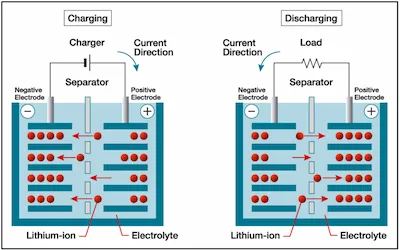
In order to prevent a short circuit between the two electrodes in a lithium-ion battery, the separator, a porous membrane, is placed between the anode and cathode.
The separator does not participate in any battery cell reactions, it is permeable to the ionic flow, but prevents physical electric contact of the electrodes.
Modern separator technology also contributes to a cell’s thermal stability and safety.
At present, mainstream lithium-ion battery separator products are dominated by microporous membranes made of polyolefin, such as polypropylene (PP) and polyethylene (PE) which are favoured for their chemical and electrochemical stability, high mechanical strength, uniform pore size, and inexpensive manufacturing and materials cost. The separator is a key element to ensure safe cell operation under vigorous conditions. Therefore, certain properties are required for a high-performance separator.
| Parameters | Requirements |
| Thickness | 20-25 μm |
| Porosity | 40-60% |
| Pore size | <1 μm |
| Permeability (Gurley) | 0.025 s μm–1 |
| Wettability | Penetrate thoroughly and quickly |
| Ionic conductivity | 10–3 to 10–1 S cm–1 |
| Tensile strength | <2% offset at 1000 psi |
| Puncture Strength | >300 g/mil |
| Dimensional stability | Lay flat and no curl up |
| Thermal shrinkage | <5% shrinkage after 60 min at 90oC |
| Shutdown temperature | PE ~130oC, PP ~160oC |
| Chemical and electrochemical stabilities | Long term stability |
Producing a microporous separator can be divided into two processes, the dry process and the wet process. They both use an extruder and can be made a continuous process with polymer resin, mineral oil and additives in, and the separator film out. The main raw material for the dry process separator is PP while the main raw material for the wet process is PE.
The microporous polyolefin separator limitations are:
- Its thermal stability due to the low melting point and glass transition temperature of polyolefin membranes
- The low wettability due to the hydrophobic nature of polyolefin polymers. It is of great commercial interest to increase the meltdown temperature as much as possible or minimise the thermal shrinkage while maintaining a reasonably low shutdown temperature and secondly achieve high wettability with electrolytes. This can be achieved by coating functional layers on the surface of the polyolefin separator during the manufacturing process.
The two main types of separator coating material are inorganic material and organic material. Inorganic coating materials are ceramic particles, represented by alumina and boehmite and organic coating materials are represented by polyvinylidene fluoride (PVDF) and aramid.
The two can be used alone or in combination during coating. The key performance indicators for separator coating material in lithium-ion battery application are particle size distribution, magnetic foreign matter content, water absorption, purity, hardness and specific gravity.
Due to the limitations of inorganic and organic coating material off setting each other, a variety of coating structures are used to meet different battery requirements.
The current mainstream coating methods in the market include single-sided single-layer inorganic coating, double-sided single-layer inorganic coating, double-sided single-layer organic & inorganic coating, single-layer double-layer organic & inorganic coating, double-sided double-layer organic & inorganic coating and double-sided single-layer organic & inorganic mixed coating.
Commercialisation
The global separator competition landscape is dominated by four countries, with China, South Korea, Japan and the United States holding market shares of 43%, 28%, 21%, and 6% respectively.
The production of dry process separators is primarily concentrated in China, with limited production in the United States and Japan.
On the other hand, wet process separators are manufactured in several countries, including China, Japan, South Korea, the United States, Poland, and Hungary.
The separator industry is characterised by high barriers to entry such as technical thresholds, specialised equipment, capital intensive, customer stickiness, production scaling, R&D technology and challenging profitability, resulting in a concentrated market competition pattern.
From 2019 to 2022, China’s competitive landscape solidified through various mergers and acquisitions, consolidating small-to-medium enterprises with smaller production lines, leading to a clear industry hierarchy with SEMCORP emerging as the leader, joined by Shenzhen Senior Technology Material Co., Ltd and Sinoma Science & Technology Co., Ltd, collectively forming a stable top three in the battery separator industry.
Dry process separators are mainly used in buses, electric tools, and energy storage, while wet process separators will be mainly used in passenger cars and consumer electronics. As the new energy vehicle sector shifts from policy-driven to market-driven dynamics, manufacturers are raising safety, endurance, and battery life standards. A notable trend is the move towards lighter and thinner separators, which increases lithium-ion battery energy density.
In 2023, China’s lithium-ion battery separator shipments will reach 17.69 billion square metres, a year-on-year increase of 33%, of which wet-process separator shipments will reach 12.94 billion square metres and dry-process separator shipments will reach 4.75 billion square metres.
The global shipment volume of lithium-ion battery separators exceeded 21 billion square metres in 2023, and the global share of shipments from Chinese separator companies surpassed 83% in the same year.
Price
Shanghai Metal Markets (SMM) provide prices for separator (diaphragm) material (1 USD ~ 7 CNY) on a daily basis (excluding weekends and Chinese holidays)
As of 2023, with new production capacities deployed alongside a slowdown in short-term demand growth, the battery separator industry quickly transitioned from a supply shortage to a tight balance between supply and demand.
Consequently, prices are under downward pressure. In this evolving landscape, leading companies with stronger profit margins are gaining greater bargaining power within the industry. Only firms that successfully navigated previous cycles and achieved economies of scale can maintain sufficient cost competitiveness.
Market Size Potential
The following separator market outlook is provided by Orient Securities in their report dated 18 December 2023. 1The lithium-ion battery separator material market is expected to usher in a growth period over the following couple of years due to the unit consumption of the separator decreasing slightly as the separator has changed to become thinner and stronger, and the unit material consumption will decrease slightly.
Chinese companies are accelerating their capacity expansion, and their global market share is expected to continue to increase. The production capacity and expansion plans of major Chinese and overseas separator companies has been tabulated. Since overseas separator manufacturers are more cautious in their expansion plans, it is believed that the future development of the separator market will still focus on the China market.
Globally, new energy vehicles maintain a rapid development trend, and the energy storage market is also expected to contribute considerable growth. In addition, lithium-ion batteries are also widely used in consumer digital, power tools, light power and other fields, and the demand scenarios are becoming increasingly rich.
At present, the single GWh consumption of wet separators is about 18 million square metres, and the main application areas are power batteries and consumer batteries. The single GWh consumption of dry separators is about 20 million square metres, which are mainly used in energy storage and small power batteries.
Considering that the single GWh consumption of dry and wet separators has a downward trend year by year, assuming that the single GWh consumption of wet/dry lithium-ion battery separators will drop to 15/18 million square metres respectively by 2025, it is estimated that the global separator market will maintain a considerable growth rate in the future, and global separator demand will exceed 37 billion square metres by 2025.
For more blog articles click here
To view GDC market research reports click here
Golden Dragon Capital Limited | Comprehensive Market Research Reports
About us
GDNM provides commentary on how energy transition minerals contribute towards the decarbonisation and electrification of the global economy, with a particular focus on the lithium-ion battery and rare earths supply chains.
GDNM founder, Mr Brendan Jephcott is an Australian who has worked in the global mining sector for more than 13 years, of which his experience covers precious metals, nonferrous metals, ferrous metals, base metals, bulk commodities, rare earths, and the lithium-ion battery industry.
For the last 9 years Mr Jephcott has focused on the burgeoning new energy industry, participating in cross-border transactions in buy-side and sell side roles, cultivating a global business network ranging from upstream resource companies, midstream intermediate product producers, and downstream consumers such as gigafactories and auto companies.