Lithium-ion Battery Precision Structural Parts
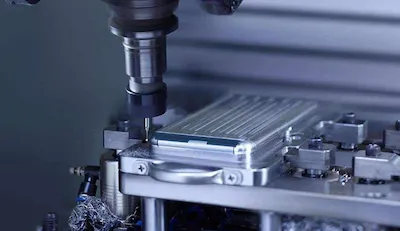
Lithium-ion battery precision structural parts refer to the casing components that make up the battery being the outer shell and cover plate. These structural components typically require high manufacturing precision, stability, and reliability to ensure the performance and safety of lithium-ion batteries. They are a key component of the lithium-ion battery. Manufacturing companies are required to have rich technical experience in explosion-proof design, leakage prevention, and ultra-long shell stretching of precision structural parts of batteries, and have high-precision and high-consistency production processes, as well as advanced stamping, stretching, injection molding and mold manufacturing technologies.
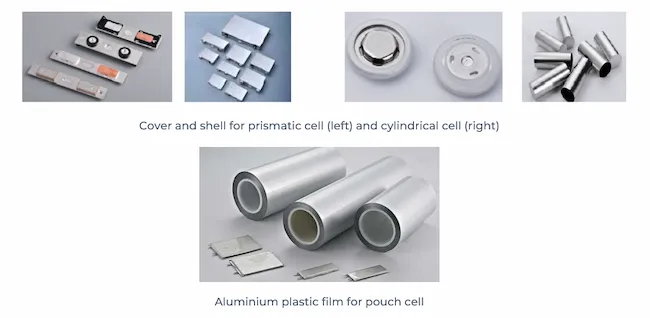
Lithium-ion battery structural parts need to be tailored for different packaging methods According to the battery packaging technology routes there are three main shapes, prismatic, cylindrical and pouch. The corresponding structural parts are hard shell square structural parts and cylindrical structural parts, both consisting of a steel or aluminium shell and a cover plate and soft shell pouch structural parts consisting of aluminium plastic film package.
Principal Processing Methods
The production process of precision structural parts includes mold design and precision manufacturing. The manufacturing processes of shells are mainly stamping (or pressing) and stretching through a die to create a round or prismatic housing while the main manufacturing processes of covers include stamping, welding, injection molding. The manufacturing processes of aluminum-plastic films include precision coating and lamination and the punch presses the film into the die to create the final shape.
In terms of equipment, the processing equipment responsible for stamping and welding is punch press, laser welding machine and friction welding machine. In China, mainstream battery cell structural parts manufacturers still mainly import overseas equipment and molds required for high-end precision stamping, especially for special equipment for mass production of cylindrical shells.
Taking Shenzhen Kedali Industry Co., Ltd, Ningbo Zhenyu Science and Technology Co., Ltd and Wujin Zhongrui Electronic Technology Co Ltd as examples, Kedali is tied to Japan’s Asahi Precision Machinery to jointly develop cylindrical shell stretching equipment, Zhenyu Technology mainly purchases Taiwan Jinfeng stretching equipment and Zhongrui Electronics cooperates with Japan’s ISIS Co., Ltd. to develop pre-nickel-plated steel shell precision stretching machines and stretching molds.
The raw materials of prismatic aluminum shell structural parts are mainly aluminum alloy, followed by copper, steel, plastic, etc.; the raw materials of aluminum-plastic film are aluminum foil, nylon, polypropylene, etc., supplemented by necessary adhesives.
Consolidating cell formats and developing common standards are well-established approaches in the automotive industry to leverage economies of scale or facilitate multi-sourcing strategies. Early on, the German Association of the Automotive Industry (VDA) and the German Institute for Standardization (DIN) proposed several industry-wide standards.
In China, the national standard “Specifications and Dimensions of Power Storage Batteries for Electric Vehicles” (GB/T34013-2017) was implemented in February 2018 and “Aluminum and aluminum alloy plates and strips for new energy power battery shells and covers” (GB/T 33824-2017) was implemented from 1 December 2017.
Commercialisation of the Lithium-ion Battery Precision Structural Parts Industry
Prismatic, cylindrical and pouches are the three main forms of cell products in the field of lithium-ion batteries currently on the market. In China, in 2023, the shipment volume of prismatic, cylindrical, and pouch batteries accounted for 93.6%, 3.4%, and 2.9% respectively, because mainstream power battery companies, such as CATL, BYD, Gotion, etc., are mainly based on prismatic battery products. Overseas, battery manufacturers such as Panasonic, LG and SK On have driven the share of cylindrical and pouch batteries. In 2024 Korea’s major battery manufacturers LG Energy Solution, Samsung SDI and SK On are shifting focus to prismatic batteries due to their superior safety compared to the pouch-type option.
In 2020, Tesla introduced the cylindrical 4680 cell format for the Model Y electric vehicle. It is reported that Tesla has achieved large-scale production of 4680 batteries in its Texas Super Factory, and plans to further expand production capacity by investing in the expansion of the Nevada factory to produce 4680 batteries. In September 2024 Panasonic Energy announced that it was ready for mass production of 4680 cylindrical automotive batteries. LG Energy Solution and Samsung SDI are nearing the mass production of Tesla’s 4680 cell design.
| Customer | Kedali | Zhenyu Tech | Ruidefeng | Changying Precision | Wuxi Jinyang | Zhongrui Electronics | SLAC Precision Equipment | SANGSIN EDP | FUJI SPRINGS | |
| China | CATL | Prismatic+ Cylindrical | Prismatic | Prismatic | Prismatic | Prismatic | ||||
| BYD | Supplier | Supplier | Supplier | |||||||
| CALB | Prismatic | Prismatic | ||||||||
| EVE | Prismatic | Prismatic | Cylindrical | |||||||
| Gotion | Prismatic | Cylindrical | ||||||||
| Sunwoda | Prismatic | |||||||||
| SVOLT | Prismatic | |||||||||
| Lishen | Prismatic+ Cylindrical | Prismatic+ Cylindrical | Prismatic+ Cylindrical | |||||||
| Overseas | LGES | Cylindrical | Cylindrical | Cylindrical | ||||||
| Tesla | Cylindrical | |||||||||
| Panasonic | Prismatic | Cylindrical | Cylindrical | |||||||
| Samsung SDI | Prismatic | Cylindrical | Cylindrical | |||||||
| Northvolt | Prismatic | |||||||||
| ACC | Prismatic | |||||||||
Competitive Landscape of the Lithium-ion Battery Precision Structural Parts Industry
The design and development of battery cell structural parts need to be well adapted to the customer’s new battery cell products, which requires downstream customers and structural parts suppliers to repeatedly run-in and continuously optimize, so battery customers generally only choose 1-2 structural parts suppliers for the same model of battery cells. Overall, the customer stickiness of lithium-ion battery structural parts is strong, and companies with first-mover advantages are more likely to form scale advantages and high-quality customer binding relationships.
In 2022, the lithium-ion battery structural parts hard-shell market size in China was 10.08 billion CNY (US$1.54 billion), of which, Shenzhen Kedali Industry Co., Ltd achieved a revenue of 4.32 billion CNY (US$617 million) from its battery structural parts business, accounting for a 42.88% market share. The top three companies in the industry include Shenzhen Kedali Industry Co., Ltd, Ningbo Zhenyu Science and Technology Co., Ltd, and Wuxi Jinyang New Materials Co., Ltd, accounting for 66.62% of China’s lithium-ion battery structural parts industry.
To view GDC Battery Precision Structure Parts Market Research Report click here
The three main barriers to entry to the lithium-ion battery precision structural parts industry are complex customer certification, high processing and equipment technology threshold, and capital intensity barriers.
Precision safety structural parts are vital for battery safety and stability, necessitating rigorous technical certification that can take 1-3 years. Gigafactories often conduct thousands of cycle tests, requiring retesting if defects are identified. This long certification period, coupled with high initial development and replacement costs, fosters strong customer loyalty. Once a supplier is certified, a trusted supply chain partnership usually develops due to the critical nature of these components and the associated risks and costs of switching suppliers.
The production of precision structural parts necessitates continuous investment in high-precision, automated equipment such as laboratory tools, stamping machines, welding equipment, and automated assembly lines. An effective structural parts manufacturer should possess independent mold development capabilities, mature quality control systems, and agility in addressing diverse customer needs. The high cost of advanced machinery requires substantial capital investment to support large-scale operations. New entrants face significant challenges in meeting these criteria quickly.
The capital investment required for a single set of structural parts production equipment in the lithium-ion battery industry is substantial, with a payback period typically ranging from 4 to 5 years. Leading gigafactory companies, which dominate the market, often negotiate extended payment terms with suppliers, necessitating significant working capital investments from those suppliers.
Lithium-ion Battery Precision Structural Parts Market Size Potential
Power batteries and structural components for energy storage batteries are still the main growth points of market demand. The scale of production capacity of power battery companies and the number of batteries in a single order have increased significantly, and the power battery market has entered a period of rapid development. The market demand for energy storage batteries is rising rapidly and is expected to maintain a rapid growth trend in the next few years. The digital battery market is becoming increasingly saturated, the growth rate is slowing.
The following precision structural parts separator market outlook is provided by Guolian Securities in their report dated 9 July 2024. Global lithium-ion battery shipments are expected to reach 2442GWh in 2026. As upstream material prices stabilize and the lithium-ion battery industry chain destocking enters its final stage, lithium-ion battery shipments are expected to accelerate. Global lithium-ion battery shipments in 2024-2026 are expected to be 1714GWh/2029GWh/2442GWh, respectively, with a three-year CAGR of 27%.
Driven by both demand and policy, the upward trend in downstream demand is the basis for the positive demand in the structural parts segment. Under the resonance of new energy demand and policy, the market size of lithium-ion battery structural parts is expected to continue to grow rapidly. In 2024-2026, the global structural parts market size is expected to be 51.5 billion, 59.7 billion, and 70.4 billion CNY (USD 7.4 billion, 8.5 billion and 10.1 billion), respectively, with a three-year CAGR of 19%.
| Unit | 2020 | 2021 | 2022 | 2023 | 2024E | 2025E | 2026E | |
| Global new energy vehicle sales | Million vehicles | 3.20 | 6.48 | 10.46 | 13.74 | 17.14 | 20.29 | 24.42 |
| YoY | % | 48% | 103% | 61% | 31% | 25% | 18% | 15% |
| China new energy vehicle sales | Million vehicles | 1.21 | 3.12 | 6.07 | 9.50 | 12.00 | 13.80 | 15.87 |
| YoY | % | 11% | 158% | 95% | 57% | 26% | 15% | 15% |
| China average installed capacity | kWh | 52.9 | 49.7 | 46.1 | 47.2 | 48 | 50 | 50 |
| China total installed capacity demand | GWh | 64 | 155 | 280 | 448 | 576 | 690 | 794 |
| Overseas new energy vehicle sales | Million vehicles | 1.99 | 3.36 | 4.39 | 4.24 | 5.14 | 6.49 | 8.55 |
| Overseas new energy vehicle adoption | % | 62.19% | 51.85% | 41.97% | 30.86% | 30% | 32% | 35% |
| Overseas installed capacity demand | GWh | 36.2 | 42.3 | 54.3 | 61.0 | 63 | 64 | 64 |
| Overseas power battery installed capacity demand | GWh | 72 | 142 | 238 | 259 | 363 | 422 | 508 |
| Global power battery installed capacity demand | GWh | 136 | 297 | 518 | 707 | 939 | 1132 | 1301 |
| Power battery stocking factor | 1.2 | 1.3 | 1.3 | 1.2 | 1.3 | 1.3 | 1.3 | |
| Global power battery demand | GWh | 159 | 372 | 684 | 860 | 1221 | 1471 | 1692 |
| Global energy storage battery demand | GWh | 11 | 24 | 47 | 102 | 149 | 194 | 220 |
| Energy storage battery stocking factor | 2.5 | 2.8 | 3.4 | 2.2 | 2.5 | 2.5 | 2.5 | |
| Energy storage battery demand | GWh | 27 | 66 | 159 | 224 | 374 | 484 | 550 |
| YoY | % | 31% | 147% | 141% | 41% | 67% | 29% | 14% |
| 3C lithium-ion battery demand | GWh | 109 | 126 | 114 | 92 | 110 | 126 | 145 |
| YoY | % | 16% | 16% | -10% | -20% | 20% | 15% | 15% |
| Global lithium-ion battery demand | GWh | 295 | 565 | 957 | 1175 | 1704 | 2081 | 2387 |
| YoY | % | 23% | 92% | 70% | 23% | 45% | 22% | 15% |
| Structural parts average value | CNY million /GWh | 46.09 | 37.01 | 33.37 | 30.63 | 30.02 | 29.42 | 28.83 |
| Structural parts market size forecast | CNY billions | 14.8 | 24.0 | 34.9 | 42.1 | 51.5 | 59.7 | 70.4 |
| YoY | % | 62.58% | 45.54% | 20.60% | 22.27% | 16.01% | 17.90% |
For more blog articles click here
To view GDC market research reports click here
Golden Dragon Capital Limited | Comprehensive Market Research Reports
About us
GDNM provides commentary on how energy transition minerals contribute towards the decarbonisation and electrification of the global economy, with a particular focus on the lithium-ion battery and rare earths supply chains.
GDNM founder, Mr Brendan Jephcott is an Australian who has worked in the global mining sector for more than 13 years, of which his experience covers precious metals, nonferrous metals, ferrous metals, base metals, bulk commodities, rare earths, and the lithium-ion battery industry.
For the last 9 years Mr Jephcott has focused on the burgeoning new energy industry, participating in cross-border transactions in buy-side and sell side roles, cultivating a global business network ranging from upstream resource companies, midstream intermediate product producers, and downstream consumers such as gigafactories and auto companies.