Importance of NdFeB Magnet Recycling
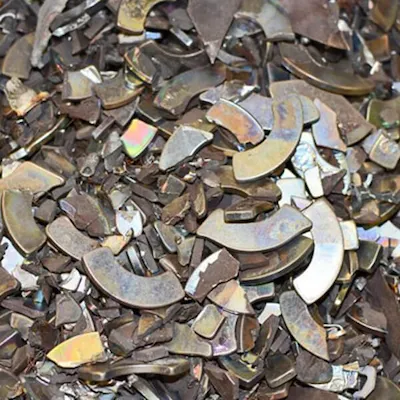
NdFeB magnet recycling is important to recover valuable rare earth elements.
NdFeB magnet waste is processed as the raw material to recover mixed rare earth oxides through crushing, vertical grinding, roasting and other processes. At present, the recycling of NdFeB magnet waste is mainly divided into hydrometallurgy and pyrometallurgy methods.
The hydrometallurgy method commonly uses acid leaching (hydrochloric acid or sulfuric acid) and precipitants such as oxalic acid. Of which, the hydrochloric acid optimal dissolution method has a simple process and low cost, but it requires strict control of process conditions and is difficult to commercialise; although the hydrochloric acid full dissolution method is easier to achieve commercial production, it consumes a lot of acid and needs to separate rare earths from iron; the sulfate double salt method is more complicated, requires a large amount of acid and alkali, and is more expensive.
The pyrometallurgy method is environmentally friendly, but it has high requirements for waste materials, and the waste materials that can be processed are relatively single. The industrial production efficiency is low or it cannot be commercialised for the time being.
NdFeB Magnet Recycling Methods
| Name | Principle | Advantages | Disadvantages |
| Chlorination | Rare earth elements can show stronger affinity with chloride ions | Good recycling effect | Severely oxidised waste, has poor recovery |
| Alloy Method | Rare earth Nd combines with molten Mg and Al to form an alloy | Get a single rare earth, short process flow | High requirements for operating equipment and high energy consumption |
| Selective Oxidation | The difference in the affinity of iron and rare earth for oxygen at different temperatures | Environmentally friendly, no chemical reagent consumption | High reaction temperature and high energy consumption |
| Total Solution | Hydrochloric acid dissolves rare earth and other elements in waste | Simple principle and operation | Large reagent consumption, environmental pollution, low product purity |
| Hydrochloric Acid | Control the pH of the solution so that the rare earth oxides preferentially react with hydrochloric acid | Low reagent consumption, short process | Low efficiency, high wastewater output |
| Oxalic Acid Precipitation | The solubility difference of salts formed by Fe2³– and rare earth ions and oxalic acid | Easy operation, simple process | High cost, low product purity |
| Sulfate Double Salt Method | Rare earth sulfate reacts with Na2SO4 to produce double salt precipitation | The reaction conditions are mild, and the cost is relatively low | Harsh reaction conditions, polluted environment |
| Solvent Extraction | The difference in binding ability between rare earth and organic extractant | High productivity, highly targeted | Easy to emulsify extractant, poor production environment |
| Electrodeposition | Electrochemical oxidation of Fe2+ to Fe³+, re-precipitation of rare earth | Less chemical reagent consumption, more convenient and efficient | High power consumption, cumbersome operation |
| Bioleaching | The migration and transformation of metals by microbial oxidation and complexation | Large processing capacity, low cost, environmental protection | High power consumption, cumbersome operation |
| Hydrogenation | Disproportionation dehydrogenation to separate rare earth Nd | High recovery rate | Long reaction time and low efficiency |
| Mechanochemical Method | With the kinetic energy of ball milling, lower the reaction temperature | Mild process conditions and low cost | Research needs to be in-depth, lack of actual basis |
The recovery of rare earth elements from NdFeB magnet recycling is a rapidly evolving field with significant potential for improvement. Current research focuses on developing advanced, cost-effective recovery processes, including the exploration of better-performing extractants, particularly ion extractants, to enhance efficiency and reduce production costs.
Researchers are also investigating microbial leaching and mechanochemical treatment of NdFeB waste to optimize process conditions and minimize energy consumption. While different methods such as hydrometallurgy recycling and pyrometallurgy recycling are currently employed based on the characteristics of various rare earth waste materials, these techniques still have limitations.
China, as a major rare earth producer, faces challenges due to excessive mining of non-renewable rare earth resources. Increasing the recycling of rare earths from secondary sources is crucial to alleviate supply pressures and improve economic benefits for enterprises. Although China currently lags behind developed countries in rare earth recycling technology and awareness, recent policy initiatives have sparked increased interest in utilizing secondary resources, leading to active research efforts aimed at advancing China’s rare earth recycling capabilities.
The future of NdFeB magnet recycling technology holds great promise. Driven by growing market demand and government initiatives to upgrade and adjust the industry, potential breakthroughs in industrial mass production technology, especially in terms of efficiency and environmental protection, could significantly expand the scale of the industry and increase profit margins. As research progresses and new technologies emerge, the rare earth recycling sector is poised for substantial growth and improvement in the coming years.
Competitive Landscape
In March 2024, China’s State Council issued a plan proposing the implementation of equipment renewal, consumer goods replacement, recycling and reuse, and standard improvement. By 2027, the amount of scrapped cars recycled will increase by about one-fold compared with 2023, the volume of used car transactions will increase by 45% compared with 2023, and the amount of waste household appliances recycled will increase by 30% compared with 2023. Rare earth permanent magnet materials play an indispensable core role in promoting high-quality development such as intelligent manufacturing and green manufacturing, and the rare earth permanent magnet material industry has continued its rapid development trend.
The NdFeB recycling industry plays a crucial role in the rare earth supply chain, with its upstream consisting of permanent magnet manufacturing enterprises. These recycling companies extract rare earth elements from production scraps, grinding sludge, and unqualified products. The industry has seen significant growth due to increasing demand for permanent magnet materials and restrictions on rare earth ore separation.
As of 2024, China’s NdFeB waste processing capacity has exceeded 100,000tpa. This overcapacity has led to challenges in raw material procurement for recycling companies. The industry is experiencing consolidation, with smaller companies facing difficulties due to environmental regulations and mandatory production plans. The profitability of rare earth recycling comes from processing fees and the recovery of non-valuable elements. The purchase price of rare earth scraps is tied to the market price of rare earth oxides. Currently, recycled materials account for nearly 30% of rare earth raw material sources in China.
However, the industry faces overcapacity issues, with domestic waste recycling and separation capacity far exceeding market supply. In October 2021, China implemented a national standard for “NdFeB Production and Processing Recycling Materials,” aimed at standardising the recycling market. The recycling industry forms a closed-loop system with permanent magnet material production companies. Companies with diverse recycling channels, advanced technologies, and strong pricing power are considered to have more competitive advantages in this sector.
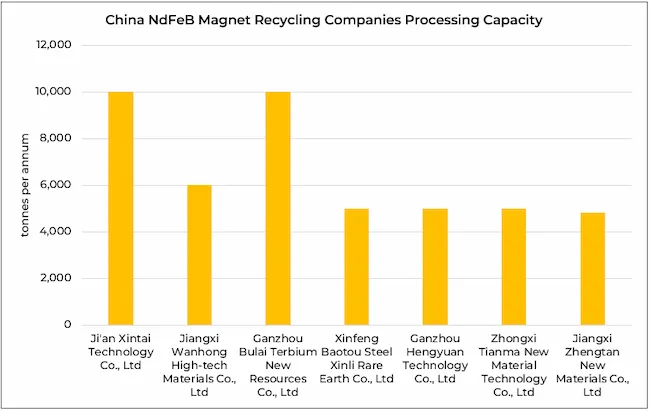
Major market participants include Ji’an Xintai Technology Co., Ltd and Jiangxi Wanhong High-tech Materials Co., Ltd (subsidiaries of Jiangsu Huahong Technology Stock Co., Ltd), Ganzhou Bulai Terbium New Resources Co., Ltd (subsidiary of Shenghe Resources Holding Co., Ltd), Xinfeng Baotou Steel Xinli Rare Earth Co., Ltd, Ganzhou Hengyuan Technology Co., Ltd, Zhongxi Tianma New Material Technology Co., Ltd, and Jiangxi Zhengtan New Materials Co., Ltd. At present, Jiangsu Huahong Technology Stock Co., Ltd is home to China’s largest NdFeB waste processing capacity.
Outside of China, Noveon Magnetics and Phoenix Tailings from the United States and HyProMag from United Kingdom are two leading NdFeB magnet recycling companies which are scaling up to enter the full circular economy and bring additional ex-China rare earth supply to market.
For more blog articles click here
To view GDC market research reports click here
About us
GDNM provides commentary on how energy transition minerals contribute towards the decarbonisation and electrification of the global economy, with a particular focus on the lithium-ion battery and rare earths supply chains.
GDNM founder, Mr Brendan Jephcott is an Australian who has worked in the global mining sector for more than 13 years, of which his experience covers precious metals, nonferrous metals, ferrous metals, base metals, bulk commodities, rare earths, and the lithium-ion battery industry.
For the last 9 years Mr Jephcott has focused on the burgeoning new energy industry, participating in cross-border transactions in buy-side and sell side roles, cultivating a global business network ranging from upstream resource companies, midstream intermediate product producers, and downstream consumers such as gigafactories and auto companies.