Importance of Ferrite Permanent Magnets
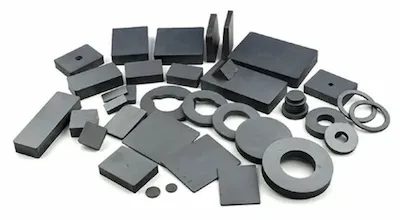
Ferrite permanent magnets, developed in the 1940s, are non-metallic magnetic materials made from strontium oxide (SrO) or barium oxide (BaO) and iron oxide (Fe₂O₃) through processes like pre-sintering, crushing, pressing, and grinding.
Known for wide hysteresis loops, high coercive force, and high remanence, ferrite permanent magnets maintain constant magnetism once magnetized, offering a stable magnetic field with minimal energy input.
Their advantages include abundant raw materials, low cost, simple production processes, and strong corrosion resistance, making them ideal for harsh environments compared to rare earth magnets, though they exhibit lower magnetic performance.
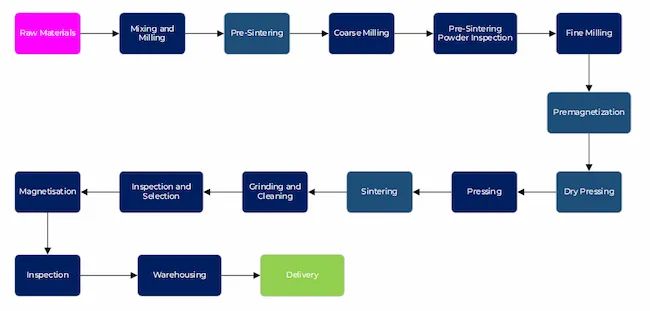
Ferrite Permanent Magnets – Principal Processing Flowsheet
| Property | Permanent Ferrite Magnets | Rare Earth Permanent Magnets |
| Magnetic Field Strength (Bhmax) | 3.5 | 40 |
| Internal Coercive Force | 0.17-5.2 | 33-50 |
| Remanent Magnetic Intensity (T) | 0.32-0.43 | 1.17-1.47 |
| Curie Temperature (°C) | 450 | 310-400 |
| Maximum Working Temperature (°C) | 250 | 150 |
| Hardness (Hv) | 480-580 | 500-700 |
| Recovery Permeability (μrec) | 1.05-1.2 | 1.02-1.08 |
| Resistivity (μΩ·cm) | >10^4 | 120-160 |
| Relative Stress Resistance | Has good demagnetization resistance and corrosion resistance | Fragile, easy to process, susceptible to corrosion; requires additional layers for corrosion protection |
| Raw Materials | Steel by-products, abundant and easily available | Rare earth materials, tight supply |
| Price | Inexpensive | Relatively high |
Ferrite Permanent Magnets – Commercial Applications
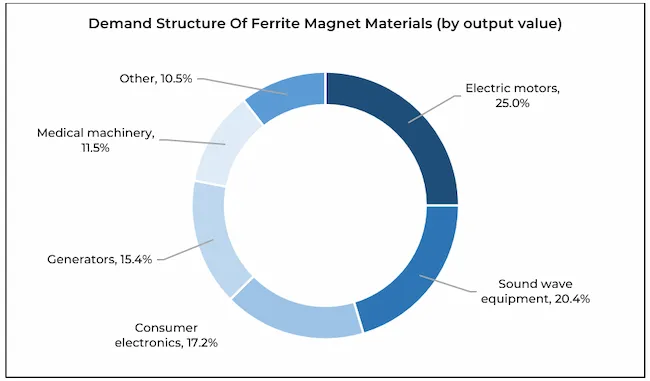
Ferrite permanent magnets are categorized into sintered (dry-pressed or wet-pressed) and bonded (extrusion, injection, or calendering) types, with applications spanning automotive, household appliances, power tools, and electronics.
- In the automotive sector, they are integral to micro-motors for engines, chassis, and body parts, with global demand projected to reach 614,000 tonnes by 2025, driven by rising vehicle intelligence and electrification (CAGR of 10.0% from 2021-2025).
- In household appliances, ferrite magnets support energy-efficient variable-frequency motors in air conditioners, refrigerators, and washing machines, with demand in China expected to hit 201,000 tonnes by 2025 (CAGR of 6.2%). The power tools sector anticipates a demand of 199,000 tonnes by 2025 (CAGR of 8.8%), fuelled by growing global shipments and market size.
Ferrite magnets serve as cost-effective alternative to rare earth permanent magnets and have extensive application areas ranging from electronics and electrical engineering to transportation, healthcare and consumer goods. Making them critical for use in information technology, power tools, automotive components and mining operations.
Ferrite magnets feature prominently in automotive micro-motors and household appliances. Micro-motors-defined by diameters under 160 mm or specialised rated power-are integral to control systems that measure, amplify and convert electromechanical signals, drive mechanical loads or supply AC/DC power.
The expansion of industrial and home automation, along with advances in smart vehicles, has fuelled global demand for micro-motors. This, in turn, has spurred growth in the ferrite magnet sector. In 2020 alone, China produced 13.9 billion micro-motors, underscoring the tight linkage between these two industries.
Ferrite Permanent Magnets – China Dominates Global Production
The market competitiveness of the ferrite permanent magnet industry in emerging countries represented by China continues to increase. Ferrite permanent magnet manufacturers in Japan, South Korea, Europe and the United States have high overall technical levels and strong product development capabilities. They mainly produce high-end products and maintain strong competitive advantages.
Major overseas companies include Japan’s TDK Corporation and South Korea’s Ssangyong. With the transfer of international manufacturing industries and the improvement of China’s enterprise technology levels, China’s ferrite magnet industry has narrowed the gap with overseas advanced levels and significantly enhanced its international competitiveness.
China dominates global production, accounting for over 60% of output with 516,000 tonnes in 2021, led by companies like Hengdian Group DMEGC Magnetics Co., Ltd, which holds a 55.3% market share and a capacity of 163,000 tonnes.
Japan’s TDK Corporation is one of the leading ferrite magnet producers outside of China, with its primary manufacturing base located in Akita Prefecture, Japan. The Company has a long history of innovation, introducing high-performance materials, and pioneering advanced manufacturing techniques like the NS1 method for mass producing thin, high-powered ferrite magnets.
TDK’s ferrite magnets are supplied to a wide customer base, with the automotive sector accounting for more than half of its sales (driven by demand EPS, brake systems, and various vehicle motors). Additional customer markets include industrial equipment, consumer electronics, medical devices, and robotics. While the overall magnetic products segment saw a decline in sales in FY24, TDK Corporation remains a major ferrite magnet supplier worldwide, leveraging its technological experience and mass production capacity.
TDK does not publicly disclose its annual production capacity. However, China states its production capacity is around 30,000 to 60,000 tonnes per annum, as of 2024, placing it among the world’s largest producers.
To view GDC rare earth magnet market research reports click here
- Sintered NdFeB permanent magnet industry research report
- Bonded NdFeB permanent magnet industry research report
- Hot-pressed NdFeB permanent magnet industry research report
- SmCo permanent magnet industry research report
- Ferrite permanent magnet industry research report
- AlNiCo permanent magnet industry research report
For more blog articles click here
To view GDC market research reports click here
Golden Dragon Capital Limited | Comprehensive Market Research Reports
About us
GDNM provides commentary on how energy transition minerals contribute towards the decarbonisation and electrification of the global economy, with a particular focus on the lithium-ion battery and rare earths supply chains.
GDNM founder, Mr Brendan Jephcott is an Australian who has worked in the global mining sector for more than 13 years, of which his experience covers precious metals, nonferrous metals, ferrous metals, base metals, bulk commodities, rare earths, and the lithium-ion battery industry.
For the last 9 years Mr Jephcott has focused on the burgeoning new energy industry, participating in cross-border transactions in buy-side and sell side roles, cultivating a global business network ranging from upstream resource companies, midstream intermediate product producers, and downstream consumers such as gigafactories and auto companies.