HPMSM, an important chemical to the energy transition
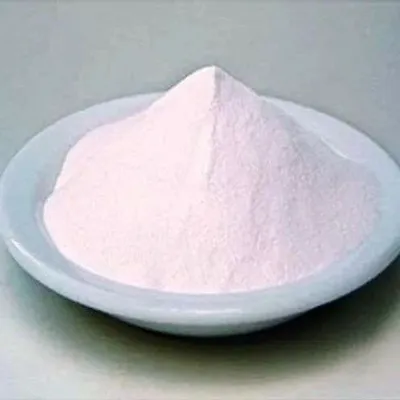
Manganese sulphate monohydrate (“MSM”) is the hydrated inorganic chemical compound occurring as a light pink powder with the formula MnSO4.H2O.
The product is a standard (agricultural and industrial) quality MSM containing a minimum 31.8% Mn / 98% MSM or a high purity manganese sulphate monohydrate (“HPMSM”) containing a minimum 32% Mn / 99% HPMSM.
Agricultural quality MSM: is mainly used as a feed additive, as a catalyst for plants to synthesize chlorophyll, to make growth good and increase harvest.
Industrial quality MSM: is mainly used as drier of ink and paint, catalyst of synthetic fatty acid, in manufacture of manganese compound, electrolytic metal manganese and manganese oxide dyeing, printing and dyeing, paper making, ceramic coating and in the pharmaceutical industry.
Battery-grade manganese sulfate: is mainly used to manufacture battery materials such as high-purity electrolytic manganese dioxide, trimanganese tetraoxide, and ternary precursors.
HPMSM Role in Lithium-ion Battery Cathode Materials
Manganese plays an important role in battery powered products. It acts as a stabiliser in the structure of NMC (nickel manganese cobalt) cathode materials. Nickel is known for its high specific energy but poor stability, manganese has the benefit of forming a spinel structure to achieve low internal resistance but offers a low specific energy. Combining the metals enhances each other strengths. Compared with standard grade MSM products, battery grade HPMSM has strict requirements on the content of various impurities.
Firstly, Manganese plays an important role in battery powered products. It acts as a stabiliser in the structure of NCM (nickel cobalt manganese) cathode materials. Nickel is known for its high specific energy but poor stability, manganese has the benefit of forming a spinel structure to achieve low internal resistance but offers a low specific energy.
Moreover, combining the metals enhances each other strengths. Compared with standard grade MSM products, battery grade HPMSM has strict requirements on the content of various impurities.
HPMSM Principal Production Method
HPMSM can be made by dissolving HPEMM with sulphuric acid to obtain the manganese sulfate (electrolytic metal method). After dissolving the metal and purifying the mother liquor solution, manganese sulphate monohydrate can be produced by a variety of crystallisation methods using conventional crystallisation equipment.
Producing HPMSM from HPEMM prevents the carryover of impurities from the electrolysis solutions to the final product. Generally, 1 tonne of electrolytic manganese can be dissolved in acid to obtain about 3 tonnes of manganese sulfate solution.
However, the market price fluctuation of HPEMM flakes is much larger than that of manganese ore, which makes it difficult to control the production cost which can be higher than the price received for the HPMSM product leading to reduced production or shutdown of factories in China producing HPMSM based on HPEMM as the raw material. When the spot price of electrolytic manganese is higher than 15,000-16,000 CNY/tonne (USD$2,143-2,286/tonne), the electrolytic metal method no longer has the advantage.
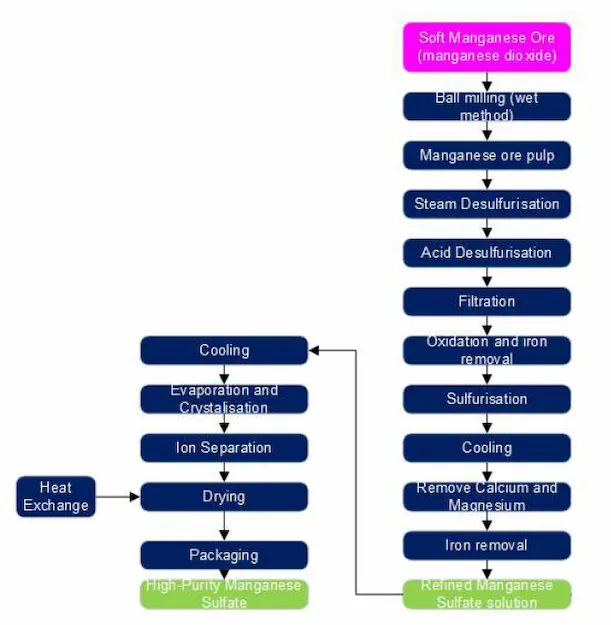
Starting with manganese ore, HPMSM can be obtained through reduction, leaching, impurity removal, crystallisation and drying steps. HPMSM can be made by leaching carbonate ore with sulphuric acid. Oxide ore can also be used, but requires reducing the higher manganese oxidation states (Mn3+, Mn4+) in the ore manganese minerals to the soluble form of manganese (Mn2+) by heating in a kiln.
Solid waste generation is, however, reduced significantly (up to 80%) with the use of oxides compared to carbonates due to the absence of calcium and magnesium carbonates which constitute much of the leach residue. The second step removes impurities and crystallises the manganese sulfate solution to obtain HPMSM.
In 2021 the supply of HPMSM to the battery market showed 92.5% of HPMSM was produced from manganese ore while 7.5% was produced from dissolving HPEMM with sulphuric acid.
Chinese HPMSM Production Methods
In China, HPMSM is increasingly being produced by a direct route from imported manganese oxide ore, largely because of the scarcity of high-quality manganese carbonate ore and also to reduce solid waste generation.
Non-Chinese cathode producers are looking at HPEMM conversion to manganese sulphate solution (“MSS”). The MSS is not crystalised and is passed on to the cathode plant in its liquid form. This saves the cost of the crystallisation step and brings additional savings in the next step because there is no requirement to dissolve the HPMSM crystals to produce a slurry in preparation to cathode coating with ternary material.
From the 1950s to the early 21st century, the industrial production of manganese sulfate in China mainly adopted the charcoal furnace roasting reduction method. The process, together with leaching, impurity removal, concentration, drying, packaging and other processes, produces manganese sulfate.
It is necessary to use high-quality manganese dioxide ore powder in the production, workers carry out roasting operations in a high-temperature environment, which is labour-intensive, dusty, and poor in environmental management.
Since the beginning of the 21st century, with the lack of manganese resources and the strengthening of environmental protection awareness, the “two-mine one-step method” has become the mainstream production process for manganese sulphate.
This method mainly uses manganese dioxide ore powder, pyrite powder and sulfuric acid to directly carry out oxidation-reduction reaction under suitable conditions to prepare manganese sulfate solution as the main process, and is accompanied by impurity removal, purification, concentration, drying and other processes.
It solves the unfavourable factors affecting industrial production such as direct reaction, dust reduction, and labour intensity reduction and opened up a new way for the utilisation of low-grade manganese dioxide ore. It has the advantages of low cost, safety and stability, and good product quality.
HPMSM Processing Flowsheet
Firstly, MSM is made directly from carbonate ores, although oxide ore can be used after roasting. Secondly, preparation of HPMSM is based on the starting raw material being either manganese ore or HPEMM.
Other methods for producing HPMSM include charcoal reduction roasting, sulfuric acid leaching method, two ore roasting, sulfuric acid leaching method, two mine acid method, sulfur acid-SO2 reduction leaching method, electrolytic metal method, chemical precipitation method and high temperature recrystallization.
In China manganese sulfate monohydrate for battery materials follows the national industry standard HG/T 4823-2015. This standard specifies the requirements, test methods, inspection rules, signs, labels, packaging, transportation and storage of manganese sulfate for batteries.
This product is mainly used to prepare secondary lithium battery cathode materials (nickel-cobalt lithium manganate, lithium manganate, lithium-rich manganese-based cathode materials, etc.), and can also be used to manufacture other manganese salts.
| Chinese Standard HG/T-4823-2015 | Industry Specifications | |||
| Element or Compound | Class I (w/%) | Class II (w/%) | Huicheng (max ppm) | ISKY (max ppm) |
| MnSO4•H2O | ≥99.0 | ≥98.0 | ≥99.0% | ≥98.0% |
| Mn | ≥32.0 | ≥31.8 | ≥32.0% | ≥31.8% |
| As | — | — | — | 10 |
| Ca | ≤0.01 | ≤0.02 | 100 | 50 |
| Cd | ≤0.0005 | ≤0.001 | 5 | 10 |
| Co | ≤0.005 | — | 50 | 50 |
| Cu | ≤0.001 | ≤0.002 | 10 | 10 |
| Fe | ≤0.001 | ≤0.002 | 10 | 10 |
| K | ≤0.01 | ≤0.001 | 100 | 100 |
| Mg | ≤0.01 | ≤0.02 | 100 | 50 |
| Na | ≤0.01 | ≤0.01 | 100 | 50 |
| Ni | ≤0.005 | — | 50 | 50 |
| Pb | ≤0.001 | ≤0.0015 | 10 | 10 |
| Zn | ≤0.001 | ≤0.002 | 10 | 10 |
| Insoluble matter | ≤0.01 | 100 | — | |
| pH (100 g/L solution, 25°C) | 4.0~6.5 | 4.0~6.5 | — | |
| Particle Size | <400µm 100% | <400µm 100% | — | |
| Si | Buyer and seller negotiate | |||
Though a China industry standard has been issued, HPMSM does not have a single “battery grade” specification, each cathode production manufacturer has its own specific requirements and different views on “battery grade”.
Commercialisation
In recent years, global production of HPMSM in 2021 was 296,000t. China dominates the HPMSM market for battery use with a 91% market share. Moreover, annual production of HPMSM in China has more than tripled between 2019 and 2021 from 84kt to 270kt.
Notably, outside of China there is only one producer of HPMSM from ore, the American company Prince International Corporation with a production plant in Belgium with a production capacity of 10,000tpa. In addition, there are four producers of HPMSM in Japan which make the sulphate from imported HPEMM, producing battery materials and make HPMSM in-house for their internal use.
Competitive Landscape
Notably, the main Chinese HPMSM producers are:
- ISKY Chemicals Co., Ltd
- Guizhou Dalong Huicheng New Materials Co., Ltd
- Qinzhou Nanhai Chemical
- Southern Manganese Group Co., Ltd (Daxin Manganese Mine Branch 20,000t/a & subsidiary Guangxi Huiyuan Manganese Industry Co Ltd (Chongzuo Branch) 30,000t/a)
- Guizhou Red Star Development Co., Ltd (via subsidiary Guizhou Hongxing Development Dalong Manganese Industry Co Ltd)
For more blog articles click here
To view GDC market research reports click here
About us
GDNM provides commentary on how energy transition minerals contribute towards the decarbonisation and electrification of the global economy, with a particular focus on the lithium-ion battery and rare earths supply chains.
GDNM founder, Mr Brendan Jephcott is an Australian who has worked in the global mining sector for more than 13 years, of which his experience covers precious metals, nonferrous metals, ferrous metals, base metals, bulk commodities, rare earths, and the lithium-ion battery industry.
For the last 9 years Mr Jephcott has focused on the burgeoning new energy industry, participating in cross-border transactions in buy-side and sell side roles, cultivating a global business network ranging from upstream resource companies, midstream intermediate product producers, and downstream consumers such as gigafactories and auto companies.