How to build a 4000tpa Sintered NdFeB Permanent Magnet Plant
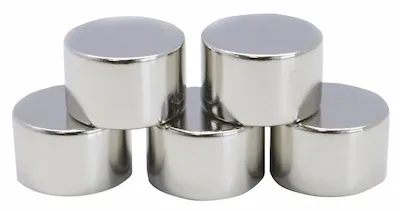
The article below describes how to build a 4,000tpa high-performance sintered NdFeB permanent magnet production line.
Sintered NdFeB Permanent Magnet – Product Grades
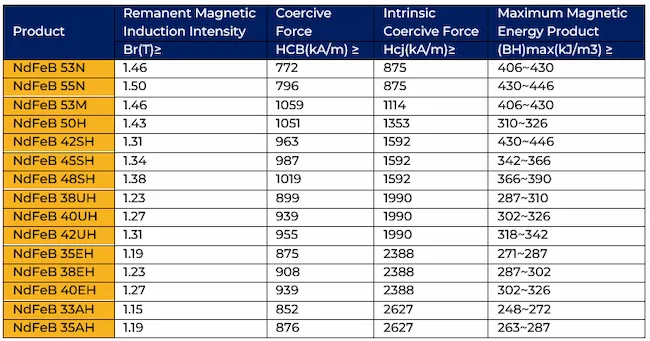
High-performance sintered NdFeB permanent magnet products are divided into six categories according to the coercive force of magnetic polarisation intensity:
- Low coercive force (N)
- Medium coercive force (M)
- High coercive force (H)
- Extra-high coercive force (SH)
- Ultra-high coercive force (UH)
- Extremely high coercive force (EH)
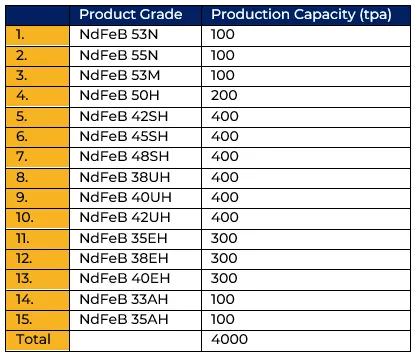
Each category of sintered NdFeB permanent magnet products is divided into several grades according to the maximum magnetic energy product. The output of various product grades is shown in the table below:
Plant Production Equipment
This project uses the NdFeB permanent magnet technology of Japan’s TDK. The construction period is scheduled for 12 months.
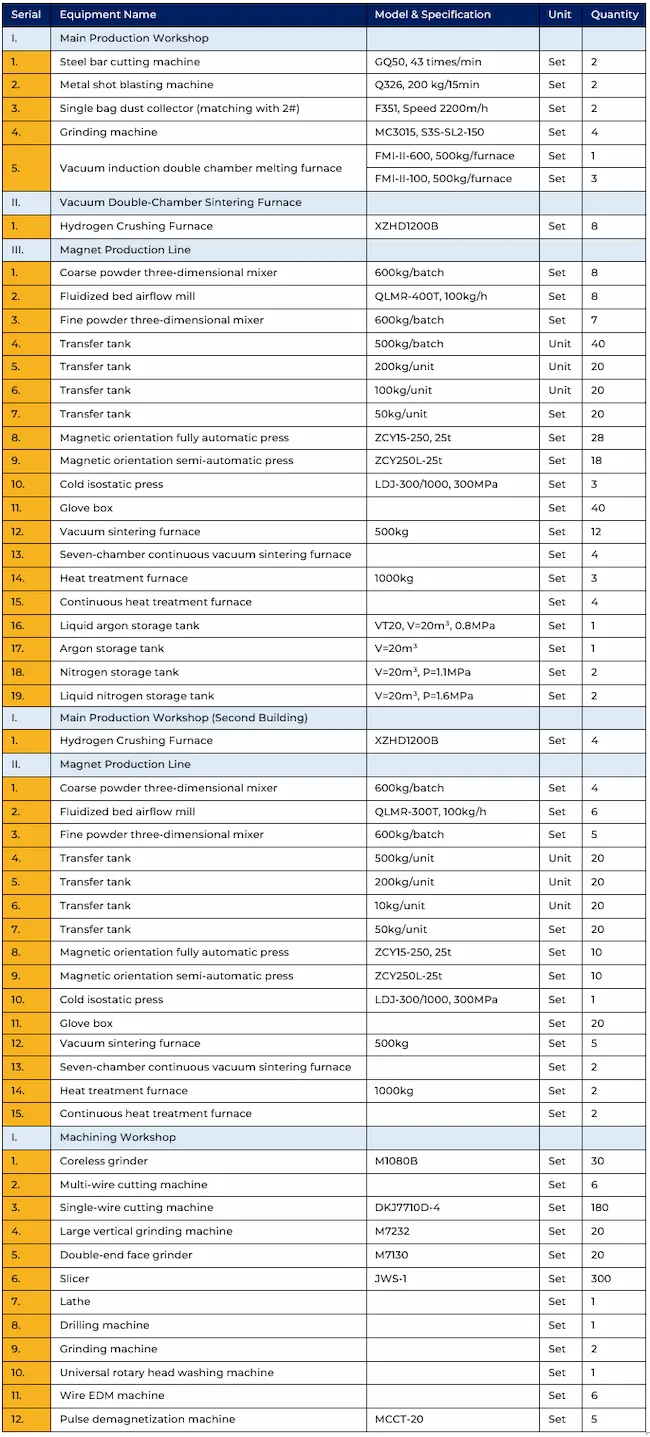
A 4,000tpa high-performance sintered NdFeB permanent magnet production line requires several key pieces of equipment summarised in the table below:
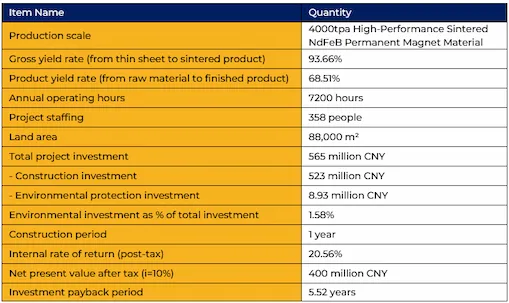
Raw Materials
The rare earth raw materials required for this project are neodymium metal (NdPr alloy) and dysprosium metal, which are non-radioactive and low-toxic substances, and their toxicity is equivalent to that of iron.
- Neodymium metal (NdPr alloy): The chemical symbol of neodymium is Nd, and its atomic number is 60; the chemical symbol of praseodymium is Pr, and its atomic number is 59. Both praseodymium and neodymium belong to the lanthanide series (rare earth elements). The NdPr alloy used in the production of magnetic material NdFeB complies with the “Praseodymium-Nd Alloy” (GB/T20892-2007).
- Pure iron: The raw material pure iron must meet the requirements of the YT2 grade in “Raw Material Pure Iron” (GB/T 9971-2004), where C ≤ 0.008%, Si ≤ 0.03% (mass fraction).
- Ferroboron: The raw material ferroboron must meet the requirements of “Ferroboron” (GB5682-1995), where B ≥ 19~22%, and the total impurity content ≤ 0.05%.
- Dysprosium: The chemical symbol of dysprosium is Dy, and its atomic number is 66. It belongs to the lanthanide series (rare earth elements). As an additive in the production of NdFeB permanent magnet materials, dysprosium can improve the coercivity of the product. Dysprosium must meet the requirements of “Metal Dysprosium” (GB/T15071-2008).
- Cobalt: The chemical symbol of cobalt is Co, a silvery-white ferromagnetic metal. As an additive in the production of NdFeB permanent magnet materials, cobalt can improve the temperature performance of the product. The raw material cobalt must meet the requirements of the (Co-2) grade product in “Cobalt” (GB6517-86), where Co≥ 99.9%.
- Aluminium metal: The raw aluminium must meet the requirements of “Aluminium Ingots for Remelting” (GB/T1196-2008), where Al≥ 99.9%.
Auxiliary Materials
- Nitrogen: mainly used as a protective gas in the production process to prevent product oxidation and equipment purging. Nitrogen requirements must meet GB/T8980-1996, N2≥ 99.999%, O2≤ 3ppm, H2O ≤ 5ppm. The annual nitrogen consumption is 215829Nm3, and the total liquid nitrogen is 270t/a. The nitrogen part of this project is supplied by the deep-cold nitrogen production system: 1000 m3/h; part of it is purchased from liquid nitrogen for gasification.
- Argon: mainly used as a protective gas in the production process to prevent product oxidation. The annual argon consumption is 134520Nm3, the combined liquid argon is 240t/a, the purity Ar ≥ 99.99%, and the source is purchased from outside.
- Hydrogen: mainly used in the hydrogen crushing process and is supplied by the hydrogen production station of this project. The purity H2 ≥ 99.999%, and the consumption is 2.88×10⁵ m3/a.
- Crucible: with an alumina content of more than 95% is called a corundum crucible. Corundum crucibles are hard and resistant to melting, high temperature resistance, acid and alkali resistance, rapid cooling and extreme heat resistance, and chemical corrosion resistance, and are used in the smelting section.
Other Materials
- Hydraulic oil: The hydraulic system of the isostatic press uses anti-wear hydraulic oil. Hydraulic oil is the hydraulic medium used in the hydraulic system that uses liquid pressure energy. It plays the role of energy transfer, system lubrication, corrosion protection, rust prevention, cooling, etc. in the hydraulic system. Hydraulic oil is made of mineral oil and is supplemented with certain additives.
- Packaging plastic bags: The mixed powder needs to be packed into well-sealed plastic bags for temporary storage before magnetic field molding. The NdFeB embryo can be isolated from the hydraulic oil in the isostatic press under the protection of plastic bags.
- Shot blasting sand: The shot blasting sand in the shot blasting machine will be damaged during use and needs to be replaced regularly.
- Cutting fluid: During the NdFeB machining process, the use of cutting fluid can reduce the friction between chips, workpieces and tools, reduce cutting temperature and cutting force, and slow down tool wear.
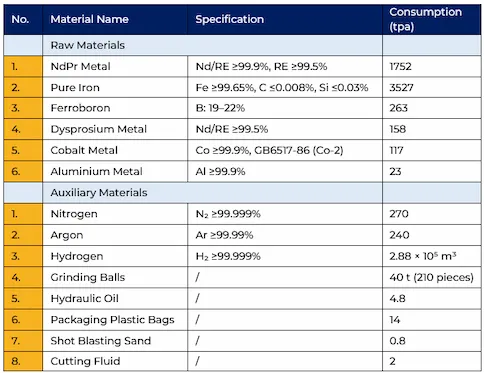
Consumption of raw and auxiliary materials to make a Sintered NdFeB Permanent Magnet
Consumption of raw and auxiliary materials for this project is shown in the following table:
Sintered NdFeB Permanent Magnet – Principal Processing Flowsheet
This project adopts powder metallurgy technology and does not involve rare earth separation and smelting. The technical route of this project is as follows: raw material pretreatment → batching → smelting and quick solidification → thin slice screening → performance testing → hydrogen crushing → mixing → air flow grinding → fine powder batch mixing → pressing → isostatic pressing → vacuum sintering → heat treatment → machining → surface treatment (outsourced) → magnetization → testing.
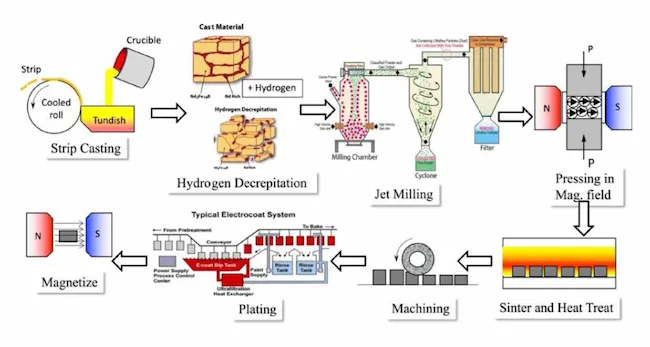
The production of thin sheets adopts the most advanced and mature thin sheet ingot (Strip-Casting) technology. Compared with the traditional die casting process, it has the following characteristics:
- The thickness of the thin sheet is only 0.2~0.3mm, which can effectively inhibit the precipitation of α-Fe crystal alloy, thereby increasing the volume percentage of the main phase Nd2Fe14B.
- The alloy grains are fine and uniform, which improves the coercive force of the product. It can reduce the amount of scarce and expensive dysprosium, which is conducive to the sustainable development of the rare earth industry.
- Thin sheet ingot is the key to the preparation of high-performance NdFeB permanent magnets, which can improve the magnet performance by more than 10%.
- High yield and low cost, compared with magnets prepared by traditional die casting process, it has higher profit margin and stronger competitiveness.
Raw material pre-treatment and batching
Since the iron bars in the raw material warehouse are long and easy to rust, they need to be cut and polished before batching to facilitate weighing and reduce impurities. The raw material pure iron is cut and derusted, and then the metal neodymium is pressed into small pieces less than 400mm, and the ferroboron is pressed into small pieces less than 40mm.
NdPr alloy, pure iron, ferroboron, dysprosium, cobalt, aluminium, etc. are mixed according to the process composition design requirements of neodymium iron boron. Metal oxide dust is generated when the raw material pure iron is derusted by using a shot blasting machine.
The shot blasting machine uses a shot blaster and centrifugal force to blast the surface of the workpiece with high-speed projectiles to achieve the desired brightness, cleanliness, roughness and strengthen the surface of the workpiece.
Smelting
The smelting section is mainly responsible for casting the prepared raw materials into sheets. After batching, the raw materials are loaded into the crucible in the vacuum induction melting rapid solidification furnace, and the melting furnace is evacuated. When the vacuum reaches 4.0Pa, argon is filled in. The melting temperature is 1450~1480℃ under vacuum and argon protection.
The protective atmosphere and its dosage during melting are: Ar gas, 85Pa. After the charge is melted, it is poured into the tundish in the melting furnace at a certain speed. The alloy liquid flows along the tundish to the surface of the cooling copper roller rotating at a certain speed. The crystal grows in the form of scaly columnar crystals to produce 0.2mm±0.05mm rapid solidification thin slices. The copper roller sends the rapidly solidified thin slices to the cooling plate.
After the melting is completed, the melting furnace is cooled to room temperature and the vacuum unit is started to discharge the argon in the furnace. After the performance test, the qualified thin slices are sent to the subsequent process, and the unqualified thin slices are returned to the vacuum melting furnace for remelting. When the vacuum induction melting furnace is opened, dust overflows. The melting furnace is evacuated to discharge argon, which contains a small amount of dust.
Four vacuum melting furnaces are used for the smelting process, including three melting furnaces with a single production capacity of 1000kg/furnace and one melting furnace with a single production capacity of 500kg/furnace. The operation cycle of each melting furnace is 4h (vacuuming for about 40min), working 24h a day and 300d a year.
Hydrogen Crushing
The smelted NdFeB thin sheets are transported to the hydrogen crushing furnace through the transfer tank. The transfer tank and the hydrogen crushing furnace are controlled by fast valves. After the two furnace tanks are combined, nitrogen is filled into the hydrogen crushing furnace, and the valves of the transfer tank and the hydrogen crushing furnace are opened to feed the hydrogen crushing furnace.
Hydrogen crushing is to use the hydrogen absorption characteristics of rare earth metal intermetallic compounds to place the NdFeB alloy in a hydrogen environment. Hydrogen enters the alloy along the Nd-rich phase thin layer, causing it to expand, burst and break, and crack along the Nd-rich phase layer, thereby turning the thin flakes into coarse powder.
After the hydrogen crushing furnace is loaded through the transfer tank, the hydrogen crushing furnace and the transfer tank valves are closed, and the hydrogen crushing furnace is evacuated and filled with hydrogen for hydrogen crushing. The reaction tank is evacuated, and when the vacuum reaches 1.0Pa (about 90min), hydrogen is filled to absorb hydrogen. After the hydrogen absorption is completed, the reaction tank is evacuated for dehydrogenation, and the material is cooled and discharged when the vacuum reaches 35Pa. The discharge particle size of the hydrogen crushing process is about 5μm, and the production cycle is 16h. When the hydrogen crushing furnace is evacuated, waste gas containing hydrogen and a small amount of dust is discharged.
The hydrogen crushing process uses 10 hydrogen crushing furnaces with a single production capacity of 1000kg. The operation cycle of each hydrogen crushing furnace is 14 hours (vacuuming for about 90 minutes), the daily working hours are 24 hours, and the annual working hours are 300 days.
Powder Making
After the hydrogen crushing process is completed, open the valve and the material enters the transfer tank. Send it to the magnet workshop for mixing and batching in the mixer, and send it to the air flow mill for powder making. The mixer mainly uses the rotation method to mix the materials evenly for subsequent processing. The air flow mill is used for ultra-fine grinding of materials.
The working principle is to spray compressed air through the nozzle at high speed. The high-speed jet drives the material to move at high speed, causing the material to collide and rub and crush. The crushed material reaches the classification area with the air flow, and the material that meets the fineness requirement is finally collected by the collection tank. The material that does not meet the requirement returns to the crushing chamber for further crushing until it reaches the required fineness and is captured.
The material transfer process between the transfer tank, the mixer, and the air flow mill is as follows: the transfer tank, the mixer, and the air flow mill are all controlled by fast valves. After the two furnace tanks are combined, nitrogen is filled into the mixer (air flow mill), the transfer tank and the mixer (air flow mill) valves are opened, and the mixer (air flow mill) is fed. The discharging process is similar to the feeding process. Under the protection of 5N (i.e. 99.999%) nitrogen, the powder is crushed to an average particle size of 3~5μm. The evenly mixed fine powder is directly loaded into a tightly sealed storage tank and then sent to the pressing section.
Magnetic Field Forming and Isostatic Pressing
The mixed powder is accurately weighed in a glove box protected by high-purity nitrogen and divided into well-sealed plastic bags for temporary storage. Under nitrogen protection, the powder is then loaded into the mold. It should be as loose as possible, and fully sealed nitrogen protection and vertical pressing in a strong magnetic field are used. The molded body is placed under the hydraulic oil level of the working cylinder of the isostatic press, and compacted by the cold isostatic press to complete the oriented pressing process.
The working principle of isostatic pressing is Pascal’s law: “The pressure of the medium (liquid or gas) in a closed container can be transmitted equally in all directions.” That is, after the product to be pressed is loaded into the equipment, the product is subjected to the ultra-high pressure medium in all directions, which increases the density of the product. The shrinkage of the block depends on the compressibility of the material and the pressure during pressing.
Sintering and heat treatment
In order to improve the strength of the product and maintain the high magnetic properties of the product, the pressed body needs to be sintered and heat treated.
That is, the pressed body is heated and discharged at a temperature lower than the melting point of the main component, so that the powder particles are combined with each other to improve its performance.
The sintering temperature is 1030 ~ 1050 ℃, the production cycle is 32h (vacuuming for about 90min), and the vacuum degree is required to be no more than 10-3 Pa; the heat treatment temperature is 1030 ~ 1050 ℃, the production cycle is 14h (vacuuming for about 90min), and the vacuum degree is required to be no more than 10-2Pa. When the sintering furnace and the heat treatment furnace are vacuumed, the waste gas is discharged, containing hydrogen and a small amount of dust.
In each process, NdFeB should be prevented from contacting with oxygen (air) as much as possible to prevent oxidation. In addition to vacuuming the equipment and filling nitrogen to isolate oxygen during preparation, the alloy powder and unsintered body that are not processed in time should be protected by containers and stored in vacuum storage boxes.
Sintering Equipment
The sintering process uses 6 continuous vacuum sintering furnaces, and the single furnace capacity is 3.0t/d. The rest use 17 intermittent vacuum sintering furnaces, with a single production capacity of 500kg/unit, an intermittent vacuum sintering furnace operation cycle of 35h (vacuuming for about 90min), 24h working day, and 300d working year. The sintered rough pieces are placed in a transfer tank and transferred to a heat treatment furnace for heat treatment.
The heat treatment process uses 4 continuous vacuum heat treatment furnaces, with a single capacity of 3.2t/d. The rest use 4 intermittent vacuum sintering furnaces, with a single production capacity of 1000kg/unit, an intermittent vacuum heat treatment furnace operation cycle of 14h (vacuuming for about 90min), 24h working day, and 300d working year. The sintered rough pieces are sent to the machining workshop for processing by a cart.
Machining
Sintered into dense and consistent blanks, slicers, multi-wire cutting machines and various grinders are used to cut, grind and process the blanks into sintered NdFeB permanent magnet of the specifications and shapes required by the end user. The machined magnets must be tested: use visual inspection and measuring tools to check the magnet defects, surface finish, and dimensional deviation; use a multi-functional non-destructive magnetic performance measuring instrument to measure the magnetic parameters of the magnet. The sintered magnets after machining have poor corrosion resistance, especially in a warm and humid environment, and must be treated with surface protection, using chemical surface treatment processes such as electroplating zinc, nickel, and copper for protection.
Product Testing
The finished sintered NdFeB permanent magnet after surface treatment must be inspected for quality such as appearance and dimensional tolerance; then, according to different user requirements, it is decided whether to magnetize the finished product or not; products that need to be magnetized are magnetized using a pulse magnetization and demagnetization machine using a pulse magnetization method, and the magnetic field strength is 30~40 kOe.
The working process of the supplementary magnetizer is to first charge the capacitor in the magnetizer with a DC high voltage, and then discharge it through a coil with extremely low resistance. The discharge time is very short, only tens of milliseconds. This current pulse generates a strong magnetic field in the coil, which permanently magnetizes the NdFeB material placed in the coil.
The finished magnet after magnetization is tested for magnetic properties or high temperature properties of the product with a fast magnetic measuring instrument and a Tesla meter, and then packaged for storage or directly shipped.
In order to strengthen the control of the quality system of the production process, sampling analysis and testing should be carried out between the above processes, including raw and auxiliary material composition and purity analysis, intermediate product chemical composition analysis, protective gas purity detection, powder particle size analysis and oxygen content detection of each major process. The mold is an important tool for powder pressing and molding. The mold production of this project is outsourced.
Products undergo electroplating treatment. The electroplated products are magnetized or not according to different requirements of users. The unmagnetized products can be directly shipped and sold. The products that need to be magnetized are returned to the construction unit for magnetization and then packaged for storage or directly shipped.
For more blog articles click here
To view GDC market research reports click here
Golden Dragon Capital Limited | Comprehensive Market Research Reports
About us
GDNM provides commentary on how energy transition minerals contribute towards the decarbonisation and electrification of the global economy, with a particular focus on the lithium-ion battery and rare earths supply chains.
GDNM founder, Mr Brendan Jephcott is an Australian who has worked in the global mining sector for more than 13 years, of which his experience covers precious metals, nonferrous metals, ferrous metals, base metals, bulk commodities, rare earths, and the lithium-ion battery industry.
For the last 9 years Mr Jephcott has focused on the burgeoning new energy industry, participating in cross-border transactions in buy-side and sell side roles, cultivating a global business network ranging from upstream resource companies, midstream intermediate product producers, and downstream consumers such as gigafactories and auto companies.