Graphite Anode Material vs Silicon Anode Material
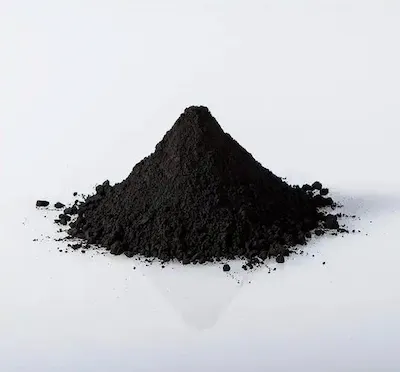
Anode materials serve as the negative electrode in lithium-ion batteries, playing a crucial role in determining battery performance characteristics such as energy density, cycle life, and charging rates.
Currently, the market is dominated by graphite-based materials namely synthetic graphite anode material, but silicon-based alternatives are emerging as promising next-generation solutions despite facing significant technical challenges.
This article below examines the advantages and limitations of both anode material types based on their structural properties, performance metrics, and commercial viability.
Graphite-Based Anode Material
Graphite-based anode materials are currently the mainstream technology, divided into two primary categories:
- Natural Graphite Anode Material: Made from natural flake crystalline graphite through crushing, spheroidisation, grading, purification, and surface treatment processes. These materials offer high compaction density and capacity generally higher than synthetic alternatives.
- Synthetic Graphite Anode Material: Produced from petroleum coke, needle coke, pitch coke, and other raw materials through crushing, granulation, classification, and high-temperature graphitisation processing. These materials excel in cycle performance, rate performance, and electrolyte compatibility.
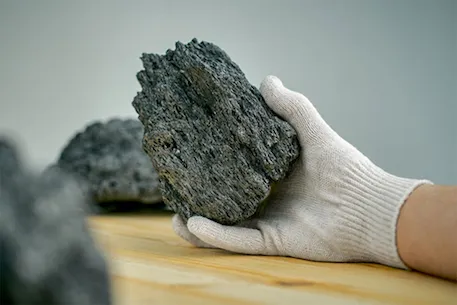
Silicon-Based Anode Material
Silicon-based materials represent an emerging technology with significantly higher theoretical capacity. The primary types include:
- Pure Silicon (Si): Theoretical capacity of 4,200 mAh/g
- Silicon Oxide (SiO): Theoretical capacity of 2,675 mAh/g
The most significant advantage of silicon-based materials lies in their superior theoretical capacity:
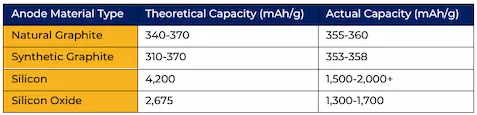
The large difference in capacity between silicon and graphite arises because a silicon atom can bond with up to four lithium ions (Li₄.₄Si/Li₂₂Si₅) while it takes six carbon atoms to bond with only one lithium ion.
Anode Material Comparison Analysis
First Coulombic Efficiency
Graphite-based anode materials demonstrate superior initial efficiency:
- Natural Graphite: 90-95% first coulombic efficiency
- Synthetic Graphite: 90-96% first coulombic efficiency
- Silicon-based Materials: 70-85% first coulombic efficiency
The lower efficiency in silicon materials results from irreversible reactions during initial lithiation, where lithium ions react with silicon oxide to generate lithium oxide and lithium silicate.
Cycle Performance
Graphite-based anode materials exhibit superior long-term stability:
- Natural Graphite: >1,000 cycles
- Synthetic Graphite: >1,500 cycles
- Silicon-based Materials: 300-500 cycles (traditional), improving to 800-1,200 cycles with advanced processing
Volume Expansion
Volume expansion during charge/discharge cycles represents a critical difference:
- Graphite Materials: 10-25% expansion
- Silicon Materials: 300% expansion
- Silicon Oxide: 100-150% expansion
The significant volume expansion in silicon materials causes particle cracking, SEI layer instability, and accelerated capacity decay.
Principal Production Methods
Natural graphite anode material processing involves four main steps:
- Milling: Reducing particle size through hammer and jet mills
- Spheroidisation: Converting flat particles into spheres for improved packing density
- Purification: Chemical treatment to achieve >99.95% purity
- Coating: Applying protective carbon layers
Synthetic graphite anode material production requires:
- Crushing: Initial size reduction of raw materials
- Granulation: Forming particles with desired size distribution
- Carbonisation: Heat treatment at 900-1,400°C
- Graphitisation: High-temperature processing at 2,500-3,000°C
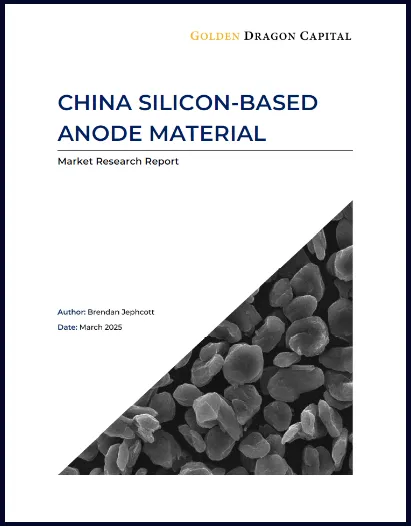
To view GDC China Silicon-based Anode Material Market Research Report click here
Silicon-Based Material Processing
Silicon-based anode materials employ more complex processing methods:
- Traditional Grinding Method: Ball milling to reduce particle size, but limited to particles >100nm with quality control challenges.
- Chemical Vapor Deposition (CVD): Advanced method producing uniform nano-scale silicon particles (≤10nm) within porous carbon structures, offering superior performance but higher production complexity.
- Pre-lithiation/Pre-magnesium: Techniques to improve first efficiency by adding lithium or magnesium sources, though adding significant cost.
Economic Analysis
Graphite-based anode materials benefit from established supply chains:
Natural graphite anode material uses abundant natural flake graphite ore from an established mining industry., and synthetic graphite uses petroleum coke and needle coke from an established petrochemicals industry.
Whereas silicon-based anode materials face higher raw material costs:
- Porous Carbon Precursor: 35% of total cost, priced at 300,000-500,000 CNY/tonne
- Silane Gas: 50% of total cost, historically 20,000-50,000 CNY/tonne
- Other Costs: 15% of total cost
However, current silicon-carbon anode material costs reach 750,000 CNY per tonne, requiring reduction to 110,000-170,000 CNY per tonne for economic parity with graphite on a capacity basis.
Commercial Applications and Market Positioning
Graphite-based materials maintain market positioning:
- Synthetic graphite anode material makes up 82.5% market share in China (2024).
- Natural Graphite: Significant portion of remaining market (14.1%).
- Silicon-based anode materials only account for 3.4% market share
In terms of commerical applications, graphite-based anode materials excel in high-volume automotive applications, energy storage systems requiring long cycle life, and applications prioritising cost-effectiveness.
Whereas silicon-based anode materials are targeting the consumer electronics requiring high energy density (smart phones), fast-charging applications, next-generation battery technologies (4680 cells, solid-state) and the premium automotive market.
Technical Challenges and Solutions
Silicon-based anode materials face several underlying critical issues:
- Volume Expansion: 300% expansion causes structural damage
- Poor Conductivity: 10⁻⁵ – 10⁻³ S/cm compared to graphite’s superior conductivity
- SEI Instability: Repeated formation and breakdown during cycling
- Manufacturing : Requires advanced CVD processing for optimal performance
Mitigation Strategies
Employing advanced silicon materials employ sophisticated structural designs:
- Nanostructuring: Particles <150nm to accommodate expansion
- Core-shell Architecture: Carbon coating for protection and conductivity
- Porous Structures: Internal voids to accommodate volume changes
- Composite Designs: Silicon embedded in carbon matrices
Future Outlook
To view GDC China Silicon-based Anode Material Market Research Report click here
The silicon-based anode market is expected to grow significantly, with projections suggesting a market size of 30 billion CNY by 2030, corresponding to shipments of 130,000-150,000 tonnes globally.
Silicon-based material market leading companies such as BTR New Material Group Co., Ltd and Ningbo Shanshan Co., Ltd are progressing through product iterations:

Concluding Thoughts
Graphite-based anode materials currently provide the optimal balance of performance, cost, and manufacturability for most lithium-ion battery applications. Their mature technology, excellent cycle life, and established supply chains make them the preferred choice for high-volume applications.
Moreover, silicon-based anode materials offer compelling advantages in energy density and fast-charging capabilities but face significant challenges in cycle life, manufacturing complexity, and cost. However, advancing technologies like CVD processing and sophisticated structural designs are addressing these limitations.
The future likely holds a complementary relationship where graphite-based anode materials continue dominating cost-sensitive, high-volume applications while silicon-based anode materials capture premium segments requiring maximum energy density.
Finally, the energy transition will depend on continued technological advancement in silicon-based anode material processing methods and rapid cost reduction for key raw materials like silane gas and porous carbon precursors.
For more blog articles click here
To view GDC market research reports click here
Golden Dragon Capital Limited | Comprehensive Market Research Reports
About us
GDNM provides commentary on how energy transition minerals contribute towards the decarbonisation and electrification of the global economy, with a particular focus on the lithium-ion battery and rare earths supply chains.
GDNM founder, Mr Brendan Jephcott is an Australian who has worked in the global mining sector for more than 13 years, of which his experience covers precious metals, nonferrous metals, ferrous metals, base metals, bulk commodities, rare earths, and the lithium-ion battery industry.
For the last 9 years Mr Jephcott has focused on the burgeoning new energy industry, participating in cross-border transactions in buy-side and sell side roles, cultivating a global business network ranging from upstream resource companies, midstream intermediate product producers, and downstream consumers such as gigafactories and auto companies.