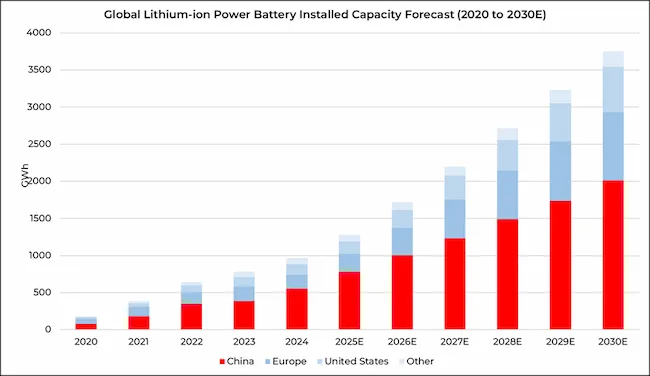
Global Lithium-ion Battery Installed Capacity Forecast (2020 to 2030E)
The global trend of automobile electrification has become a trend, driving the growth of lithium-ion battery shipments.
Global lithium-ion battery shipments increased from 182GWh in 2020 up to 969GWh in 2024, with a CAGR of 51.8%, and are expected to grow to 3754GWh by 2030, with a CAGR of 25.3% from 2024 to 2030.
Therefore, lithium-ion battery shipments in the European and American markets alone are still expected to usher in a period of rapid expansion.
- European lithium-ion battery shipments are expected to increase from 190GWh in 2024 up to 918GWh by 2030, with a CAGR of 30.0%.
- US power lithium-ion battery shipments are expected to increase from 143GWh in 2024 up to 608GWh in 2030, with a CAGR of 27.2%.
The Strategic move into Europe
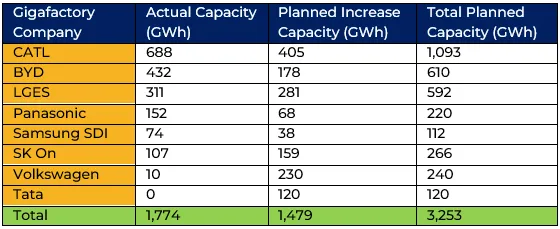
Gigafactories are actively expanding production and are expected to fully benefit from the decarbonisation and electrification of the global automotive industry:
- Overseas: The future focus is the large-scale expansion of overseas gigafactories. In the past, overseas gigafactories were delayed in expanding production due to the impact of the pandemic. Moreover, as the pandemic improves, these gigafactories have begun to restart and expand production. However, at the same time, auto companies such as Volkswagen and Tata have begun to build their own production capacity.
- Domestic: Leading gigafactory companies such as CATL and BYD are actively expanding production, and second-tier gigafactory companies such as EVE Energy are also expanding production.
Competitive Landscape is opening
The competitiveness of China’s gigafactories in Europe is limited, and the market gap needs to be filled urgently. Local battery manufacturers in Europe face the dual dilemma of production capacity and operation.
Northvolt was abandoned by BMW due to production capacity issues and cancelled the battery contract worth more than 2 billion euros previously signed. Furthermore, ACC has suspended its battery factory construction plan in Germany and Italy due to cost issues. BritishVolt declared bankruptcy in early 2023.
It is estimated that there will be a production capacity gap of about 500GWh in the European market by 2030. Moreover, due to the limited competitiveness of local gigafactories in Europe, this part of the market gap needs to be filled by overseas manufacturers likely being East Asian leaders.
The localisation of supply chain capacity in the automotive industry determines that the gigafactories that land production first will have the first-mover advantage and be the first to obtain market orders.
Therefore, all major gigafactories are laying out local production capacity in Europe, hoping to be the first to build a low-cost, high-capacity power battery supply chain for European auto companies and then seize the European market.
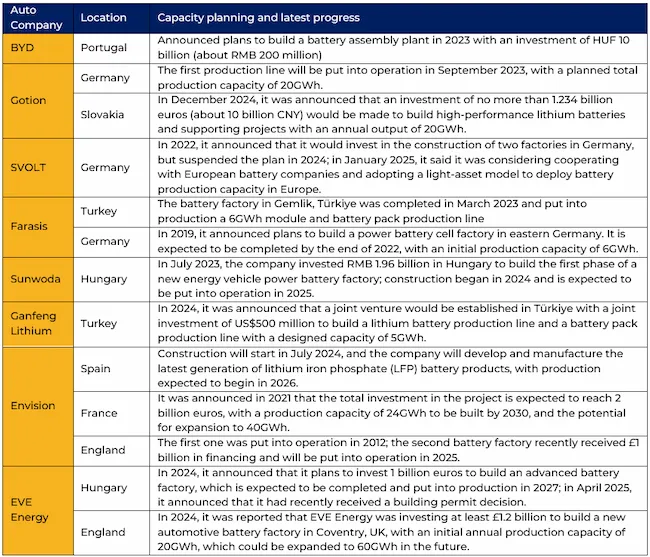
Gigafactories companies including CATL, Envision Power, EVE Energy, Gotion, and Sinotruk are stepping up the construction of local production capacity in Europe. Among them, CATL has planned to set up two major factories in Germany and Hungary, EVE Energy and CALB have settled in Hungary and Portugal, respectively.
Chinese Lithium-ion Battery Manufacturers are Going Overseas
CATL capacity utilisation rate remains high, and the pace of capacity expansion is expected to accelerate: the capacity under construction in 2024 will reach a historical high.
CATL’s 2023 capacity was 552GWh, with 100GWh under construction and a capacity utilisation rate of 70%. Its 2024 capacity was 676GWh, with 219GWh under construction and a capacity utilisation rate of 76.3%. Moreover, the capacity utilisation rate has increased month-on-month since July 2024, rising to around 90% in September. It is currently in full production, and the subsequent 219GWh of capacity under construction is expected to be accelerated.
The new production capacity is expected to reach 219GWh in 2025 (including 35GWh in overseas bases): the main bases under construction are Hungary (100GWh), Xiamen-CATL (60GWh, 10-15GWh invested), Jining-CATL (120GWh), Guizhou-CATL (60GWh, 10-15GWh invested), and Luoyang Base (120gwh, 30GWh invested).
CATL’s overseas expansion strategy in Europe:
European Lithium-ion Battery Regulations
- Policy: The EU’s “Batteries and Waste Batteries Act” implemented in 2023 requires full life cycle management of batteries from 2025, battery passport, and the proportion of renewable materials. Imported batteries must pass third-party verification, otherwise they may face entry bans. Localised production can reduce the difficulty of compliance and avoid export restrictions. However,at the same time, the EU provides subsidies through projects such as “European Battery Innovation” (such as Tesla’s German factory received 2.9 billion euros in support) to attract foreign investment to build factories. Chinese companies can obtain subsidies and reduce investment risks through localized production.
- Cash Cost: Overseas production capacity can minimise costs and help boost overseas revenue. The labour cost in Eastern Europe is only 1/3-1/2 of that in Western Europe, and the land price is low, which is suitable for large-scale factory construction; the battery transportation cost accounts for 8%-12% of the whole chain cost, of which road transportation accounts for the highest proportion (9%-11%). If the factory is built in Eastern Europe close to the main factory area, the logistics cost in the region can be reduced by 6%-9%, and the annual cost savings exceed 10 million euros/GWh of production capacity.
Building out a European Lithium-ion Battery Supply Chain
- Market side: The EU plans to ban the sale of ICE vehicles by 2035, and there is a production capacity gap of about 500GWH for power batteries. By 2030, the sales volume of electric vehicles in the European market is estimated to exceed 14 million, the demand for power batteries will exceed 950GWh, and the market demand for energy storage batteries will be 187GWh. Combined with the actual release of local battery production capacity in the European market, it is estimated that by 2030, there will be a production capacity gap of about 500GWh in the European market.
- Supply chain: As a core battery supplier, CATL needs to stay close to OEMs to maintain its supply chain advantages and strengthen the industrial cluster effect. In December 2023, BYD established its first pure electric and plug-in hybrid vehicle factory in Hungary, with an estimated annual production capacity of 150,000 vehicles and gradually increased to 300,000 vehicles and put into production at the end of 2025.
CATL’s Plans for Conquering Europe’s Lithium-ion Battery Market
In addition, leading auto companies such as Mercedes, BMW, Stellantis, and Volkswagen have all planned production plants in Hungary. CATL’s Debrecen plant in Hungary will supply battery cells to European production bases in Germany and Hungary, and supply about 30 electric vehicle brands including BMW, Mercedes, and Volkswagen. Mercedes-Benz will become the first and largest user of CATL’s Hungarian plant at the initial production capacity scale.
However, under the influence of multiple factors such as cost, policy, market, and supply chain, strengthening the “OEM + battery plant” industrial cluster effect and accelerating the construction of European production capacity have become CATL’s first choice.
CATL’s Hong Kong IPO funds Hungary Plan and expansion into EU
The funds raised by CATL’s Hong Kong IPO will be mainly invested in Hungary’s capacity construction. 90% of the funds (HK$27.64 billion) will be used for the construction of the Debrecen plant in Hungary, which is planned to have a total capacity of 72GWh and will be built in two phases.
700 million euros have been invested in the first phase of the project, with a planned capacity of 34GWH, and it is expected to be put into production in 2025; the second phase of the project has a planned capacity of 38GWH, and is expected to start construction in 2025 and put into production in 2027.
Meanwhile, after reaching full production, it will support European auto companies such as BMW and Mercedes-Benz, and the service radius will cover major European markets. The remaining 10% of the funds will be used as working capital to support daily operations.
CATL is deploying overseas production capacity and will build three major European super battery factories. In addition to the Hungarian factory in the fundraising project, CATL has now built a factory in Thuringia, Germany, with a capacity of 14GWH.
Furthermore, in December 2024, CATL announced that it would set up a joint venture with Stellantis, a world-renowned auto company to build a battery factory in Spain, with a planned production capacity of 50GWH, and trial production is expected to start at the end of 2026.
In 2024, CATL and Indonesian Battery Group jointly established a joint venture and invested approximately US$1.18 billion to build the JV5 battery manufacturing plant. The plant is expected to start production in 2027, with a planned annual battery production capacity of 15GWh.
BYD Expansion Outlook
BYD’s current production capacity is about 610GWh, and it is expected to increase by 178GWh in the short term. BYD expects to produce 5.5-6 million vehicles in 2025, a year-on-year increase of 35-48%. Battery installations will increase with sales, and domestic production capacity under construction is expected to accelerate.
- BYD is accelerating the layout of overseas bases. At present, vehicle factories in Thailand, Indonesia, Hungary, Brazil and other places have been put into production one after another. In the future, it plans to build a completely new energy vehicle industry chain in multiple overseas bases, and use the advantages of local resources to layout battery material production capacity.
- BYD released the new generation blade battery “Megawatt Flash Charge” which has a 10C ultra-high rate fast-charging capability and a super-large current of 1000A, which can achieve 20 kilometers of energy replenishment in 10 seconds and a range of 400 kilometers in 5 minutes. As the commercialisation of the new generation of blade batteries progresses, it is expected to drive the growth of demand for electric vehicles. In addition, in addition to the existing power and energy storage battery business, BYD is also actively deploying in the 3C and fuel cell fields.
Second-tier and Third-Tier Gigafactory Layouts
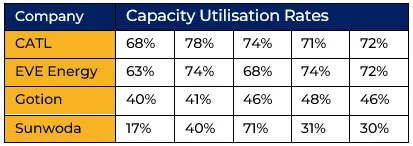
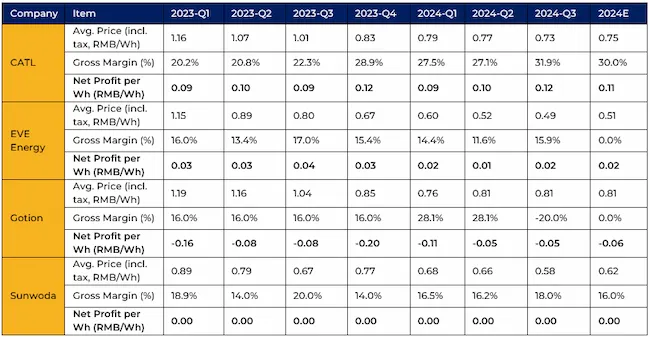
Affected by the intensified domestic competition, the capacity utilisation and profitability of second-tier and third-tier gigafactories are under pressure and their expansion plans are significantly slower than those of the leaders. The average gross profit margin of second-tier and third-tier gigafactories is about 15% lower than that of CATL, and the capacity utilisation rate in Q3-2024 was also significantly lower than that of CATL. Of which, the capacity utilisation rates of Gotion and Sunwoda were 46% and 30% respectively, while that of CATL is 72%.
Due to their weak financing capabilities and upstream and downstream integration capabilities, second-tier and third-tier gigafactories have no advantage over CATL in the fiercely competitive power battery field. Their domestic production capacity is mainly used for energy storage systems by binding core customers.
Second-tier and third-tier gigafactories are accelerating their overseas expansion, and overseas power battery production capacity is expected to accelerate with orders. The intensification of domestic competition has prompted second- and third-tier gigafactories to accelerate the expansion of overseas customers. Among them, SVOLT won a battery order from BMW and an order for nearly 5.48GWh of battery packs from Stellantis. CALB reached a battery supply cooperation with France’s Forsee. Gotion signed cooperation agreements with 5 well-known European companies; and Sunwoda received designated supply notices from Germany’s Volkswagen and Volvo.
EVE Energy, Sinotruk, Sunwoda, and SVOLT
- EVE Energy plans to build a total of about 365GWh of new production capacity, actively expand the production of 46 series large cylindrical batteries, and make efforts in both power and energy storage. The new production capacity is planned to be 365GWh, and its overseas base is expected to be accelerated in 2025. The company has accumulated a number of well-known domestic and overseas customers in the fields of home energy storage and industrial and commercial energy storage, such as Huawei and GoodWe.
- Sinotruk: has planned a total of 461GWh of production capacity, of which 278GWh is to be implemented. As of March 2025, its Portugal base has entered the construction stage; Sichuan and Fujian bases are expected to accelerate implementation and drive equipment demand as downstream energy storage battery demand grows.
- Sunwoda: has a total planned production capacity of 214GWh, and a long-term capacity plan of over 500GWh. Among them, Hungary’s overseas production capacity is 5GWh, and it has entered the infrastructure stage as of May 2025. In the future, as Volkswagen & Volvo’s overseas fixed-point orders increase, Sunwoda is expected to increase its Hungarian production capacity layout.
- SVOLT: has a total planned production capacity of 354GWh, of which 46GWh is overseas. Currently, there is still 191GWh of planned production capacity to be implemented. Due to the intensified domestic competition, the implementation speed has slowed down. We believe that the subsequent German production capacity is expected to accelerate with the large orders from BMW and Stellantis.
Capacity Utilisation Rates and Gross Profit Margins
For more blog articles click here
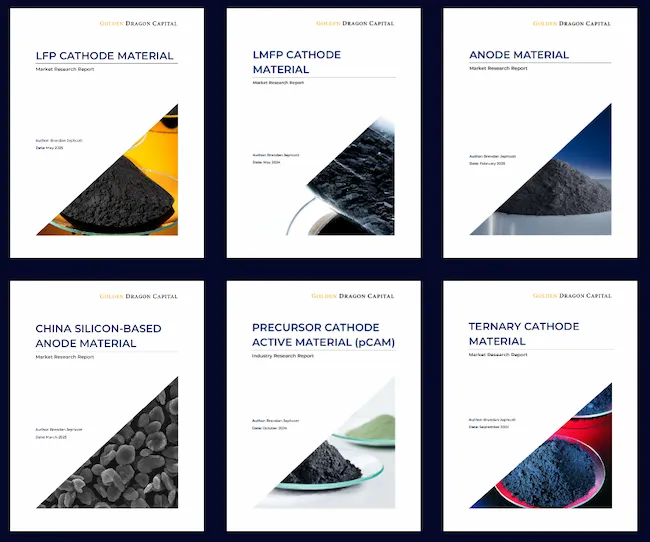
To view GDC market research reports click here
Golden Dragon Capital Limited | Comprehensive Market Research Reports
About us
GDNM provides commentary on how energy transition minerals contribute towards the decarbonisation and electrification of the global economy, with a particular focus on the lithium-ion battery and rare earths supply chains.
GDNM founder, Mr Brendan Jephcott is an Australian who has worked in the global mining sector for more than 13 years, of which his experience covers precious metals, nonferrous metals, ferrous metals, base metals, bulk commodities, rare earths, and the lithium-ion battery industry.
For the last 9 years Mr Jephcott has focused on the burgeoning new energy industry, participating in cross-border transactions in buy-side and sell side roles, cultivating a global business network ranging from upstream resource companies, midstream intermediate product producers, and downstream consumers such as gigafactories and auto companies.