Global Electric Vehicles Outlook (2025-2030E)
2019 was a watershed moment in the global electric vehicles industry as Tesla entered China leading to a rapid increase in the adoption of electric vehicles in China.
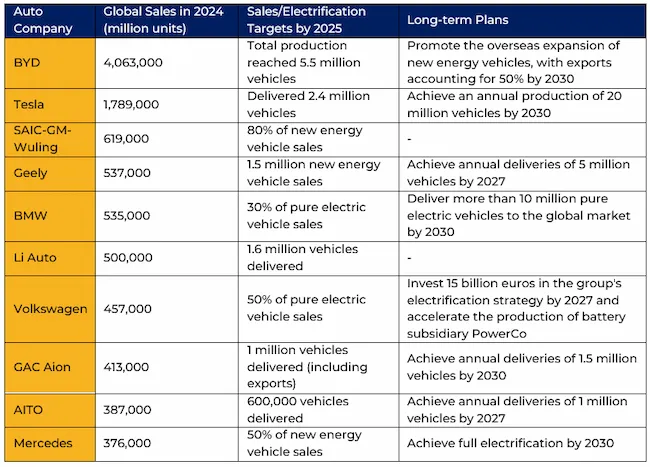
As of 2025, in terms of the automotive electrification movement, Chinese auto companies strongly dominate the new energy vehicles market, and it will take time for overseas auto companies to convert from ICE to electric vehicles.
Among the top ten global electric vehicles sales in 2024, Chinese companies occupy 7 of the 10, with strong performance. Of which, new brands such as Geely Group and AITO have emerged and ranked at the top of the list. In contrast, the electrification process of overseas legacy auto companies is lagging behind. Volkswagen, BMW, and Mercedes ranked 5th, 7th, and 10th in new energy vehicle sales in 2024 respectively.
The transformation of legacy European auto companies has been affected by many factors and is lagging behind electric vehicle adoption
- Policy: After the COVID-19 pandemic, major European countries fell into economic recession and government debt levels remained high. Many European countries have cancelled or slowed down their new energy subsidy policies to cut government public affairs expenditures.
- Supply chain: Compared with Chinese new energy vehicle companies that have a vertically-integrated industrial chain, Europe’s local battery industry chain lags behind and has no breakthroughs in key technologies. Local gigafactories such as Northvolt have gone bankrupt or suffered losses one after another, resulting in dependence on imports for key components and high production costs.
- Infrastructure: European cities have insufficient charging facilities, consumers are anxious about charging time and range anxiety, and the cost advantage of electric vehicles is offset by high electricity prices, resulting in consumers’ enthusiasm for electric vehicles being lower than traditional ICE vehicles.
Legacy Auto Companies Plans for Electric Vehicles
- Volkswagen continues to insist on electrification, hoping to establish a self-controlled battery supply chain, and announced the construction of 8 gigafactories around the world, with a total production capacity of 330GWh by 2030, but the capacity construction has slowed down.
- Stellantis also insists on building a local battery supply chain, and established Automotive Cells Company (ACC) in a joint venture with Total Energy and Mercedes-Benz, and established a Spanish battery factory in a joint venture with CATL, planning 50GWh of power battery production capacity.
- Mercedes-Benz postponed its plan to have electric vehicles (including hybrid models) account for 50% of its total sales
- Porsche gave up the goal of 80% of electric vehicle sales in 2030
- Audi gave up the radical pure electric policy, emphasizing that the main models must ensure “fuel and pure electric dual-travel”
Electric Vehicles Market Penetration Rates
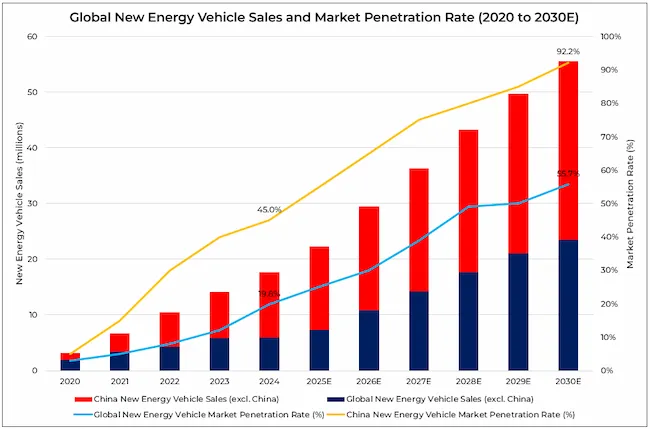
The core reason why the global market penetration rate of new energy vehicles is still low is that the market penetration rate in the European and American markets is much lower than that in the Chinese market, meaning there is still a lot of room for electrification worldwide.
Since 2022, the market penetration rate of new energy electric vehicles in Europe and United States has never exceeded 20%, especially in the United States, where the market penetration rate of new energy vehicles in 2024 has always been below 10%.
However, the new energy vehicle market in Europe and the United States has a broad market space, meaning the share of new energy vehicles still has a lot of room for future growth.
In 2024, the global market penetration rate of new energy vehicles was 19.8% and is expected to increase to 55.7% by 2030. Moreover, the global sales of new energy vehicles in 2024 was 17.7 million vehicles, and is expected to increase to 55.6 million vehicles by 2030, with a compound annual growth rate of 21% from 2024 to 2030.
China: The market penetration rate of new energy vehicles was 45.0% in 2024, and the market penetration rate of new energy vehicles in China is expected to increase to 99.2% by 2030. Moreover, China’s new energy vehicle sales in 2024 was 11.7 million units, and is expected to increase to 32.1 million units by 2030, with a compound annual growth rate of 18.3% from 2024 to 2030.
China
China: Being the most mature EV market with the segment heading towards 60% adoption rate of new vehicle sales being EV, is currently an intense price war, primarily led by BYD, which has slashed prices on some EV models by up to 34%, pushing the cost of its entry-level Seagull below USD$8,000.
The price war, initially spurred by fierce competition for market share has now drawn regulatory attention, with Chinese authorities urging auto companies to self-regulate and avoid selling below cost, fearing that continued cutthroat pricing could drive weaker firms into bankruptcy and damage the global reputation of Chinese EVs.
While the market has benefited consumers with lower prices, market penetration rates continue to increase, but as result, industry consolidation may only leave the strongest contenders in the market place, being BYD, Li Auto, NIO, Xiaomi, XPeng and some other legacy auto companies.
EU and United States
Europe: The market penetration rate of new energy vehicles was 17% in 2024 and is expected to increase to 60.2% by 2030. Europe’s new energy vehicle sales is expected to increase to 12.2 million units by 2030, with a compound annual growth rate of 26.5% from 2024 to 2030.
Europe is now pushing for affordable EVs and is intensifying as regulatory targets as consumer demanding low-cost models. Historically, European auto companies have focused on larger, premium EV models, causing average prices to rise sharply.
However, the European market is shifting is underway from the high-end to a more cost-effective offering, with at least ten new mass-market, low-cost EV models set to launch in 2025. These new product launches, spurred are expected to make EVs more accessible to a broader range of consumers and drive a substantial increase in auto sales.
European policymakers are also supporting the energy transition with incentives, infrastructure investments, and related policies to boost localised EV and lithium-ion battery production, ensuring Europe remains globally competitive.
United StatesThe market penetration rate of new energy vehicles in 2024 was 9.7%, and is expected to increase to 32.4% by 2030. Moreover, the sales volume of new energy vehicles in the United States in 2024 is expected to increase to 6.2 million units by 2030, with a compound annual growth rate of 25.4% from 2024 to 2030.
The United States is actively working to increase EV market penetration rate by making lower-cost models more accessible to mainstream consumers. High upfront prices remain the leading barrier for many Americans, with only about 3% of EVs in the United States.
To address this, automakers have begun reducing prices, Tesla, for example, has repeatedly slashed costs, while the federal government offers incentives like the Clean Vehicle Tax Credit, which provides up to USD$7,500 for qualifying EV purchases.
These measures, combined with declining battery costs and increased competition, are gradually narrowing the price gap between EVs and traditional cars. Industry analysts estimate that as more affordable EV models become available, particularly after 2027, consumer uptake in the United States will accelerate significantly.
Rise of Lithium-ion Batteries used in Electric Vehicles
The global trend of automobile electrification has become a trend, driving the growth of power battery shipments. Global power battery shipments increased from 182GWh in 2020 up to 969GWh in 2024, with a CAGR of 51.8%, and are expected to grow to 3754GWh by 2030, with a CAGR of 25.3% from 2024 to 2030.
Moreover, European power battery shipments are expected to increase from 190GWh in 2024 up to 918GWh by 2030, with a compound annual growth rate of 30.0%. US power battery shipments are expected to increase from 143GWh in 2024 up to 608GWh in 2030, with a compound annual growth rate of 27.2%. Power battery shipments in the European and American markets are still expected to usher in a period of rapid expansion.
For more blog articles click here
To view GDC market research reports click here
Golden Dragon Capital Limited | Comprehensive Market Research Reports
About us
GDNM provides commentary on how energy transition minerals contribute towards the decarbonisation and electrification of the global economy, with a particular focus on the lithium-ion battery and rare earths supply chains.
GDNM founder, Mr Brendan Jephcott is an Australian who has worked in the global mining sector for more than 13 years, of which his experience covers precious metals, nonferrous metals, ferrous metals, base metals, bulk commodities, rare earths, and the lithium-ion battery industry.
For the last 9 years Mr Jephcott has focused on the burgeoning new energy industry, participating in cross-border transactions in buy-side and sell side roles, cultivating a global business network ranging from upstream resource companies, midstream intermediate product producers, and downstream consumers such as gigafactories and auto companies.