Understanding Lithium-Ion Battery Component Materials: Complete Technical Guide
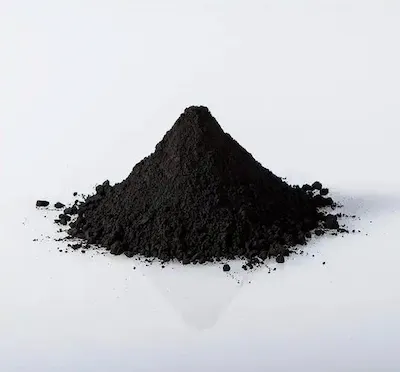
Lithium-ion battery component materials include the cathode, anode, electrolyte, and separator, but first, what is a lithium-ion battery? and how does it work?
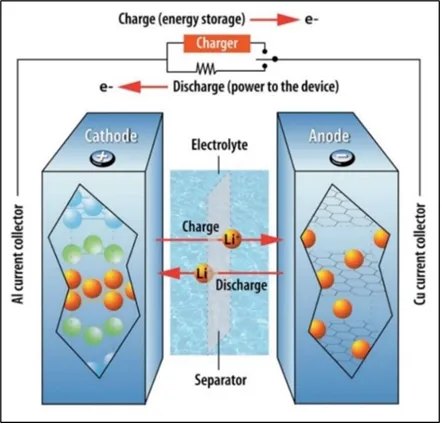
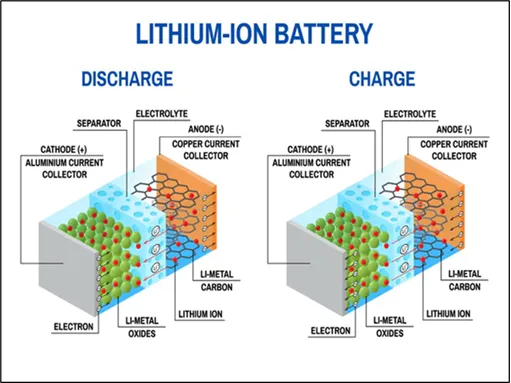
Simply put, a lithium-ion battery is a portable rechargeable device which stores and releases energy by moving lithium ions between two electrodes: the cathode (positive) and anode (negative). During charging, lithium ions move from the cathode to the anode; during use, they move back, creating electricity.
Today high-performance rechargeable lithium-ion batteries are used in electric vehicles, energy storage systems, and cosumer electronics.
Lithium-ion Battery Component Materials
The four main lithium-ion battery component materials include the cathode, anode, electrolyte, and separator, with each providing a core function in a lithium-ion battery.
- Cathode: As the positive electrode, the cathode, typically made of lithium-based compounds like lithium cobalt oxide (LiCoO2) or lithium iron phosphate (LiFePO4), stores lithium ions and releases them to the anode during charging, while accepting them back during discharge to generate electrical energy.
- Anode: The negative electrode, usually composed of graphite or graphite with silicon, stores lithium ions received from the cathode during charging and releases them back during discharge, enabling the flow of electrons through an external circuit to power devices.
- Electrolyte: This liquid or gel medium conducts lithium ions between the anode and cathode, facilitating the charge and discharge processes, while also contributing to battery stability, heat dissipation, and preventing electrode corrosion.
- Separator: A non-conductive, permeable membrane, the separator physically separates the anode and cathode to prevent short-circuiting, while allowing lithium ions to pass through during operation, ensuring safety and efficient ionic exchange.
Cathode Materials – the powerhouse of lithium-ion battery component materials
The cathode material is one of the four main lithium-ion battery component materials which plays a crucial role in determining the performance of lithium-ion batteries, with energy density and safety being the core considerations.
To achieve high energy density, power density, good cycle performance, and reliable safety, the cathode material must meet several underlying conditions.
- Cathode material should provide a lithium source for battery charging and discharging, offering a higher electrode potential to ensure high output voltage, and maintain a stable voltage platform for consistent output potential.
- Additionally, cathode material should have a small electrochemical equivalent to ensure high energy density, a high diffusion coefficient of lithium ions to enable high power density, and good reversibility for optimal battery cycle performance.
- Furthermore, cathode material should possess higher electronic and ionic conductivity, as well as good chemical stability. Lastly, it should be derived from abundant industrial resources and have a low production cost to ensure long-term economic viability.
The cathode material industry chain begins with mining companies extracting and processing raw minerals into concentrates which chemical salt converters refine into high-purity chemical salts.
These chemical salts are then used by cathode manufacturers to produce active cathode materials, sold to lithium-ion battery makers for integration into battery packs which are deployed in the fields of new energy vehicles, energy storage systems, and consumer electronics.
While vertical integration is common with companies like gigafactories often owning midstream lithium-ion battery component material production, most firms specialise in specific segments of the supply chain and collaborate across the lithium-ion battery component materials sector.
Cathode Material Product Types
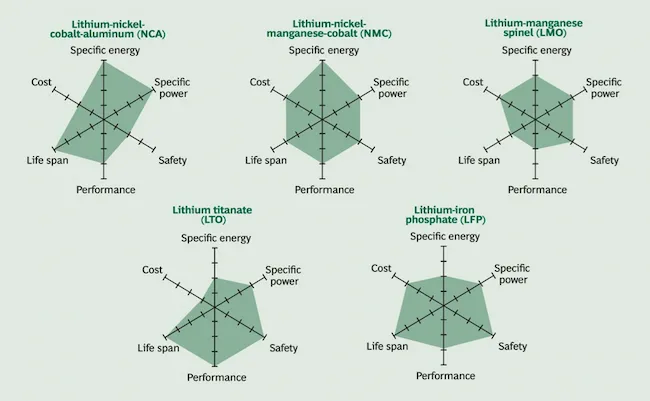
Today, lithium-ion batteries are divided according to which cathode is used in the material system, of which the mainstream cathode material technologies include lithium cobalt oxide (“LCO”), lithium manganese oxide (“LMO”), lithium iron phosphate (“LFP”), and ternary material namely nickel-cobalt-manganese (“NCM”) and nickel-cobalt-aluminum (“NCA”).
In terms of product performance indicators, cathode material types vary in energy density, cycle life, cost, safety, and low-temperature performance, as such cathode materials can be are applied to different end-use application scenarios.
- LCO cathode material advantages include high tap density, stable charge and discharge, and high working voltage, but disadvantages include expensive raw material inputs such as cobalt, poor cycle performance and poor safety performance. Currently, LCO cathode material is mainly used in consumer lithium-ion batteries.
- LMO cathode material advantages include an abundant manganese resource, low production cost, and good safety performance, but disadvantages include its low energy density and poor cycle performance. Currently, LMO cathode material is used in batteries applicable for logistics vehicles and miniature passenger vehicles which are cost sensitive with low mileage requirements.
Cathode Materials used in Electric Vehicles
- LFP cathode material advantages include high cycle performance, good safety performance and low cost but disadvantages include lower energy density, low electronic conductivity, low Li+ diffusion rate and poor low-temperature performance. Currently, LFP cathode material is used in batteries applicable in the fields of new energy vehicles and energy storage. However, with continuous improvement in the battery material packing systems blade battery, cell-to-pack, cell-to-chassis, the low energy density disadvantage of LFP cathode has improved, which has greatly increased its performance leading to its resurgence in demand in recent years, in particular its consumption in the new energy vehicle market.
- Ternary cathode material combines nickel, cobalt, and manganese to improve the overall performance of the material and with good electrochemical performance, good cycle performance, and high energy density, it is widely used in the field of high-end new energy vehicles but has the disadvantage of high production costs. Based on gigafactories demanding higher and higher energy density, and consumers wanting longer mileage per charge, it is expected that ternary cathode material technology roadmap will develop towards using high-nickel material in the future.
| Cathode Material | Lithium Cobalt Oxide (LCO) | Lithium Manganese Oxide (LMO) | Lithium Iron Phosphate (LFP) | Ternary Material | |
| (NMC) | (NCA) | ||||
| Chemical formula | LiCoO2 | LiMn2O4 | LiFePO4 | Li (Ni, Co, Mn) O2 | |
| Structure type | Layered | Spinel | Olivine | Layered | |
| Theoretical capacity (ah/kg) | 274 | 148 | 170 | 273-285 | 273-285 |
| Actual capacity (ah/kg) | 135-150 | 110-120 | 130-140 | 155-220 | 210-220 |
| Tap density (g/cm3) | 2.8-3.0 | 2.2-2.4 | 0.8-1.1 | 2.6-2.8 | |
| Compaction density (g/cm3) | 3.64-4.20 | 2.80-3.20 | 2.20-2.60 | 3.40-3.80 | |
| Cycle life (times) | 500-1,000 | 500-2,000 | 2,000-6,000 | 800-2,000 | |
| Operating voltage (v) | 3.0-4.5 | 3.0-4.3 | 3.2-3.7 | 2.8-4.5 | 3.40-3.80 |
| Thermal stability | Poor | Excellent | Superior | Poor | |
| Material cost | Very high | Low | Low | Moderate | |
| Energy density (Wh/kg) | 180-240 | 130-180 | 130-160 | 180-240 | |
| Safety performance | Low | Quite High | High | Moderate | Moderate |
| Environmental friendlessness | Highly-toxic | Non-toxic | Non-toxic | Ni-Co is pollutive | Ni-Co is pollutive |
| Advantages | Stable discharge, production process is easy | Resource rich, price is low, easy to manufacture | Safety is good, price is low, cycle life is good | Stable high density from power generation, good cycle life | |
| Disadvantages | Price is costly, cycle life is poor | Energy density is low, cycle life is poor | Energy density is low, product consistency is poor | All metal prices are expensive | All metal prices are expensive |
| Commercial Applications | Consumer electronics | Two-wheelers and power tools | New energy vehicles and energy storage | Consumer electronics, power tools, new energy vehicles and energy storage | |
For more blog articles click here
To view GDC LFP cathode material industry market research reports click here
Anode Material – the workhorse of lithium-ion battery component materials
Anode material is one of the four main lithium-ion battery component materials. Referred to as the negative electrode in high-performance rechargeable lithium-ion batteries, and is paired with cathode material (positive electrode) in a lithium-ion cell.
Being a host, the anode acts where it allows lithium-ion intercalation and deintercalation during the charge and discharge cycles.
The anode should have the lowest possible electrode potential, high Li+ migration rate, high Li+ intercalation/deintercalation reversibility, good electrical conductivity and thermodynamic stability. The anode generally needs to meet the following characteristics:
- Low first cycle irreversible loss,
- High coulombic efficiency,
- Fast lithium-ion diffusion into and out of the anode,
- High ionic and electronic conductivity,
- Minimum structural changes upon charge and discharge,
- High specific capacity (mAh/g), and
- Ability to form and maintain a stable solid electrolyte interface (SEI) layer upon cycling.
These characteristics makes the anode material have great influence on lithium-ion battery product performance such as energy density, cycle performance, charge-discharge rate, and low-temperature discharge performance.
Anode Material Product Types
Anode materials are mainly divided into two categories as either carbon-based or non-carbon based.
Carbon-based anode material is subdivided into synthetic graphite anode material, natural graphite anode material, composite graphite anode material, mesophase carbon microspheres, graphene-based anode material, and disordered carbon (hard carbon and soft carbon) anode material.
Non-carbon anode material is subdivided lithium titanate anode material, tin-based alloy anode material, silicon-based anode material, and other types of non-carbon anode material.
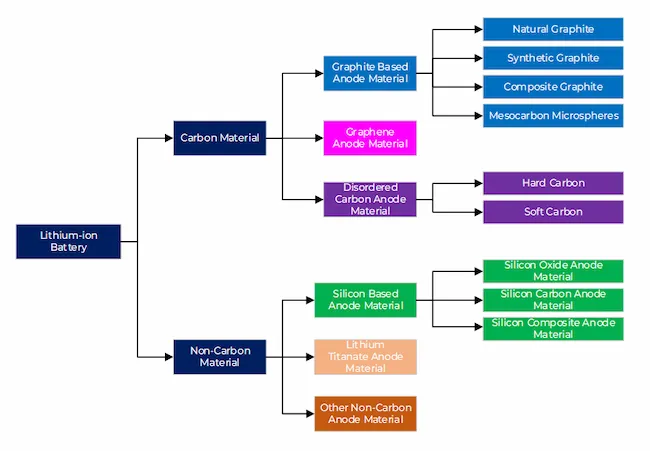
Natural graphite anode material and synthetic graphite anode material are the most commonly used product types:
Synthetic graphite anode material
- Synthetic graphite anode material meets the performance requirements for power batteries and energy storage batteries, mainly being good cycle life performance and high safety. It is mainly used for power batteries in electric vehicles and high-end consumer electronic products. Synthetic graphite anode material is made from petroleum coke, needle coke, pitch coke, and other raw materials through crushing, granulation, classification, and high-temperature graphitisation processing. Synthetic graphite anode material has advantages in cycle performance, rate performance, compatibility with electrolyte, but its capacity is generally lower than that of natural graphite anode material.
Natural graphite anode material
- Natural graphite anode material is used for lithium-ion batteries applied to consumer electronic products and for power batteries in electric vehicles. It is made from natural flake crystalline graphite as the raw material, which undergoes crushing, spheroidising, grading, purification, surface treatment, and other processes. Product characteristics include high compaction density and its capacity is generally higher than that of synthetic graphite anode material. Lithium-ion battery product indicators such as cycle performance, rate performance, and high and low temperature performance are important indicators for judging the product performance of natural graphite anode material.
Other carbon-based anode materials
- Other carbon-based anode materials are made from using soft carbon (easy graphitisation carbon) or hard carbon (difficult graphitisation carbon) according to the degree of easy crystallisation during the heat treatment process. The crystallinity of soft carbon can be freely controlled through heat treatment, usually pitch and its derivatives made from coal or petroleum are used as the raw material. Hard carbon is a kind of carbon with an amorphous structure, such as low-temperature pyrolytic carbons, raw materials such as furan resins containing oxygen atoms or acrylonitrile resins containing heteroatoms of nitrogen are used.
Non-carbon anode materials
- Non-carbon anode materials include transition metal oxides, multi-element lithium alloys, lithium metal nitrides, transition metal nitrides, phosphides, sulfides, and silicides. Although these anode materials have greater advantages than carbon materials in some aspects, such as higher specific capacity, better cycle performance and rate performance, there are many production challenges to be solved, such as volume expansion, voltage hysteresis, and poor safety. At present, the silicon-based anode material is most likely to be the first to make a technology breakthrough as it has already been applied in commercial practice, but its product performance needs further verification and evaluation, and it has not yet been rolled out on a mass-production scale. Today, most of the non-carbon anode products are still in the R&D stage and batch sampling stage.
Role of the anode material in lithium-ion batteries
Anode material product indicators being one of the core lithium-ion battery component materials, should include having the lowest possible electrode potential, high Li+ migration rate, high Li+ intercalation/deintercalation reversibility, and good electrical conductivity and thermodynamic stability.
Compared with other anode materials, carbon-based anode materials have the advantages of high specific capacity, low electrochemical potential, good cycle performance, non-toxic, stable in the air, and are the most mature anode material technology used in commercial practice today.
The theoretical capacity of the natural graphite anode material is 340-370mAh/g, and theoretical capacity of the synthetic graphite anode material is 310-367 mAh/g. From the perspective of cycle performance, synthetic graphite anode material is better than that of natural graphite anode material.
According to BTR New Materials Group Co., Ltd, the cycle of natural graphite anode material (GSN product) is about 500 cycles, the cycle of synthetic graphite anode material (AGP-2L-P) can reach 6,000 cycles. The main reason is that the particle size of natural graphite anode material is inconsistent and there are many surface defects so it is easy to react with the electrolyte resulting in a decrease in cycle performance.
From the perspective of expansion rate, the expansion rate of natural graphite anode material is higher than that of synthetic graphite anode material. The main reason is that flake graphite has a high degree of crystallinity, a large unitisation of the sheet structure, and obvious anisotropy. Therefore, large volume changes occur during lithium intercalation and deintercalation.
Due to its excellent performance and low price, the market penetration of synthetic graphite anode material continues to increase.
| Performance Indicators | Natural Graphite | Synthetic Graphite | Soft Carbon | Hard Carbon | Graphene | Lithium Titanate | Silicon Carbon |
| Specific capacity (mAh/g) | 340-370 | 310-370 | 250-300 | 350-400 | 400-600 | 165-175 | < 3579 (Si max capacity) |
| First rate capacity (%) | 90-93 | 90-96 | 80-85 | 80-85 | 30 | / | 84 |
| Tap density (g/cm3) | 0.8-1.2 | 0.8-1.1 | 0.7-1.0 | 0.7-1.0 | 1.5-2.0 | 0.6-1.1 | |
| Compaction density (g/cm3) | 1.6-1.85 | 1.5-1.8 | 1.35-1.5 | 1.35-1.5 | 1.8-2.3 | 0.9-1.6 | |
| Working voltage (v) | 0.2 | 0.2 | 0.52 | 0.52 | 0.5 | 1.55 | 0.3-0.5 |
| Cycle life (times) | >1000 | >1500 | >1000 | >1500 | 10 | >30000 | 300-500 |
| Safety | Okay | Excellent | Excellent | Excellent | Excellent | Superior | Good |
| Charge performance | Okay | Okay | Excellent | Excellent | Poor | Good | Good |
| Rate performance | Poor | Excellent | Superior | Superior | Poor | Superior | Okay |
| Advantages | Mature technology and supporting process: low cost | The supporting technology is mature; the cycle performance is good | High charge and discharge efficiency; good cycle performance | Stable junction: long cycle life in charge and discharge | Excellent high and low temperature coal energy: excellent safety performance | Higher theoretical specific energy | |
| Disadvantages | The specific energy has reached the limit; the cycle performance and rate performance are poor | Low specific energy; poor rate performance; poor safety performance | Low initial charge and discharge efficiency; rapid capacity reduction: excellent rate | Poor cycle stability; serious voltage hysteresis | Technology, immature process; high cost; low energy density | Immature technology and supporting process; high cost; deformation of charging and discharging batteries |
To view GDC anode material industry market research reports click here
Electrolyte – the lifeblood of lithium-ion battery component materials
Lithium-ion batteries consist of graphite as anode, a transition metal oxide (e.g. LiCoO2 (LCO), Li1−xFePO4 (LFP), LiNi1−x−yMnxCoyO2 (NMC)) as cathode, a non-aqueous solution as electrolyte, and a polyolefin film as separator. The migration of lithium cations (Li+) back and forth between the two intercalation electrodes with different potentials (i.e., rocking-chair concept) in the electrolyte allows reversible transfer between chemical energy and electric energy, adopting the prestige title for the electrolyte as the “lifeblood of a lithium-ion battery.
Besides high Li+ diffusion between electrodes, electrolyte is one of the four main lithium-ion battery component materials which plays a role in battery performance, namely building stable electrode/electrolyte interphases/interfaces, specific capacity, working temperature range, cycle life, and safety.
| Electrolyte general performance requirements |
| High conductivity requiring low electrolyte viscosity, high lithium salt solubility and ionisation. It can quickly conduct Li ion charge and discharge process and has good charge and discharge performance. |
| Li+ conduction migration number is high. |
| High stability requiring the electrolyte to have a high flash point, high decomposition temperature, low electrode reactivity, and no side reactions. |
| The interface is stable, with good film-forming properties on the surface of cathode and anode materials and can form a stable low-impedance solid electrolyte interphase (SEI) film during the charging and discharging process in the first few cycles. |
| Wide electrochemical window which can passivate the electrode surface to work in a wide voltage range. It can tolerate higher working voltage, which is one of the keys to the energy density advantage of lithium-ion batteries. |
| Wide operating temperature range ensuring the high and low temperature working performance of lithium-ion batteries. |
| Good wettability with the cathode and anode electrode materials. |
| Not easy to burn. The flammable organic solvent of the electrolyte is the main problem of battery safety. |
| Environmentally friendly, non-toxic or less toxic. |
| Low production cash cost. |
How electrolyte affects lithium-ion battery performance
The electrolyte can affect the performance of a lithium-ion battery in several ways:
- The electrolyte can affect specific capacity of a lithium-ion battery with interface conditions affecting the reversible specific capacity of the electrode material.
- Thermal stability properties of the electrolyte namely its liquid range and low-temperature conductivity performance directly impact the working temperature range of lithium-ion batteries.
- Electrolyte determines the corrosiveness of the current collector which related to the aging of the battery electrode materials and thus impacts the cycle life of lithium-ion batteries.
- Solvents in electrolyte material are prone to spontaneous combustion at high temperatures which can affect the safety performance of lithium-ion batteries.
The electrolyte formula used in lithium-ion batteries can often vary, however the mass proportion of solvent used is generally the highest.
For example, the mass proportions of a common electrolyte formula using lithium hexafluorophosphate as the salt consists of six (6) kinds of organic solvents accounting for about 70% of the total mass of raw materials, four (4) kinds of additives accounting for about 17% and the lithium salt, namely lithium hexafluorophosphate accounting for about 13% of the total mass of raw materials.
To view GDC lithium hexafluorophosphate market research reports click here
Separator – the guardian of lithium-ion battery component materials
A separator is one of the four main lithium-ion battery component materials, and is a crucial insulating film in lithium-ion batteries, characterised by numerous meandering and penetrating micropores.
Its primary function is to isolate the positive electrode (cathode) from the negative electrode (anode), preventing short circuits within the battery system while allowing the free passage of lithium ions through the micropores.
This separation is vital for forming an effective charge and discharge circuit during the electrolytic reaction, thereby minimizing energy loss in the cell. The performance of the separator significantly influences the interface structure and internal resistance of the battery, directly affecting its capacity, cycle life, and safety.
Separator product characteristics
The separator typically exhibits excellent chemical stability and mechanical properties, contributing to increased energy density, extended cycle times, and improved safety.
Given that the separator plays a critical role in determining internal resistance and other performance indicators, its quality is paramount. Factors to be considered when selecting appropriate separators for rechargeable batteries include:
- Electronic insulation ensures mechanical isolation between the positive and negative electrodes.
- Good electrochemical stability and will not decompose during charging and discharging.
- Appropriate pore size and porosity lowers electrical resistance and increases ionic conductivity.
- High electrolyte corrosion resistance, and perfect chemical and electrochemical stability in high polar organic solvents.
- Excellent wettability to the electrolyte to allow sufficient liquid absorption and moisturizing ability.
- Appropriate thickness and uniform pore size distribution.
- Exceptional heat resistance that prevents significant shrinkage at high temperatures.
- Good mechanical properties, including puncture strength, tensile strength, etc., but as thin as possible.
- Exceptional properties that prevent dendritic growth.
- Maintain robust stability and good mechanical integrity to prevent deformation or damage after being subjected to stress generated during battery assembly and during operation, damage caused by collisions and falls, and puncture of lithium dendrites during cycling.
- Outstanding thermal stability and high temperature resistance, protection against automatic shutdown and a suitable thermal closure temperature.
- Low cost for large-scale industrial production.
Separators have high requirements
The order of importance of each design principle varies with the application of the battery. In many applications, it is often necessary to compromise other requirements of the separator to balance the performance, safety and cost.
For example, high porosity and thin separator is preferred to achieve small internal resistance and low power consumption, but for some applications, the separator should bear certain thickness to ensure sufficient physical strength.
The types of separators are molded, woven, non-woven or microporous. Since organic solvents are often involved in the electrolytes in the rechargeable battery system, the separator material is required to be corrosive-resistant to organic solvent.
Polyolefin materials have the advantages of excellent mechanical properties, chemical stability and relatively low cost, so mainstream lithium-ion battery separator products are dominated by microporous membranes made of polyolefin, such as polypropylene (PP) and polyethylene (PE).
Separators play a crucial role in lithium-ion batteries
The battery components of two electrodes and an electrolyte directly participate in electrochemical reactions. In contrast, a battery separator should be electrochemically inactive (current insulator) and mechanically stable while running electrochemical cells.
The separator isolates each of the anode and cathode to prevent internal short circuiting of the battery and allows lithium ions to pass through in the liquid electrolyte filling in the membrane porous structure.
Separators impact several battery performance parameters, including energy and power density, life cycle and safety. A good separator can effectively help the lithium-ion movement in the electrochemical reaction and help to charge and discharge efficiently.
The lithium-ion battery releases a lot of heat in the process of high-current charging and discharging, leading to a significant increase in the battery’s internal temperature, and there is a risk of occurring of electrode decomposition separator damage, and thermal running. The separator material plays a role in the safety performance of lithium-ion batteries.
The separator being one of the core lithium-ion battery component materials, is a key element to ensure safe cell operation under vigorous conditions, for example, burr, dendrites, cell abuse or even sudden crash. Punctures on the separator would result in a short circuit between anode and cathode. The separator increases internal cell resistance, and the separator takes up valuable space inside the battery, making separator optimisation an important part of the battery design.
Therefore, certain performance properties are required for a high-performance separator.
| Parameter | Requirement |
| Thickness | 20-25 μm |
| Porosity | 40-60% |
| Pore size | <1 μm |
| Permeability (Gurley) | 0.025 s μm–1 |
| Wettability | Penetrate thoroughly and quickly |
| Ionic conductivity | 10–3 to 10–1 S cm–1 |
| Tensile strength | <2% offset at 1000 psi |
| Puncture Strength | >300 g/mil |
| Dimensional stability | Lay flat and no curl up |
| Thermal shrinkage | <5% shrinkage after 60 min at 90oC |
| Shutdown temperature | PE ~130oC, PP ~160oC |
| Chemical and electrochemical stabilities | Long term stability |
To view GDC separator market research reports click here

For more blog articles click here
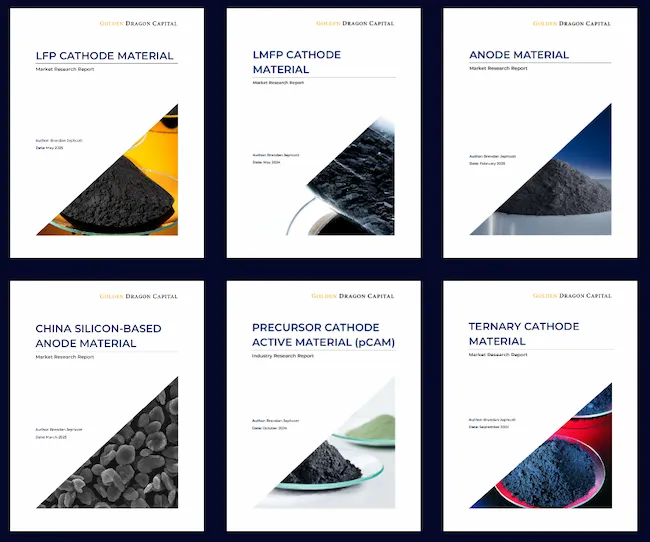
To view other GDC lithium-ion battery component materials market research reports click here
Golden Dragon Capital Limited | Comprehensive Market Research Reports
About us
GDNM provides commentary on how energy transition minerals contribute towards the decarbonisation and electrification of the global economy, with a particular focus on the lithium-ion battery and rare earths supply chains.
GDNM founder, Mr Brendan Jephcott is an Australian who has worked in the global mining sector for more than 13 years, of which his experience covers precious metals, nonferrous metals, ferrous metals, base metals, bulk commodities, rare earths, and the lithium-ion battery industry.
For the last 9 years Mr Jephcott has focused on the burgeoning new energy industry, participating in cross-border transactions in buy-side and sell side roles, cultivating a global business network ranging from upstream resource companies, midstream intermediate product producers, and downstream consumers such as gigafactories and auto companies.