AlNiCo Permanent Magnets
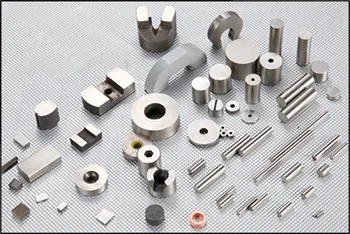
Aluminium-nickel-cobalt magnets, known as AlNiCo permanent magnets, were discovered in 1931, when Japanese metallurgist Tokushichi Mishima alloyed aluminium, nickel, cobalt and iron into a single and robust magnetic material, establishing the first-generation technology of what would become the global permanent magnet material industry.
AlNiCo permanent magnets ushered in a new era of high-performance magnetic material, prized for their exceptionally strong magnetic flux density-remanence up to 1.35 T-and remarkable thermal stability. Typical AlNiCo magnet formulations maintain full magnetic function at temperatures up to 550°C, and optimised designs can endure continuous operation exceeding 600°C, surpassing the limits of most alternative magnets.
Despite their high flux density, AlNiCo permanent magnets exhibit relatively low intrinsic coercivity (below 160 kA/m), which gives them a non-linear demagnetisation curve making them susceptible to loss of magnetisation if used in open circuits or low-aspect-ratio geometries.
To counteract this, AlNiCo magnet manufacturers often employ closed magnetic circuits or long, slender shapes that reinforce the internal field. The reversible temperature coefficient of AlNiCo permanent magnets small among permanent magnets, approximately –0.02 %/°C-ensuring that field strength remains stable across wide temperature swings. Their Curie temperatures, typically in the 800–860°C range, provide a comfortable margin above normal operating conditions.
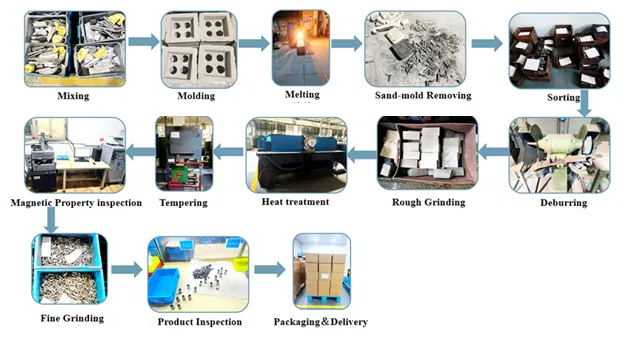
AlNiCo permanent magnets are manufactured by two primary processes. Casting involves pouring the molten alloy into molds, producing a vast array of shapes-cylinders, squares, rings and complex profiles-with the highest achievable magnetic performance and the lowest reversible temperature coefficient.
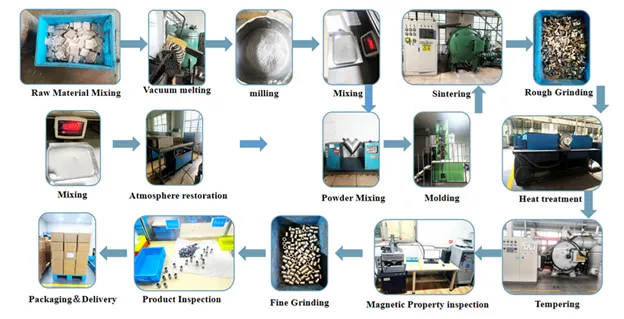
However, cast blanks require more extensive machining to achieve tight tolerances. Sintering, by contrast, compacts and heats powdered alloy under vacuum to yield smaller parts with superior dimensional accuracy and easy machinability, albeit with a modest reduction in magnetic strength. The brittle nature of the material makes both casting and sintering necessary, as conventional forging or rolling is not feasible.
Present Day Scenario
Today, AlNiCo permanent magnets are still used in applications demanding stable, high-temperature performance such as electric motors and generators in harsh environments, audio transducers such as AlNiCo 5 guitar pickups and high-end microphones, sensors, traveling-wave tubes, aerospace and oil-well tools, and other precision instruments.
While rare-earth magnets (NdFeB and SmCo) have captured markets where maximum energy product and miniaturization are paramount, AlNiCo continues to excel where thermal endurance and field stability are critical. The most popular grades-AlNiCo 5, balancing coercivity and remanence, and LNG37, offering top-end flux density-demonstrate the enduring relevance of this pioneering magnetic alloy.
AlNiCo Permanent Magnets Composition
These magnets are generally composed of aluminium, nickel, cobalt, and iron, of which this alloyed material demonstrates remarkable magnetic properties. Before the development of rare earth magnets in the 1970s, AlNiCo permanent magnets were considered the strongest permanent magnets available. This historical significance cannot be overstated, as AlNiCo permanent magnets enabled the miniaturisation and improved product performance across multiple industries for over four decades before newer magnetic materials emerged.
AlNiCo permanent magnets derive their name from their composition, as aluminium (Al), nickel (Ni), and cobalt (Co), combined with iron (Fe) as the base material. The general composition typically includes 8-12% aluminium, 15-26% nickel, 5-24% cobalt, with the remainder 38%-72% as iron, though some products may also contain up to 6% copper and up to 1% titanium, which are used to enhance specific magnetic properties.
Product Series of AlNiCo Permanent Magnets
AlNiCo permanent magnets are produced through several distinct manufacturing processes, each yielding materials with different characteristics suitable for various applications. The three primary manufacturing methods are casting, sintering, and bonding, with cast and sintered being the most significant. Cast AlNiCo permanent magnets represent the most common production method and provide the highest magnetic performance, with maximum energy products ranging from 4.25 to 10 MGOe depending on the grade.
- Cast AlNiCo permanent magnets are manufactured by pouring molten alloy into molds, followed by solidification, heat treatment, and finishing operations, allowing for the production of both simple and complex shapes with near-net dimensions, making it cost-effective for both low and high volume production.
- Sintered AlNiCo permanent magnets are manufactured using powder metallurgy techniques, of which fine metal powders are compressed in dies and then sintered at high temperatures to create solid materials with specific magnetic properties.
Principal Processing Method of AlNiCo Permanent Magnets
While sintered AlNiCo offers slightly lower magnetic performance than cast versions (with energy products ranging from 1.5 to 5.25 MGOe), they provide better dimensional precision and are particularly cost-effective for medium to high-volume production of smaller parts, though they are generally limited to simpler shapes.
AlNiCo Permanent Magnets Key Product Indicators
The AlNiCo family encompasses numerous product grades with varying magnetic and physical properties to suit diverse applications. The nomenclature system for these magnets identifies them primarily as AlNiCo 2, 3, 5, 6, 8, and 9, with additional sub-classifications that further specify their characteristics. AlNiCo 5 represents the most commonly used grade, offering a balanced performance profile with good remanence and moderate coercivity, with several variants such as LNG44 being popular in commercial applications.
AlNiCo permanent magnets are further classified as either isotropic or anisotropic based on their magnetic orientation. Isotropic grades can be magnetised in any direction but have low magnetic performance, while anisotropic grades have a preferred direction of magnetisation permanently established within their crystalline structure during manufacturing, delivering maximum magnetic performance along that specific axis.
The various grades offer a spectrum of performance characteristics, for example, AlNiCo 2 and 3 provide lower magnetic strength but are more economical. While AlNiCo 5, 5DG, and 5-7 offer moderate to high remanence with modest coercivity, and AlNiCo 8 provides higher coercivity at the expense of remanence. AlNiCo 9 delivers the highest overall energy product for applications requiring maximum magnetic strength.
To view GDC market research reports click here
- Sintered NdFeB permanent magnet industry research report
- Bonded NdFeB permanent magnet industry research report
- Hot-pressed NdFeB permanent magnet industry research report
- SmCo permanent magnet industry research report
- Ferrite permanent magnet industry research report
- AlNiCo permanent magnet industry research report
AlNiCo Permanent Magnets Key Features
One of AlNiCo permanent magnets’ most distinguishing characteristics is their exceptional temperature stability, making them the preferred choice for high-temperature applications. AlNiCo alloys possess an impressive Curie temperature of approximately 850°C, significantly higher than other magnetic materials such as ferrite (450°C) and NdFeB (310-340°C), which means they retain their ferromagnetic properties at much higher temperatures. This high Curie temperature translates to practical operating capabilities at temperatures ranging from -273°C to 550°C, allowing these magnets to function reliably in extreme environments where most other magnetic materials would fail.
Beyond their high temperature tolerance, AlNiCo permanent magnets also demonstrate remarkably low reversible temperature coefficients, typically around -0.02% per °C for remanence and +0.01% per °C for coercivity in high-performance grades like AlNiCo 5, meaning they experience minimal changes in magnetic properties as temperature fluctuates. This combination of high maximum operating temperature and low sensitivity to temperature changes makes AlNiCo permanent magnets indispensable in applications requiring consistent magnetic performance across varying thermal conditions, such as aerospace, industrial sensors, and specialised measuring instruments that must maintain calibration accuracy despite temperature variations.
AlNiCo permanent magnets offer a distinct profile of advantages and limitations that define their role in the broader spectrum of magnetic materials. Their primary advantages include exceptional temperature stability with operational capabilities at temperatures up to 550°C, significantly outperforming other magnetic materials in high-temperature environments. They demonstrate excellent long-term stability with minimal magnetic degradation over time, making them ideal for applications requiring consistent performance over extended periods. Their strong corrosion resistance enables reliable operation in harsh environments without the need for protective coatings, simplifying design and manufacturing processes while ensuring durability in challenging conditions. Despite these advantages, AlNiCo permanent magnets have notable limitations that have reduced their market share compared to newer magnetic materials.
AlNiCo Permanent Magnets have low coercivity
Their relatively low coercivity makes them susceptible to demagnetization when exposed to strong opposing magnetic fields, requiring careful design considerations and often necessitating longer magnets or closed magnetic circuits to maintain performance. Their hard and brittle nature makes them difficult to machine using conventional methods, requiring specialised techniques for drilling, cutting, or shaping after casting, which increases manufacturing complexity and cost. Additionally, while their maximum energy product (BH)max of up to 10 MGOe is impressive compared to ferrite magnets, it falls significantly short of modern rare earth magnets like NdFeB, which can exceed 50 MGOe, limiting their applicability in applications where maximum magnetic strength per volume is critical.
Commercialisation of AlNiCo Permanent Magnets
The unique properties of AlNiCo permanent magnets make them valuable in specialised applications that leverage their advantages. Their temperature stability and reliability make them ideal for high-precision measuring instruments, electrical meters, sensors, and other devices where consistent performance under varying environmental conditions is critical.
In military and aerospace applications, AlNiCo permanent magnets are preferred for their high reliability, temperature resistance, and long-term stability, enabling them to withstand harsh operating environments while maintaining consistent magnetic performance.
The telecommunications industry uses AlNiCo permanent magnets in various equipment where their low temperature coefficient ensures reliable operation across temperature fluctuations that would compromise the performance of other magnetic materials. Their excellent corrosion resistance makes them suitable for outdoor and industrial environments where exposure to moisture, chemicals, or weathering might damage alternative magnetic materials, contributing to their popularity in applications requiring long service life without degradation.
| Industry | Products |
| Measuring & Instrumentation | Precision laboratory balances, fluxgate magnetometers, ammeters, voltmeters, wattmeters, speedometers, magnetic position sensors, Hall-effect sensors |
| Military & Aerospace | Gyroscopes, navigation instruments, guidance systems, actuators, traveling-wave tubes, radar receivers |
| Telecommunications | Traveling-wave tubes, microwave amplifiers, relay switches, loudspeakers, microphones |
| Outdoor & Industrial | Magnetic separators, lifting magnets, holding fixtures, solenoid valves, high-temperature handling equipment |
Competitive Landscape
Global production of AlNiCo permanent magnets is heavily concentrated in a few countries, of which China dominates with an estimated 70% market share of global manufacturing capacity. The remaining 30% market share comes primarily from Europe (20~22%) and the United States (8~10%).
China’s dominance in AlNiCo permanent magnets
China leads in global AlNiCo magnet production through leveraging its abundant raw material resources, established industrial infrastructure, and significant investment in magnetic material production facilities. Of which, Hangzhou Permanent Magnet Group Co., Ltd, a company focused on the R&D, production and sales of permanent magnets, in particular NdFeB, SmCo, and AlNiCo. Of which, its annual production output of AlNiCo magnet materials exceeds 800 tonnes, accounting for about 40% of global production, and the Company has always been at the leading position of the global AlNiCo magnet industry.
Other AlNiCo magnet companies in China which have developed significant manufacturing capacities and various grades of AlNiCo permanent magnets include XHMAG Inc., Ningbo Vastsky Magnet Co., Ltd, and Ningbo Yunsheng High-Tech Magnetics Co., Ltd, all of which have developed significant manufacturing capacities for various product grades.
Production outside of China
Outside of China, the United States AlNiCo magnet companies focus mostly on servicing the military by providing high-quality, specialised magnets for aerospace, defense, and precision industrial applications. While Europe (Germany, Great Britain, and France) focus mostly on premium magnets for automotive, industrial, and scientific applications.
United States companies include Arnold Magnetic Technologies which focuses on electronics, automotive, medical, and industrial applications. Other significant companies include Adams Magnetic Products Co., Ltd Electron Energy Corporation, Bunting Magnetics Company, and Dexter Magnetic Technologies, each specializing in different aspects of AlNiCo magnet production and applications.
European companies include Vacuumschmelze GmbH & Co. KG which has a long history of producing magnetic materials for aerospace, communications, and medical equipment. Other companies include Storch Magnetics, Rochester Magnet Co., and Magnetic Component Engineering LLC.
Market Size Potential
The global AlNiCo magnet market continues to evolve, shaped by technological advancements, changing industrial requirements, and shifting global manufacturing landscapes. Despite competition from newer magnetic materials, global demand for AlNiCo permanent magnets remains robust, with projected growth of USD$363 million between 2024 and 2028, at a CAGR of 7%, driven largely by applications in electronics, automotive sectors, and specialised industrial equipment.
The automotive industry’s transition toward EVs is creating new opportunities for AlNiCo permanent magnets in high-temperature applications within EV powertrains, sensors, and control systems, where their temperature stability provides advantages over some alternative magnetic materials.
For more blog articles click here
To view GDC market research reports click here
Golden Dragon Capital Limited | Comprehensive Market Research Reports
About us
GDNM provides commentary on how energy transition minerals contribute towards the decarbonisation and electrification of the global economy, with a particular focus on the lithium-ion battery and rare earths supply chains.
GDNM founder, Mr Brendan Jephcott is an Australian who has worked in the global mining sector for more than 13 years, of which his experience covers precious metals, nonferrous metals, ferrous metals, base metals, bulk commodities, rare earths, and the lithium-ion battery industry.
For the last 9 years Mr Jephcott has focused on the burgeoning new energy industry, participating in cross-border transactions in buy-side and sell side roles, cultivating a global business network ranging from upstream resource companies, midstream intermediate product producers, and downstream consumers such as gigafactories and auto companies.